Français (France)
 Deutsch (DACH)
 Italiano (Italia)
 Dutch (Nederlands)
 English (United States)
 English (Canada)
 French (Canada)

bfinance insight from:

Martijn de Vree
Head of Strategic Advisory Services

Alex Dreger
Analyst
Family offices, endowments and wealth managers often have more flexibility than their pension fund, insurer or sovereign wealth fund (SWF) counterparts to navigate change. Because of their governance structures and internal capabilities, they can respond relatively swiftly to market upheaval, adapting portfolios as conditions evolve.
Given shifting geopolitics, AI-driven disruption and changing market regimes, the need for resilient portfolios has rarely been greater during what we’re calling the ‘turbulent twenties’. That is driving an appetite to adapt portfolios, yet the bfinance 2027 Outlook Poll also suggests these ‘leaner’ allocators are less likely to stress test the changes.
The poll of 164 allocators at organisations spanning more than 30 countries, including asset owners responsible for around $1.2 trillion, found that fewer than a third (31%) of family offices, endowments and wealth managers had added more stress testing in recent years. By contrast, almost half (49%) of pension funds, insurers and SWFs had done so (see Figure 1, below).
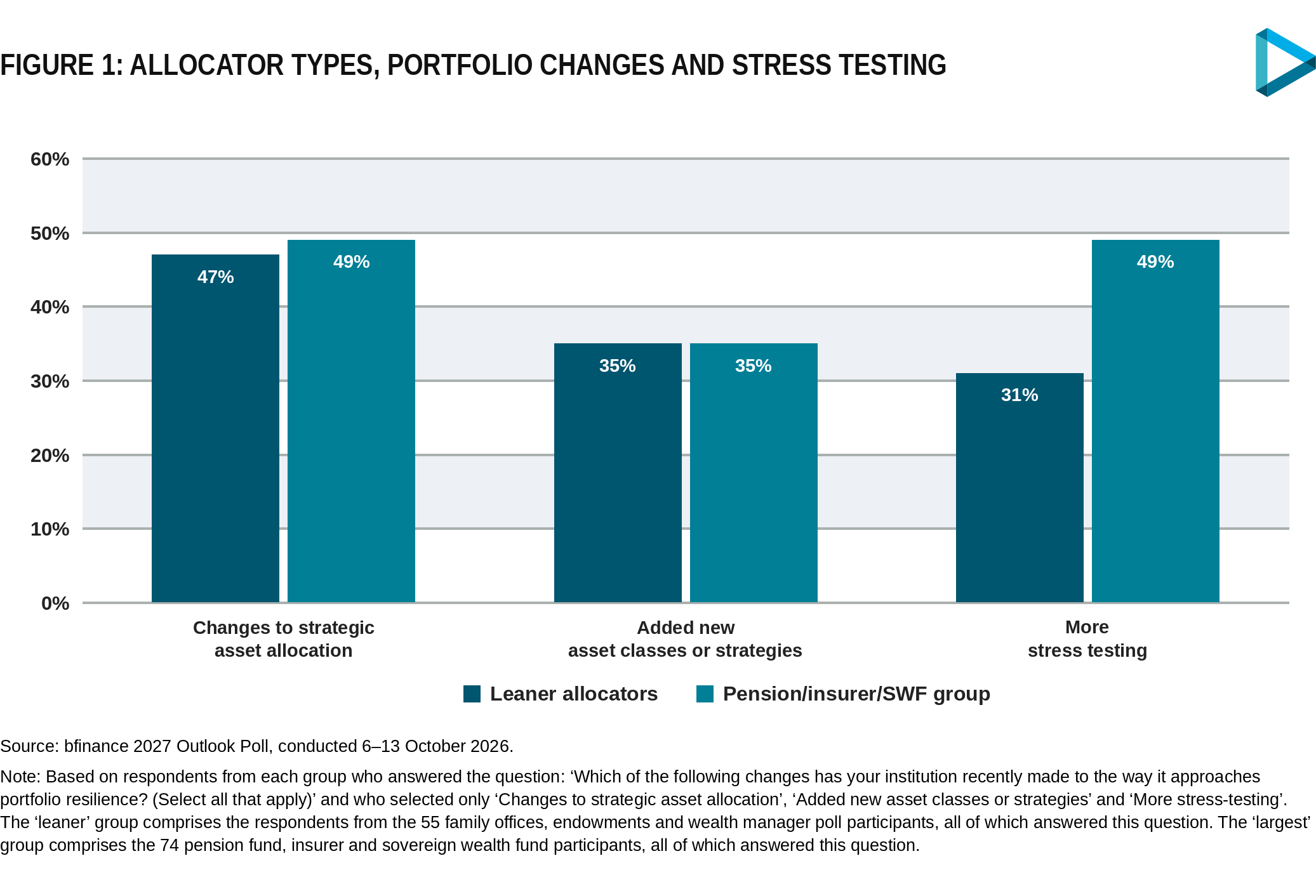
Stress testing: lower down the list for leaner allocators
Asset allocators were also asked which single portfolio change they expected to bring the greatest improvement in resilience over the next two years. Figure 2 shows every answer, because the picture does not all point one way. Stress testing was the choice of 5% of family offices, endowments and wealth managers and 12% of pension funds, insurers and SWFs. It is not the single top priority of any allocator group, but seems to be lower down the list for leaner allocators.
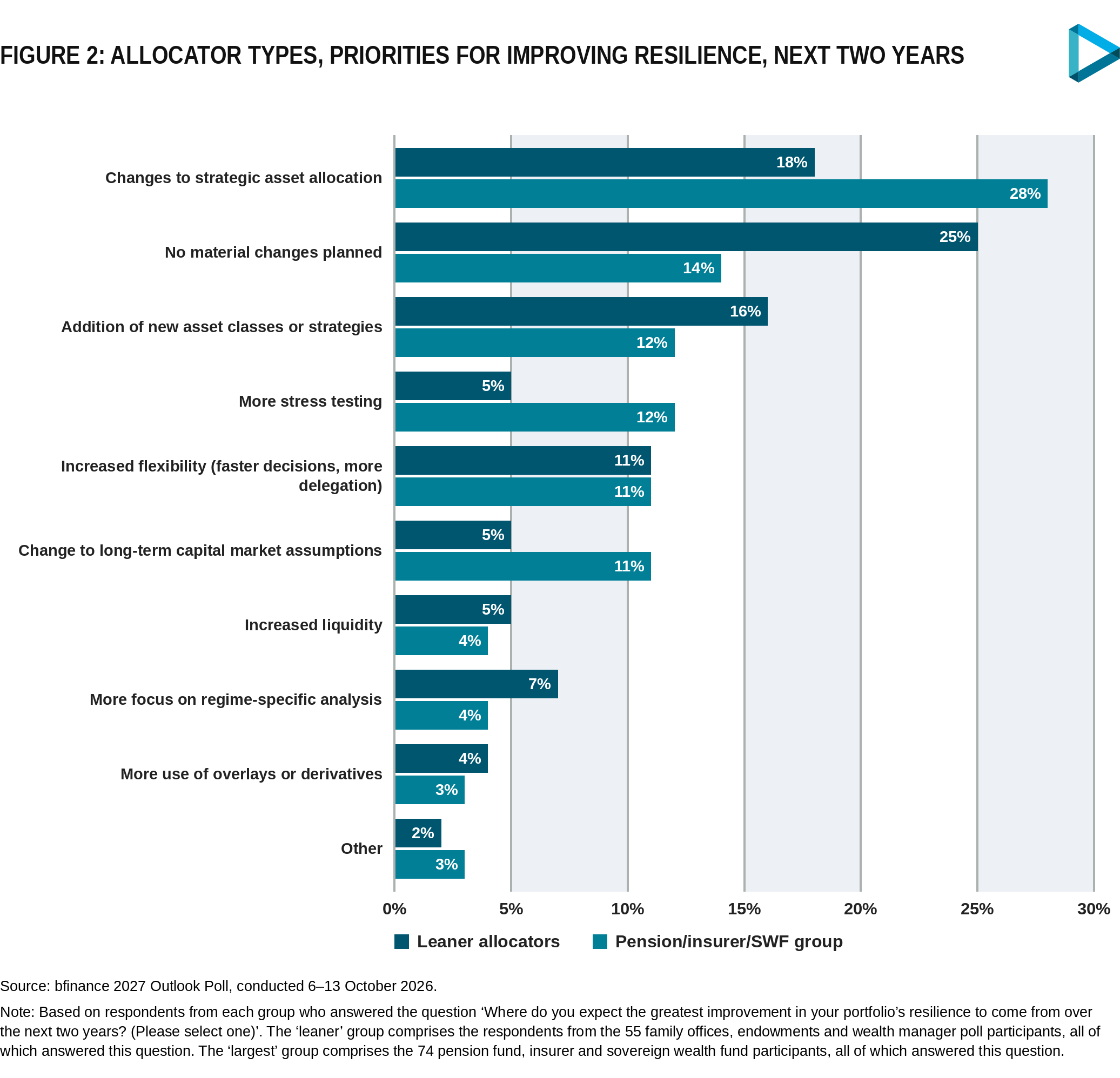
The structural drawdown sensitivity for certain allocator types
To some extent, it is hardly surprising that respondents from pension funds (largely defined benefit, DB) and insurance companies would be more likely to have stress tests at the front of their minds when investment conditions become challenging and uncertainty spikes. Regulatory frameworks, prescribed liabilities and strict risk management constraints mean that stress testing is firmly embedded in both process and culture.
Conversely, many wealth managers, endowments and family offices do not typically – at risk of over-generalisation – have the same degree of structural sensitivity to drawdowns (and the same constraints surrounding the management of the relevant risks) as their investor counterparts in the DB pension or insurance space. Naturally, it is easier to scale up something that is already embedded and well-resourced than it is to take the initiative in an area of activity that may be less firmly rooted within an organisation.
However, drawdown risks are central to both groups. Indeed, one could argue that stress testing should be just as strategically central to a family office as it is to an insurance company.
Resilience amid less predictable macroeconomic and market outcomes
Forecasters are currently putting high probabilities on scenarios that depart from their baselines, as a measure of the uncertainty facing allocators in a more fragmented and multipolar world of the turbulent twenties (See Outlook 2027: allocating under constraints in the 'turbulent 20s'). Therefore, resilience depends not just on making portfolio changes, but on regularly stress-testing portfolios and adapting asset allocations dynamically as risks evolve. When was the last time your portfolio was tested against a future that looked very different from today?
Stress testing helps to build resilience. A new allocation may bring risks the old portfolio’s history does not capture, and even unchanged portfolios can become exposed as market regimes, correlations and liquidity conditions evolve. The real test is not whether a portfolio survives the shocks we expect, but whether it remains resilient when diversification fails and market relationships behave in ways not seen recently, or even possibly before.
Investors know which conditions worry them. Of all respondents to the bfinance 2027 Outlook Poll, 61% name stagflation as their biggest vulnerability, and 67% of family offices, endowments and wealth managers have lost conviction that government bonds reliably diversify equity risk. Recent years show how quickly the ground can shift: bonds and equities fell together in 2022, and portfolios built on the assumption that one would cushion the other found that it did not.
Portfolios with thinner liquidity buffers or more concentrated positions have less room to absorb a misjudgement. Investors make better decisions when they have seen how their portfolio behaves under adverse scenarios before those scenarios occur.
Five steps: stress testing doesn’t need to be complicated
- Start with a few plain scenarios. Pick three or four regimes, such as stagflation, a geopolitical shock, deflation and an AI-driven regime shift, and write one sentence on what each would do to your portfolio. Keep them plain; the aim is a shared vocabulary for the committee, not a forecast.
- Stress liquidity as well as returns. Model spending needs, capital calls and rebalancing in a downturn, not only the fall in value. Some 35% of family offices, endowments and wealth managers say existing private commitments have constrained their ability to rebalance or invest. A portfolio can survive a drawdown and still be unable to act on it.
- Run a reverse stress test. Start from the outcome you cannot tolerate, such as missing a spending commitment, and work back to what would cause it. It needs only a spreadsheet and tends to surface the assumptions that matter most.
- Agree decision rules in advance. Set triggers and delegated authority so a stress event does not wait for the next committee meeting. Family offices, endowments and wealth managers name internal decision speed among the three constraints most likely to limit them in a market shock (see Figure 3, below) – in theory, these leaner allocators have greater flexibility, and the poll suggests formal agreed plans could help convert theory into practice.
- Keep the process proportionate. Stress testing does not require a dedicated risk team or complex infrastructure. Start with simple scenarios and seek additional analytical support only when the questions become more complex. Keep a one-page record of each test.
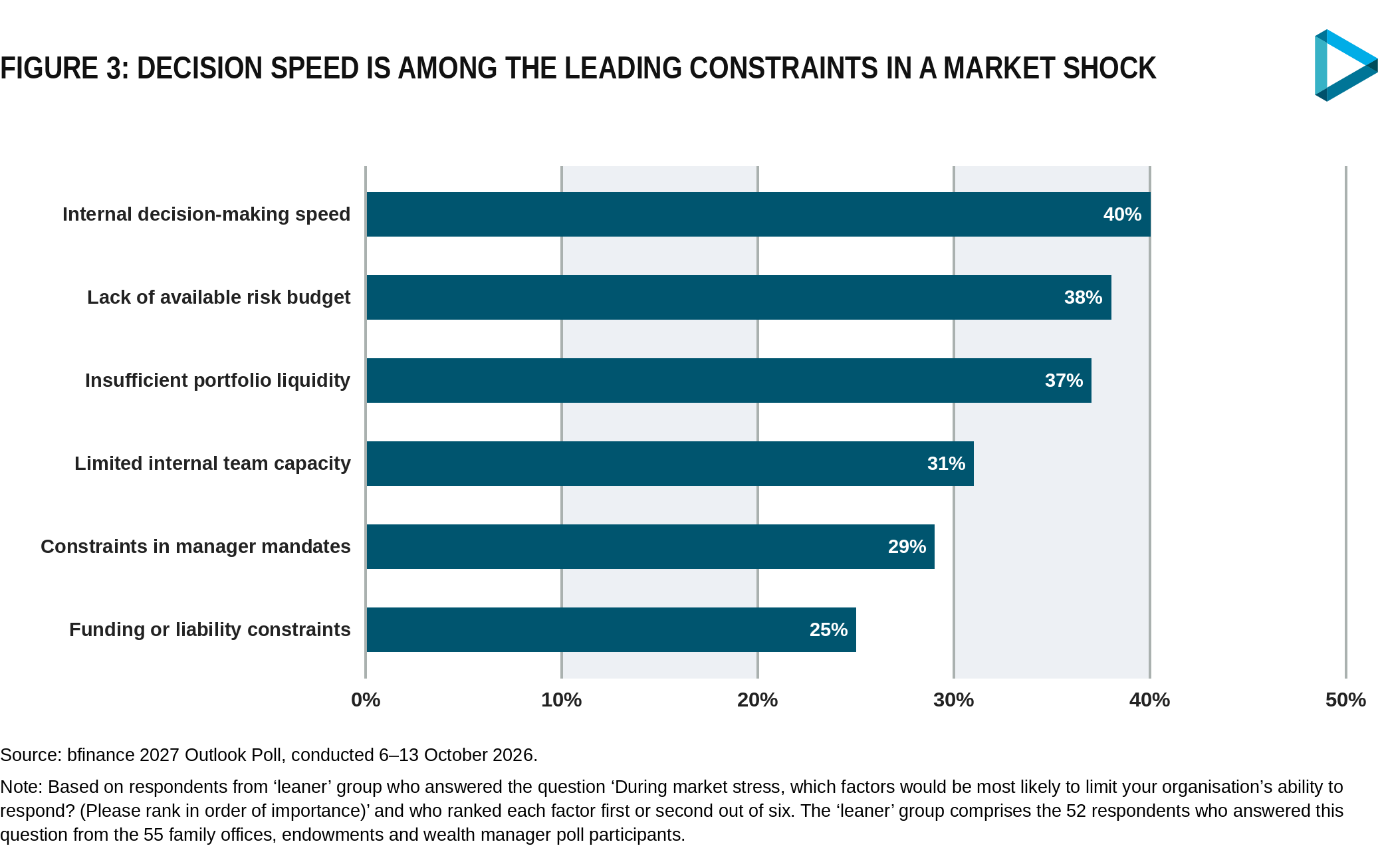
Make stress testing a standing discipline
The simplest change is a rule: every portfolio should be stress-tested regularly against a consistent set of scenarios, whether or not an allocation change is being considered. It does not need a risk team. It needs a page, a shared set of scenarios and someone with the authority to say a test is incomplete.
Three questions are worth asking at your next committee meeting:
- What is our portfolio tested against?
- Could the portfolio meet its commitments in a downturn?
- Who decides when conditions change, and how quickly?
Being flexible on paper does not mean nimble or resilient in practice. Without a clear-eyed view of potential scenarios and how they may harm existing portfolios, meaningful action may be difficult. To put it very crudely, having the discretion to make a quick investment in an opportunistic sector means little if the cash isn’t there to fund the move.
Regular stress testing should not be prioritised because it is prescribed by regulators or required by internal models. It should be prioritised because it is strategically powerful. Where resources are limited, simplified approaches are available – and no less powerful in terms of highlighting potential weak spots in an existing portfolio.
Important Notices
This commentary is for institutional investors classified as Professional Clients as per FCA handbook rules COBS 3.5R. It does not constitute investment research, a financial promotion or a recommendation of any instrument, strategy or provider. The accuracy of information obtained from third parties has not been independently verified. Opinions not guarantees: the findings and opinions expressed herein are the intellectual property of bfinance and are subject to change; they are not intended to convey any guarantees as to the future performance of the investment products, asset classes, or capital markets discussed. The value of investments can go down as well as up.