Français (France)
  Deutsch (DACH)
  Italiano (Italia)
  Dutch (Nederlands)
  English (United States)
  English (Canada)
  French (Canada)
bfinance insight from:

Ravi Rastogi
Managing Director, Global Head of Insurance

Mathias Neidert
Managing Director, Head of Fixed Income
A bfinance poll of EU insurers points to a material increase in CLO debt allocations through 2027. Regulatory reform is an important catalyst, but governance, internal capability and portfolio integration may determine how much of that intent converts into investment.
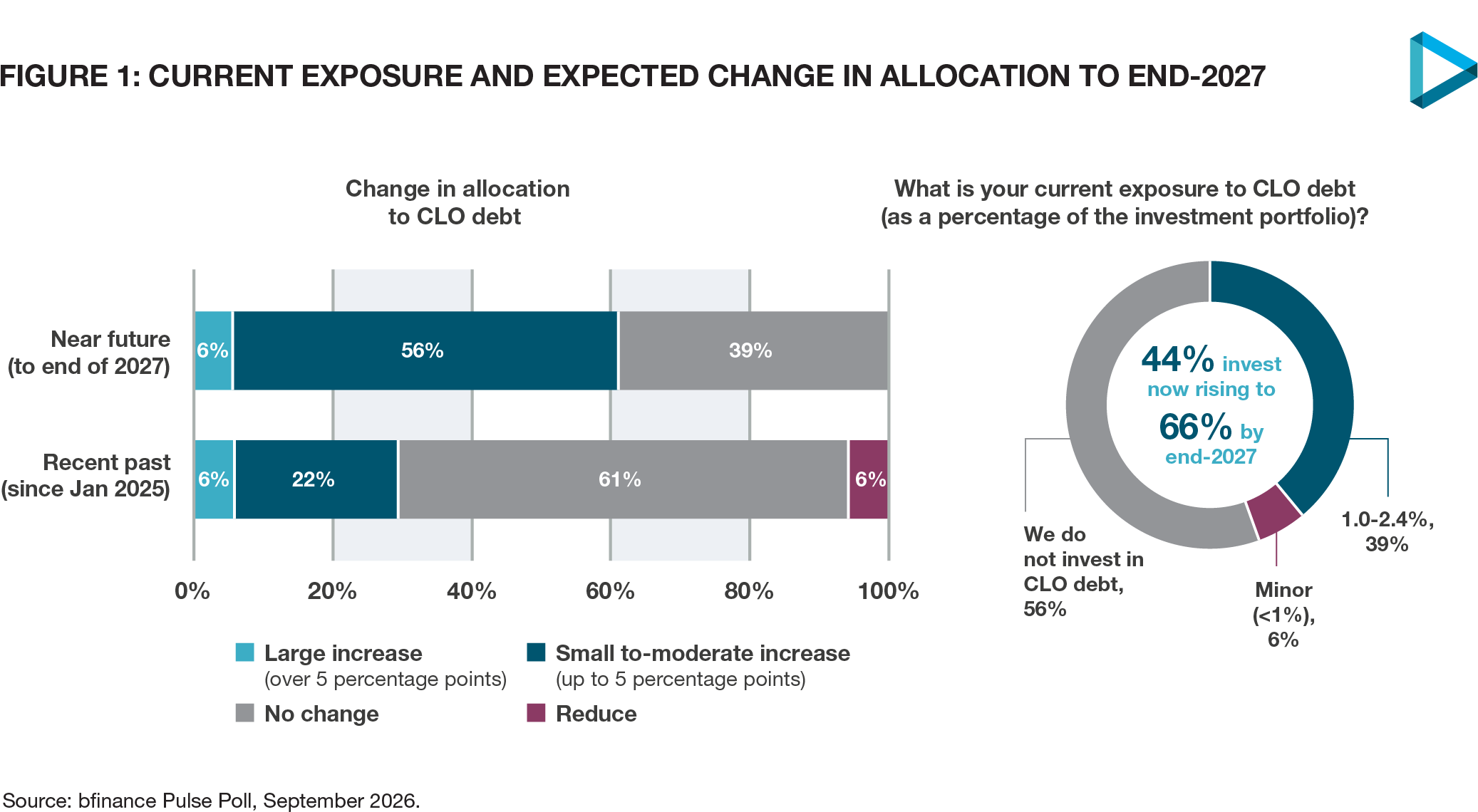
European insurers appear to be approaching a turning point in their use of CLO debt, according to the bfinance Insurer Pulse Poll – CLOs. While fewer than half of respondents currently invest in the asset class, approximately two thirds intend to by the end of 2027, based on responses from 20 insurers* in EU countries. More strikingly, the majority of respondents intend to increase their allocation over that period, echoing the US insurance industry’s much greater exposure to the deeper US CLO market.
*Note: 20 insurers participated in this Pulse Poll but were permitted to omit particular questions in cases of organisational sensitivity so n varies by question (e.g., n=19, n=18).
The scale of the anticipated change is notable, but so is its character. Most respondents are contemplating measured increases rather than wholesale portfolio repositioning. The findings suggest CLO debt is moving further into the mainstream of insurers’ credit allocations, rather than becoming a new alternatives allocation in its own right.
Regulation changes the relative economics
One obvious catalyst is the revised Solvency II framework, which applies from 30 January 2027. Among a broader package of reforms, the new rules materially reduce Standard Formula spread-risk capital requirements for securitisations. Senior non-STS positions – the treatment applicable to much of the CLO market – receive a new and substantially lower set of risk factors. The difference is significant at investment-grade ratings. Under the existing calibration, the spread-risk factor for the AAA-equivalent non-STS securitisation is 12.5% per year of modified duration. The new senior calibration is 2.7% (a drop of almost 80%); equivalent changes at subsequent credit-quality steps are 13.4% to 3.3% (AA), 16.6% to 4.4% (A); and 19.7% to 7.5% (BBB) – reductions of c 60% (BBB) to 75% (AA) vs pre-reform.
For insurers using the Standard Formula, that changes the capital-adjusted relative-value calculation materially. It does not, however, make capital treatment the sole investment case. Internal-model firms are not directly affected by the new Standard Formula parameters, and EIOPA has cautioned that risk-return characteristics, ALM fit, liquidity and specialist expertise remain important constraints on insurer participation in securitisation. That nuance is strongly reflected in the poll.
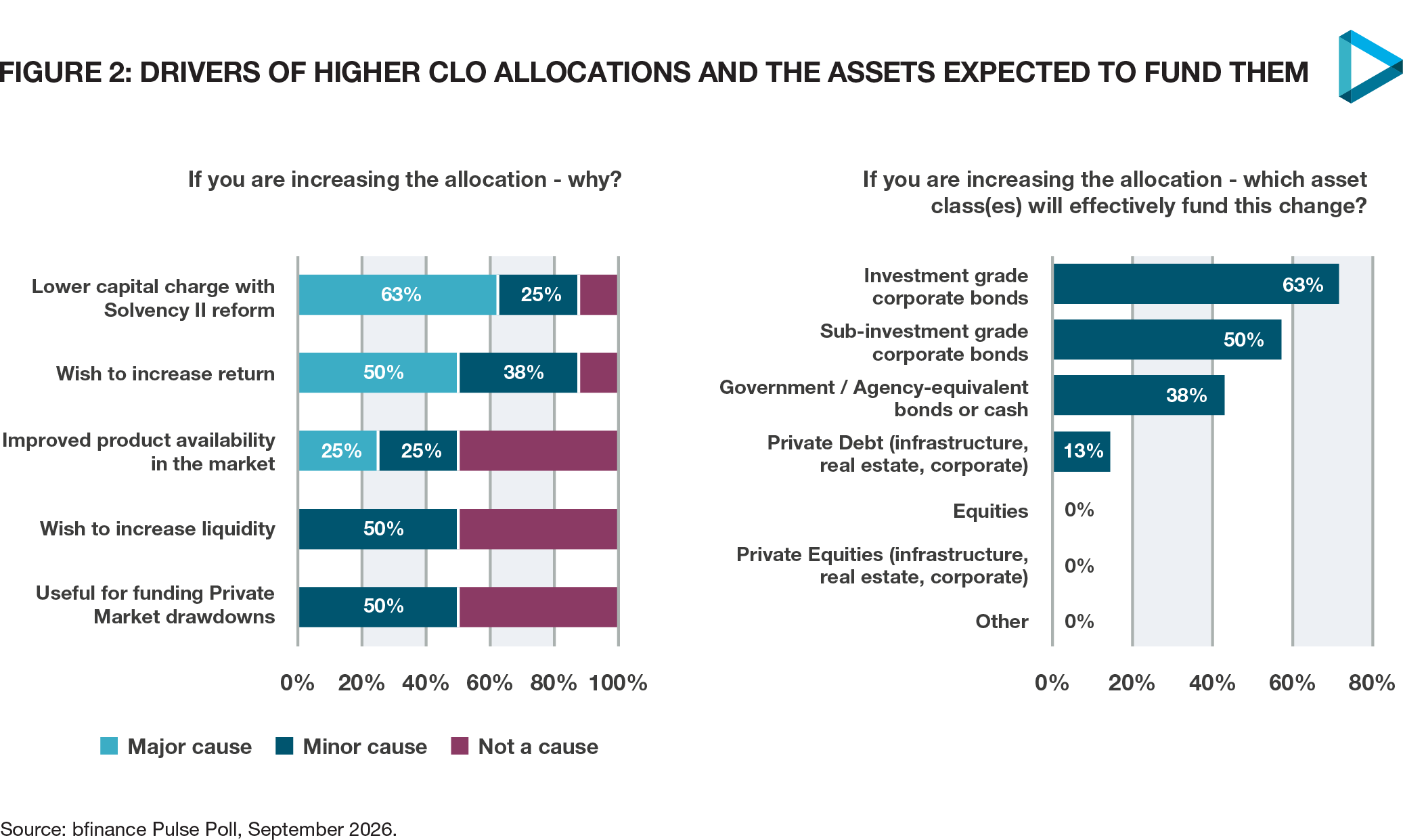
Among respondents increasing exposure, 63% identify the lower Solvency II capital charge as a major driver and a further 25% as a minor one. Return enhancement is almost equally prominent. Improved product availability also plays a role.
Where the capital is coming from is particularly revealing. Some 63% expect to fund higher CLO allocations from investment-grade corporate bonds and 50% from sub-investment-grade corporates. Only 13% cite private debt. The emerging shift therefore looks primarily like a reallocation within credit portfolios, rather than a move away from private markets.
That interpretation has some external support. J.P. Morgan Asset Management reported earlier in 2026 that lower spread-risk SCR under the Solvency II review was prompting European insurers to revisit securitised assets, “especially CLOs”. Earlier evidence also establishes the low starting point: EIOPA found that only 12% of Standard Formula insurers held securitisations at end-2021, representing just 0.33% of their aggregate investments, although 37% of surveyed firms subsequently indicated an intention to increase exposure.
A broader 2025 SLC Management survey of 250 insurer decision-makers found that only 13% expected to increase CLO allocations over the following two years. The populations are not directly comparable, since SLC’s study covered several jurisdictions and regulatory regimes, but the contrast reinforces the sense of particularly strong near-term momentum among EU insurers in the current poll.
Implementation bottlenecks
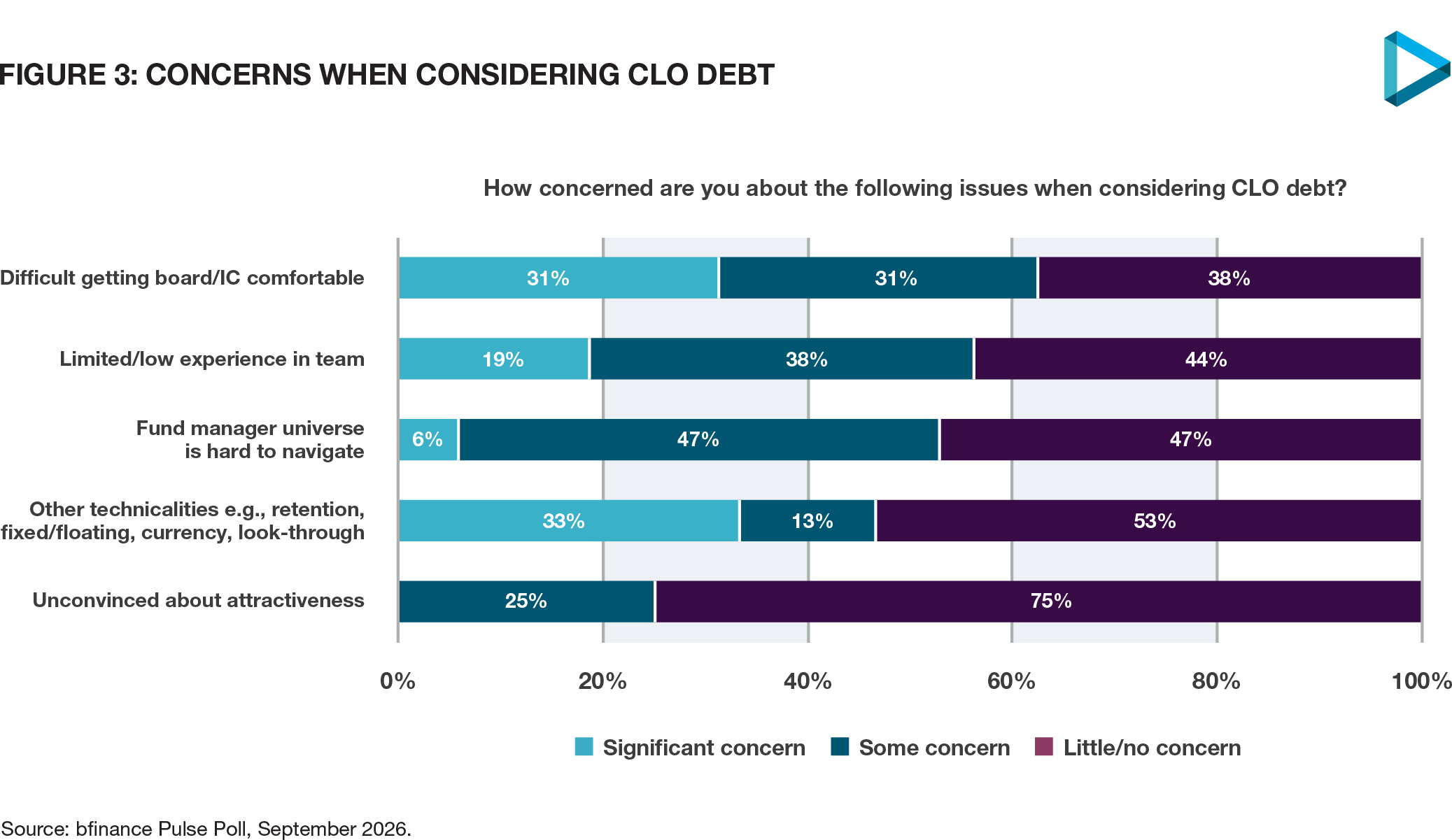
The survey also suggests that investment conviction is not the main barrier. Board and investment-committee comfort, limited internal experience and the difficulty of navigating the manager universe all rank well above concerns about the attractiveness of the asset class itself. Technical considerations – including retention requirements, fixed versus floating exposure, currency and look-through – remain material too.
Portfolio interaction is another issue. As one Belgian life insurer observed, “The overlap with existing positions in private credit … is difficult to manage.” For insurers that have spent recent years expanding direct lending and other private-credit allocations, understanding underlying leveraged-loan exposures across public, private and securitised strategies will be increasingly important.
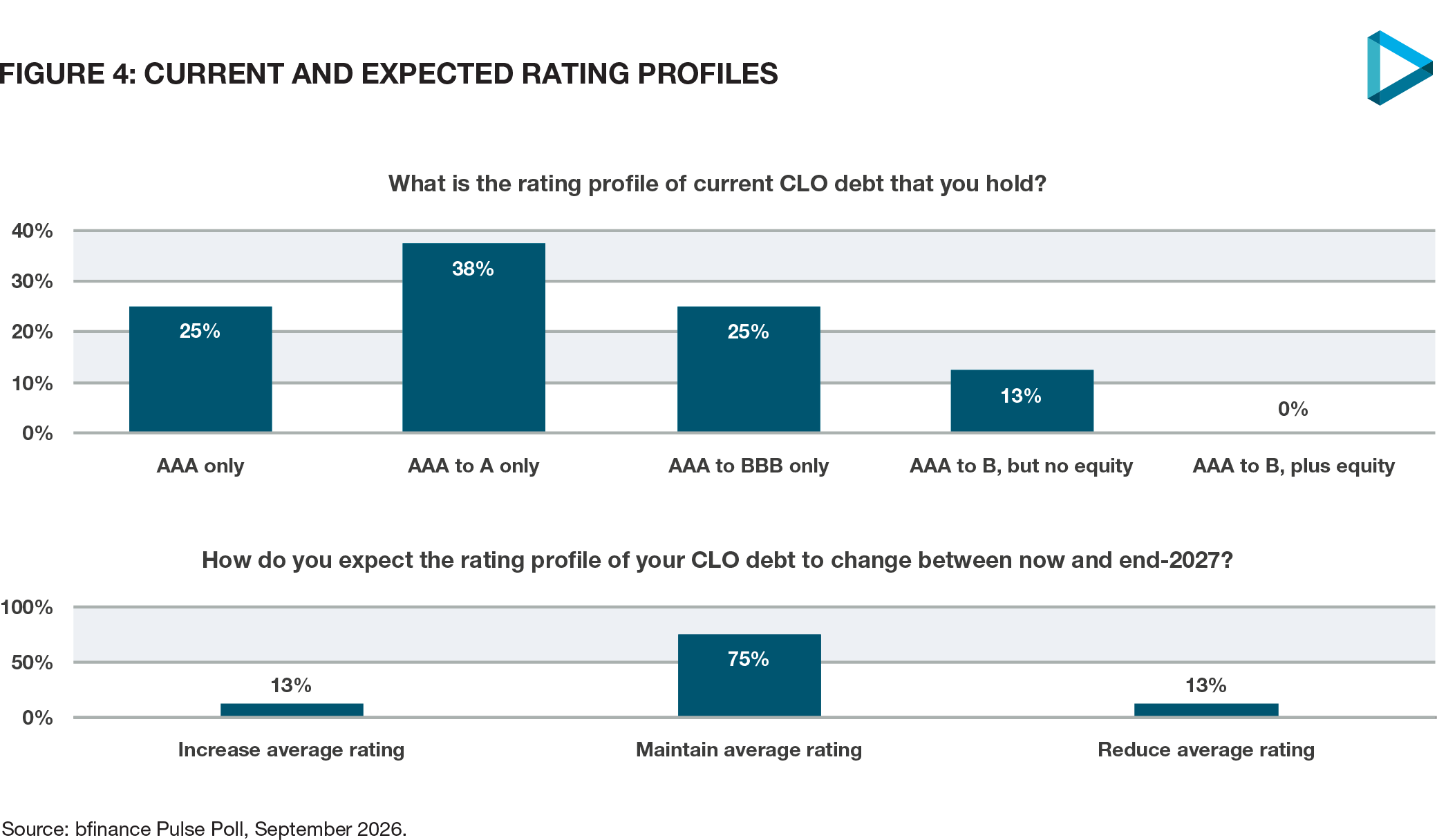
Importantly, the anticipated increase does not appear to be accompanied by a move down the CLO capital structure. Only 13% of current investors hold sub-investment-grade CLO debt, while three-quarters expect their average rating profile to remain unchanged through end-2027.
Nor does the trend appear likely to produce widespread internalisation. Among respondents answering the implementation question, 82% expect their CLO exposure to be entirely externally managed at end-2027; only 18% envisage any internal management.
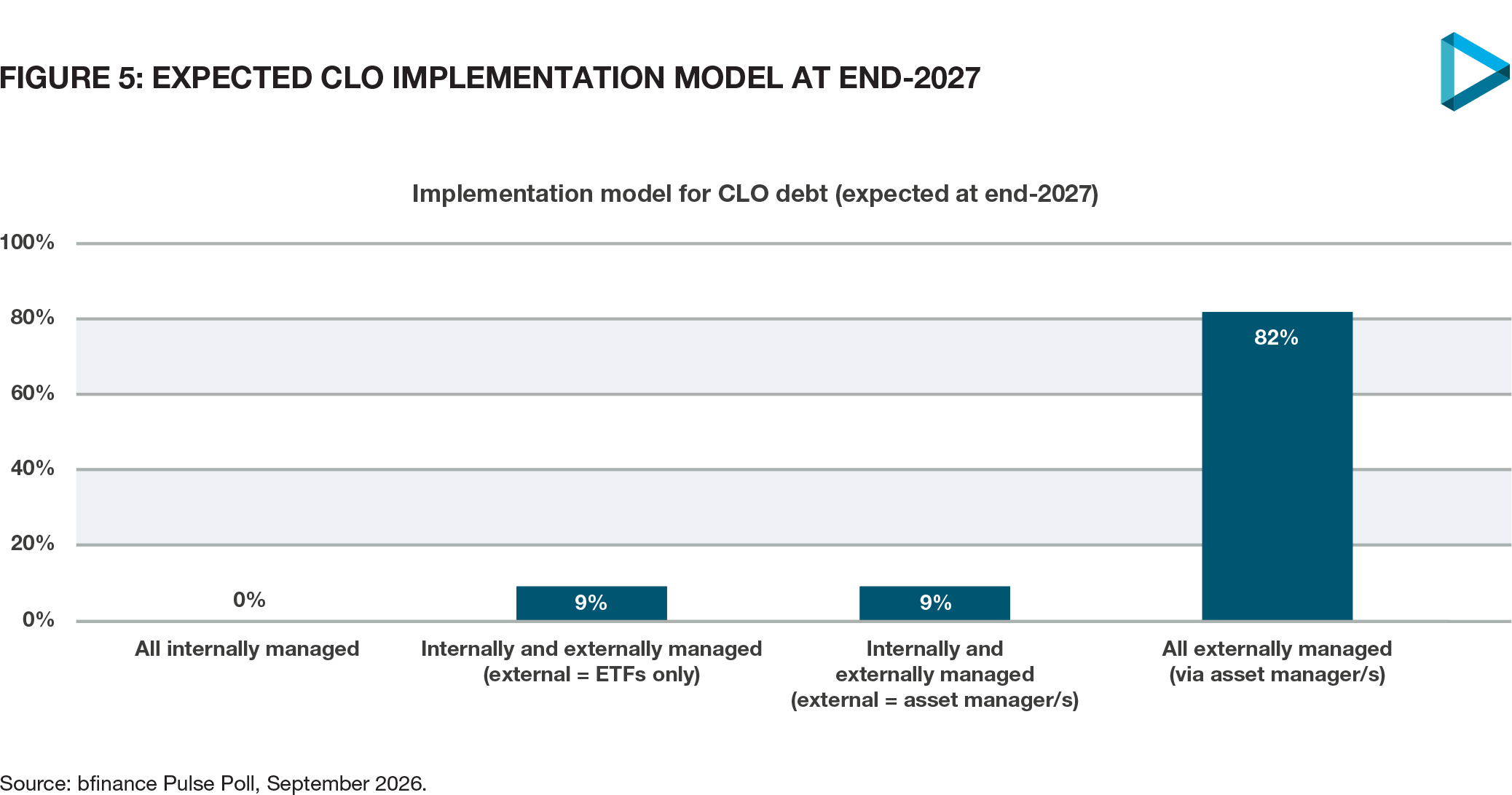
For service providers to the insurance community, therefore, the opportunity extends beyond supplying product. Insurers will also need manager selection, portfolio transparency, look-through analysis and reporting that can stand up to internal risk functions and investment committees.
This bfinance survey is an indicative pulse poll rather than an industry census. Even so, it captures a striking point in the development of insurer CLO allocations. Solvency II is changing the capital equation; the next test is whether governance and implementation capabilities can evolve quickly enough to match desired investment intentions.
Important Notices
This commentary is for institutional investors classified as Professional Clients as per FCA handbook rules COBS 3.5R. It does not constitute investment research, a financial promotion or a recommendation of any instrument, strategy or provider. The accuracy of information obtained from third parties has not been independently verified. Opinions not guarantees: the findings and opinions expressed herein are the intellectual property of bfinance and are subject to change; they are not intended to convey any guarantees as to the future performance of the investment products, asset classes, or capital markets discussed. The value of investments can go down as well as up.