Français (France)
  Deutsch (DACH)
  Italiano (Italia)
  Dutch (Nederlands)
  English (United States)
  English (Canada)
  French (Canada)
 - Canada, Financial Services Company
- 2025
- All asset classes, global
- Multi-billion
- Evaluate glide path asset allocation methodology for the Target Date Fund (‘TDF’) products
- Strategic Asset Allocation
Our specialist says:
Establishing a portfolio construction methodology which is theoretically sound, implementable in practice, and competitive in the industry is critical for a well-functioning portfolio solutions product. There are several approaches to implementing a Target Date Fund methodology, however. Important considerations for balancing these three core ideals across implementation approaches include maintaining consistency in portfolio philosophy throughout the methodology, ensuring the retirement nature of the fund is central to investment decision making, e.g. accounting for longevity risk, and that assumptions and modelling are relevant for real world financial market evolutions.
Client-specific concerns
A Canadian Financial Services Company has engaged bfinance to support in evaluating its glidepath asset allocation methodology for its Target Date Fund (‘TDF’) products. This engagement has two key objectives: a thorough review of the existing methodology, and an evaluation of best practices derived from academic research and industry standards, particularly those employed by leading asset managers in the target date fund space. The aim was to provide the client with a qualified and objective view of the current methodology. This results in the validation of the existing overarching approach with the identification of areas of potential refinements, accompanied by actionable recommendations to support the client’s decision-making process.
bfinance value-add
- Assumptions. bfinance evaluated key assumptions, such as their investable universe, capital market assumptions, and cash flow assumptions. bfinance suggested adding private market asset classes to increase diversification. For example, the client could benefit from infrastructure as a long-term, income-generating asset class with differentiated risk and return characteristics, particularly in areas like inflation sensitivity and economic cycle resilience.
The client’s risk estimation framework is academically verified but would benefit from greater consistency in data treatment, more nuanced unsmoothing techniques, and explicit recognition of the unique characteristics of certain asset classes. A more appropriate unsmoothing technique could incorporate multi-period lag models or Sharpe-ratio based calibrations to adjust volatility.
- Metrics. bfinance replicated the calculation methodology for each performance metric. This provided grounds for assessing how well chosen metrics align with the client’s objectives, as well as a sense check of figures employed. Limitations on the assumption that yearly returns are independent, and identically distributed were highlighted, and bfinance provided refinements which could enhance the accuracy of return calculations.
Selected risk measures establish a sound foundation for evaluating the portfolio’s ability to achieve its long term goals. bfinance offered some considerations aimed at enhancing its robustness, such as more realistic implementation of purchasing power evolution.
- Allocation. The optimization output was analysed within, and across asset classes, as well as its suitability. The efficient frontier process is conceptually appropriate but sensitive to input assumptions. Conducting sensitivity analysis to test the robustness of results could strengthen confidence in outputs.
- Glidepath. bfinance evaluated the glidepath construction process. It was noted that, while the process is systematic, it adopts a brute force approach which is misaligned with the more efficient portfolio optimization techniques adopted elsewhere in the methodology. The process is also highly sensitive to assumptions about returns, volatility, and correlations.
- Tactical leeway. The client’s TAA assumptions were analysed in the context of industry peers, best practices, and relative to their performance objectives. Institutional investors often target half of total portfolio tracking error to come from TAA. The TAA risk and return assumptions appear appropriate, however, the client may seek to confirm the appropriate of potential losses from the strategy.
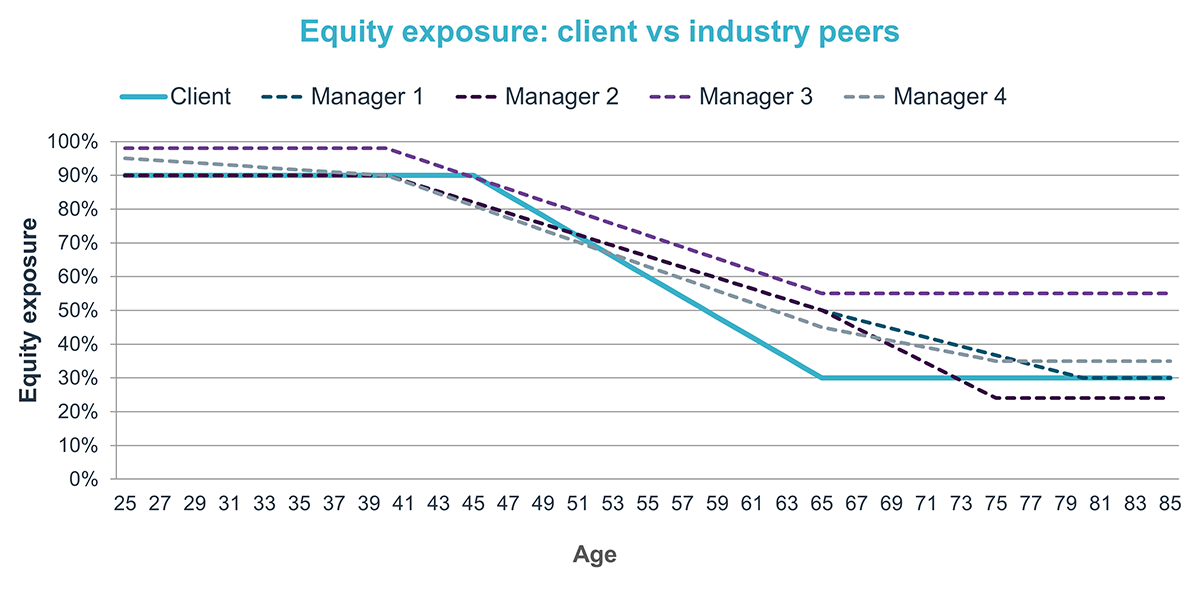
- Industry review. The industry review placed the client’s methodology in the context of industry peers across several key aspects of a target date fund methodology: glide path design, capital market and demographic inputs, asset class diversification, and tactical leeway and glide path adjustments. bfinance found that overall, the client’s approach is broadly consistent with other large target date funds. While there exists considerable dispersion amongst providers, notably around glide path shape, the client is aligned with the broader industry with regard to key assumptions.
- Academic review. The academic review, with an accompanying literature review, covers the 5 key pillars to target date fund methodologies as discussed in the literature: glide path shape, de-risking strategy, optimization method, measuring risk, and benchmarking. While there are areas which the client could investigate for potential refinements, like the de-risking strategy or glide path shape, there is no part of their methodology which is disregarded by either the literature or industry peers.