Français (France)
  Deutsch (DACH)
  Italiano (Italia)
  Dutch (Nederlands)
  English (United States)
  English (Canada)
  French (Canada)
 - APAC, Sovereign Wealth Fund
- 2025
- Private Debt, Global
- Not disclosed
- First-time private debt allocation, optimal sizing & funding, detailed implementation plan across multiple sub-portfolios
- Portfolio Design
Our specialist says:
“Entering a new asset class is not a straightforward task – especially one that has changed considerably over the past decade and is complex from a cashflow perspective. As well as a clear view on the strategic asset allocation picture… investors must also find a way forward that fits with the team’s resources, governance model, liquidity needs and more. The goal is not only to make an investment ‘case’ but to provide confidence with a step-by-step implementation roadmap.”
Client-specific concerns
A sovereign wealth fund was considering the introduction of private debt to the portfolio. They sought to understand how this asset class might complement existing exposures, determine an optimal allocation size and choose whether to fund the allocation from fixed income, equity or both.
Implementation was also in focus during this comprehensive portfolio design project. This included mapping the wide variety of sub-sectors in the private debt universe and considering matters such as fees/costs, scalability, liquidity, cashflow planning, vehicle types and more.
To add complexity, it was important that the analysis and proposals fit within the investor’s existing framework, which featured separate sub-portfolios with different objectives, such as ‘conservative’ versus ‘growth’ (each of which might benefit from the addition of private debt in different ways).
bfinance value-add
- Analysing existing exposures through a risk factor lens. The investor’s current holdings were assessed to gauge their exposure to macroeconomic drivers including growth, real interest rates and inflation, with a factor-based approach.
- Modelling allocations. Although declining base rates may impact overall returns in private debt, spreads are forecast to remain structurally robust and default rates are expected to remain relatively low, supporting strong risk/return expectations for this asset class. A mean variance optimisation analysis, tailored to the investor’s sub-portfolios (growth, balanced, conservative), demonstrated improvement in the efficient frontier with the inclusion of private debt in all cases.
- Understanding the diverse private debt sector. Private debt offers a range of sub-strategies, each of which can deliver distinct return streams and diversification benefits. However, these attractions must be balanced against concerns around complexity and scalability.
- Providing customised practical guidance. Two proposals were generated, with differing levels of complexity, so that the investor could consider resourcing and governance aspects when determining a preferred path forward. This was followed by the creation of a detailed implementation plan tailored to the organisation’s needs, including cashflow planning, vehicle considerations and fee expectations.
Forward-looking efficient frontier analysis
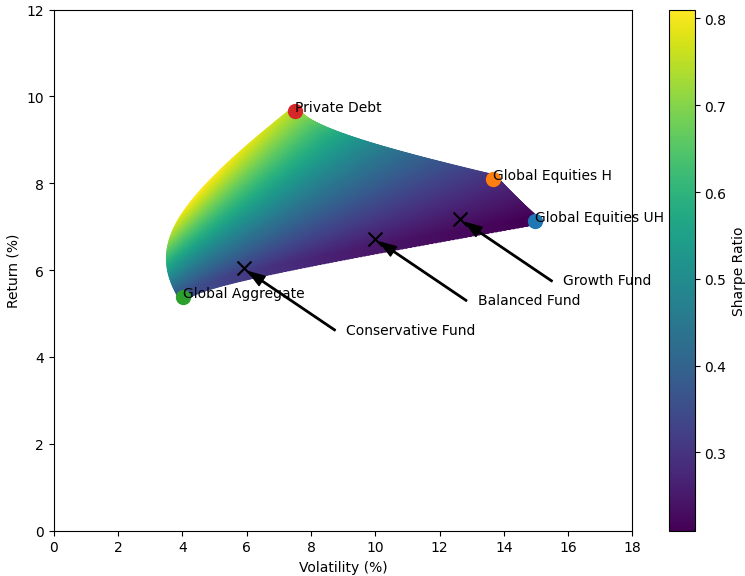
Source: bfinance. Local returns are net-of-fees and based on data ending August 2024. Expected returns are five-year annualised assumptions. The Sharpe ratio assumes a cash rate of 4.0%. The Conservative, Balanced and Growth Funds represent possible expected returns for the current portfolios, excluding private debt.