Français (France)
  Deutsch (DACH)
  Italiano (Italia)
  Dutch (Nederlands)
  English (United States)
  English (Canada)
  French (Canada)
 - Bermudian Reinsurer
- 2024
- All asset classes (focusing on fixed income), global
- 1.5 billion USD
- Add asset classes to SAA; increase risk
- Strategic Asset Allocation
Our specialist says:
Establishing a well-constructed SAA is critical to preserving capital and meeting liquidity requirements. The proposed SAAs demonstrate the value of blending forward-looking simulations, particularly focused on downside scenarios, with practical considerations, demonstrating the ability to take additional credit and duration risk without meaningfully increasing portfolio VaR. By engaging in a dialogue with the client, multiple iterations and proposals were considered, incorporating realistic, portfolio-specific considerations. The end result saw bfinance propose a range of options for the client’s consideration, accompanied with detailed forward- and backward-looking scenario analysis.
Client-Specific Concerns
A Bermudian reinsurance company engaged bfinance to review its investment strategy. The goal was to propose ways to increase risk-taking without compromising portfolio robustness. The reinsurer manages a substantial, >1 billion USD portfolio, composed mostly of fixed income. The primary objective of the portfolio is to preserve capital and provide liquidity to support underwriting. While this structure has historically achieved its objectives, there was a desire to potentially expand into riskier assets (equities, hedge funds, private equity), or to take on more credit and duration risk.
Key objectives included:
- Maintaining a conservative tail risk profile: An annual Value-at-Risk (“VaR”) was a key metric for all analysis. Proposed portfolios would be subject to VaR limits.
- Assessing the impact of adding riskier asset classes: The portfolio has historically been primarily invested in highly rated fixed income instruments. The client sought a greater understanding of the volatility, drawdown and yield implications of adding asset classes that had greater upside, such as listed equities.
- Modestly increasing credit and duration risk: The portfolio had strict limits for credit quality, emerging market exposure and duration. However, the client sought recommendations to increase these ranges.
Outcomes:
- Moderate Risk SAA: Allowed for modest increases in credit risk and duration, delivering a slight uplift in returns with a corresponding rise in volatility relative to the current portfolio.
- Expanded Asset SAA: Promoted even wider increases in credit risk and duration. Additionally, the inclusion of new asset classes were considered, with small allocations to listed equities, hedge funds, private equity and infrastructure. Relative to the Modest Risk SAA, the Expanded Asset SAA delivered higher returns and volatility. However, due to the diversifying properties of the new asset classes, tail risk was broadly comparable between the two proposals.
- Realistic SAA: Following an initial presentation of the first two options, and in light of the key learnings thus far, the client sought to stress-test an additional two SAAs of their own design. The Realistic SAA presented a portfolio that had a similar composition to the current portfolio, with greater credit risk.
- Ambitious SAA: One final portfolio was modelled, with asset weights informed by the client following feedback from the first stage of the project. Relative to the current portfolio this SAA allowed for more credit risk and exposure to new asset classes.
bfinance’s comprehensive analysis resulted in the development of four Strategic Asset Allocations tailored to the reinsurer’s objectives. The first two options were proposed by bfinance, while the second two were requested by the client:
Each strategy was informed by efficient frontier analysis and scenario simulations, offering a comprehensive evaluation of potential risk-return trade-offs. Lower risk assets, including short-duration US treasuries and cash, were favoured in the lower risk portion of the efficient frontier. As the portfolio combinations moved up the frontier, riskier assets were included, including leveraged loans, high yield and private debt. Overall, the primary recommendation was to allow for wider constraints for credit quality and duration, bolstering the expected return with modest increases in risk. A secondary recommendation for the riskier SAA proposals was to include listed equities, infrastructure, private equity and hedge funds in the investable universe.
Sub-asset class portfolio design was also considered. Due to the focus on duration, credit quality and volatility, key asset classes were optimised individually to determine the appropriate mix of sub-asset classes. US treasuries, US corporates, and securitised were considered in isolation. The result of this saw more duration risk within treasuries and corporates. Within securitised, bfinance blended quantitative analysis (which favoured low-duration, high-yielding CLOs) with practical considerations, reaching a more diversified securitised portfolio than the current asset mix.
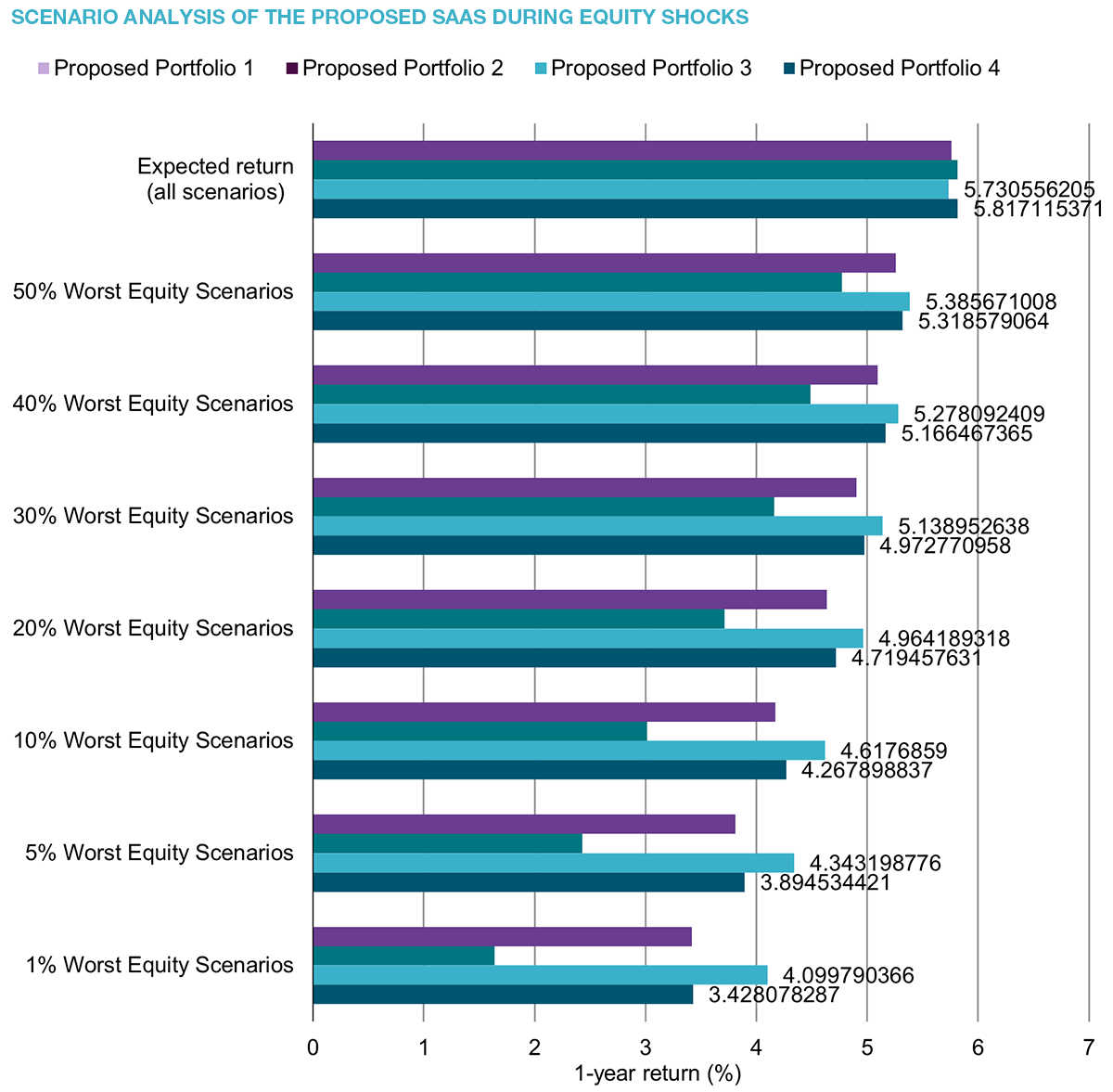
Tail risk was identified as a critical factor, with credit exposure being the primary driver of potential portfolio losses. The analysis highlighted the relatively comparable Value-at-Risk figures for all SAAs, demonstrating that increasing credit and duration does not necessarily lead to a material jump in tail risk during adverse market conditions. Additionally, stochastic, forward-looking tail risk events were assessed, with the returns for each SAA mapped to a) a simulated equity shock, b) an increase in the US yield curve, and c) an increase in US investment grade spreads. The proposed SAAs had broadly robust performance in these scenarios.
Historic scenario analysis was used to stress test the proposed SAAs. Two periods were assessed: Q4 2010 and Q3 2011. The former saw the US Federal Reserve announce the second round of its quantitative easing programme, buoying equities but putting upward pressure on bond yields. The latter saw a US credit rating downgrade, leading to a sell-off in equities but a rally in bonds as investors sought quality. The drawdown profile of each SAA was assessed in these periods, demonstrating only marginally deeper drawdowns relative to the current portfolio.