Français (France)
  Deutsch (DACH)
  Italiano (Italia)
  Dutch (Nederlands)
  English (United States)
  English (Canada)
  French (Canada)
 - German Pension Plan
- 2024
- Fixed income and equities, global
- Multi-billion EUR
- Review and suggest improvements for the portfolio, focusing on yield and volatility
- Strategic Asset Allocation
Our specialist says:
Thoughtful strategic asset allocation analysis is critical to maximising the chances of achieving income goals, particularly for portfolios weighted towards fixed income. The proposed asset allocations demonstrate the value of blending quantitative rigour with practical considerations, offering a clear way to address concentration risks, enhance diversification, and optimise yield. By tweaking the current asset mix and considering new strategies for inclusion, the client was able to determine a path to achieve the same targeted cash yield with less volatility.
Client-Specific Concerns
A German pension and insurance plan engaged bfinance to review and refine their portfolio. The organisation manages a substantial, multi-billion EUR portfolio, composed of domestic and international fixed income strategies alongside a modest allocation to risk-seeking assets. This defensive nature was informed by a portfolio-level cash yield target, with an additional focus on mitigating volatility. While it has historically delivered a satisfying return profile, there was opportunity to improve diversification and lower portfolio volatility without compromising the expected yield – given the higher rate environment.
Key objectives included:
- Producing capital market assumptions for each asset class under consideration. This involved determining expected income and price changes over a five-year horizon. For fixed income, the price change was broken down further into expectations for shifts in credit spreads and base rates.
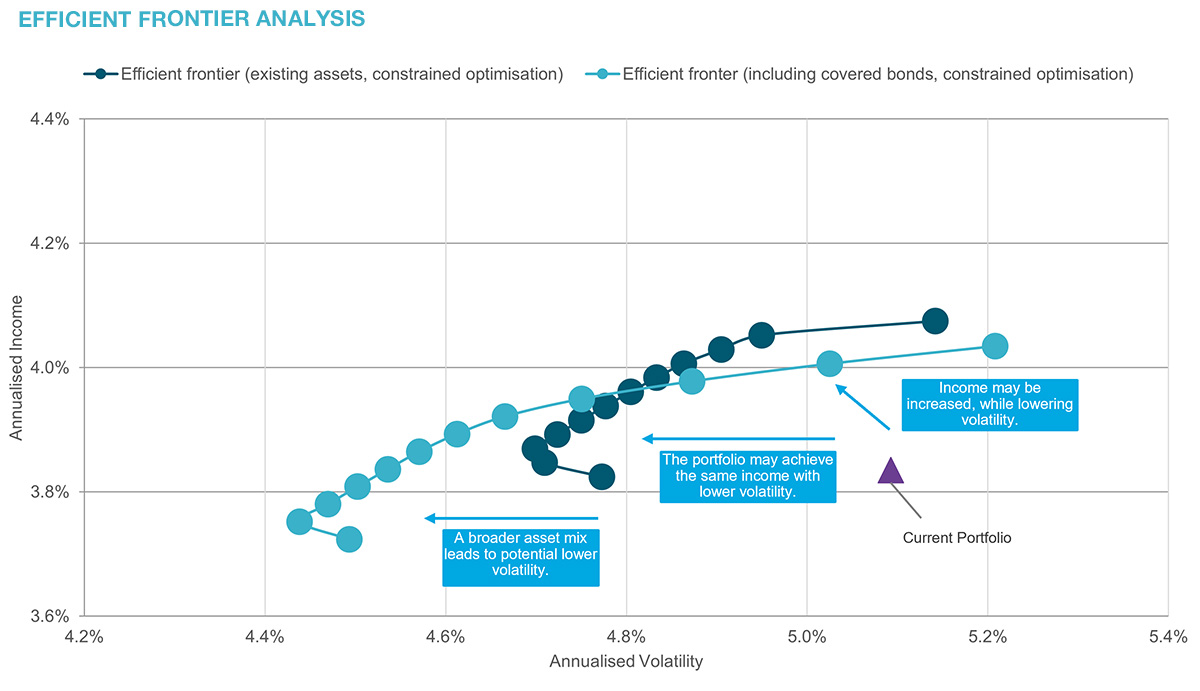
- Evaluating the existing asset allocation. This was done via a mean-variance optimisation, which determined the highest income level that could be achieved for a given level of volatility, subject to relevant constraints. Cash and mortgage bonds were favoured in the lower-risk portion of the efficient frontier, while emerging market debt featured in the higher-risk portfolios.
- Providing clear choices. Through the optimisation, the team developed four candidate portfolios for the client’s consideration. While all were well diversified across credit types with exposure to fixed and floating rate debt, risk profiles varied from ‘medium’ to ‘medium-high’. This enabled the investor’s team—who had developed a robust understanding of the various choices through the process—to reach an informed decision.
- Identifying new asset classes for inclusion. The addition of European covered bonds and leveraged loans were put forward for consideration into the portfolio.
- Reducing concentration risk. A large portion of the current portfolio was consolidated into a single asset class (Danish mortgage bonds), which presented idiosyncratic, country-specific concentration risk.
Outcomes:
- Optimised portfolio using the current asset mix. This retained the incumbent asset mix, however tilted the weightings within pre-defined limits to reduce portfolio volatility while maintaining the portfolio cash yield.
- Optimised portfolio using an expanded asset mix. This proposed a sizeable allocation to European covered bonds, which delivered further improvements in portfolio volatility. It was recommended to fund this allocation from the Danish mortgage bond sleeve. Loans were initially considered, however were later ruled out following discussions with the client.
bfinance’s comprehensive analysis resulted in the development of two portfolio asset allocation options tailored to the organisations objectives:
Each strategy was informed by efficient frontier analysis, offering a comprehensive evaluation of potential risk-return trade-offs. The primary recommendation for the current asset mix was to adjust portfolio weights to reduce portfolio volatility without reducing the cash yield. This involved reallocating capital into mortgage bonds and investment grade fixed income, funded from emerging market debt and municipal bonds. A secondary recommendation was to consider adding European covered bonds into the expanded asset mix.
Portfolio volatility was identified as a critical factor. All potential portfolios were back-cast using market indices to determine historic volatility and drawdown profiles, notably during the 2022 fixed income sell-off. Higher levels of volatility could compromise the ability of the portfolio to meet future cash yield requirements. The proposed portfolios demonstrated reductions in volatility and shallower drawdowns than the current portfolio.
Each portfolio asset allocation was supported by a detailed implementation plan to address the organisation’s specific needs. Firstly, it was recommended to consolidate emerging market debt managers into a single mandate focused on hard currency, however with the flexibility to allocate to local currency and emerging market corporates. Secondly, it was suggested to explore a multi-asset credit manager focused on sub-investment grade strategies, allowing the flexibility to allocate between high yield and loans. Finally, it was proposed to set up a dedicated European covered bond mandate.