English (Global)
  Français (France)
  Deutsch (DACH)
  Italiano (Italia)
  Dutch (Nederlands)
  English (Canada)
  French (Canada)
 - Middle East, Endowment
- 2024
- Equities, Global
- Several hundred million USD
- Redesign global equity sleeve, set realistic active risk budget, enhance resilience across market regimes, maintain Shariah compliance
- Portfolio Design, Manager Selection
Our specialist says:
“It is important to take care when setting investment objectives and benchmarks for public equity allocations. There can often be a mismatch between performance expectations and tolerance for (absolute and relative) risk… How do we streamline portfolios to improve efficiency, while still allowing suitable scope for outperformance? How should the desire to mitigate downside risk be balanced alongside benchmark-relative goals? These are not questions that should be approached simplistically, especially from a governance perspective.”
Client-specific concerns
A Middle Eastern endowment sought to overhaul its several-hundred-million-dollar global equity allocation following a decade-long period of underperformance versus the global equity benchmark (Dow Jones Islamic Market World). Broadly defensive positioning had successfully mitigated downside risk but contributed toward negative relative returns. The portfolio was allocated on a regional basis to a variety of active and passive strategies, with some significant country and sector tilts (versus benchmark) that had not been rewarded.
Priorities included setting new objectives for the portfolio (including a long-run information ratio that would underpin a tracking error budget and active return expectations), considering resilience across various market regimes including periods of over- or under-performance for particular factors or styles, and reviewing the manager line-up with both performance and cost efficiency in mind. Shariah compliance was also required.
bfinance value-add
- Re-thinking risk aversion. The portfolio had a rolling beta persistently below one, reflecting its overall defensive tilt and low downside capture, but the reduction in risk had contributed toward meaningful benchmark-relative underperformance. Researchers scrutinised the current benchmark, concluding that it remained fit for purpose, and presented analysis to substantiate a case in favour of greater risk tolerance going forward.
- Proposing multiple model portfolios for different risk appetites. Three optimized model portfolios were developed, each offering a different level of historic absolute volatility. These were based on mean variance optimisation that considered several equity styles across various market regimes (e.g. value-favourable versus growth-favourable environments) to understand the nuances of risk and return across different historic periods.
- Taking a core-satellite approach. The team recommended streamlining core exposures with a shift from regional to global mandates, reducing the number of manager relationships and enabling potential fee savings. A core-satellite model can also clarify the potential benefits of additional dedicated allocations for sectors such as global small caps, emerging markets and China. Research combined efficient frontier analysis with relevant practical insights to determine the attractiveness of potential satellites, including the impact of Shariah constraints on investable universes.
- Adding manager selection for full end-to-end support. Although offered modularly to preserve independence of the design phase, the investor ultimately engaged bfinance for manager selection services during implementation.
Illustrative efficient frontier analysis of equity styles, October 2007 – September 2024
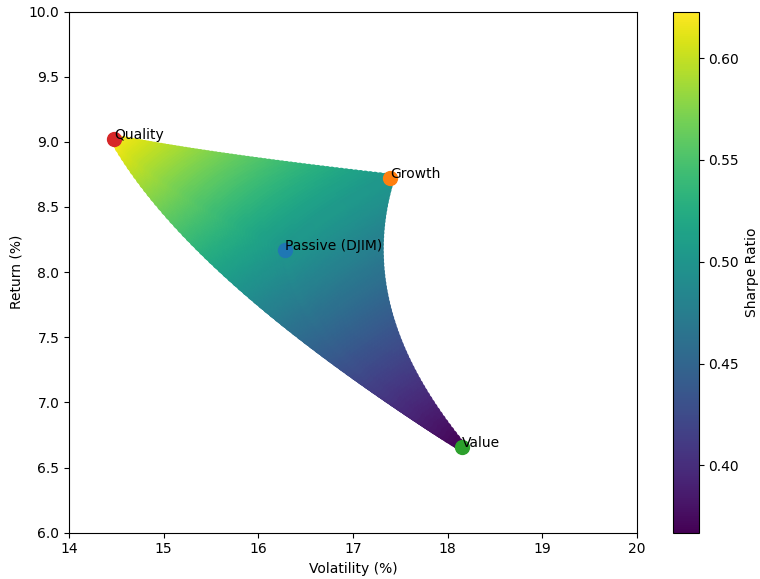
Source: bfinance. Results represent portfolios constructed using median peer group track records, gross total return as of September 2024, in USD. Passive is the Dow Jones Islamic Market World.