Français (France)
  Deutsch (DACH)
  Italiano (Italia)
  Dutch (Nederlands)
  English (United States)
  English (Canada)
  French (Canada)
bfinance insight from:

Ruben Mutsaers
Senior Director

Phil Cunliffe
Senior Associate
For many institutional investors, foreign currency exposures have often been treated as an afterthought to the central job of asset allocation: a manageable byproduct; a risk that should (and often could!) be dampened to whatever extent was appropriate for one’s base currency and liability profile; a subject where sub-optimal positioning would rarely receive harsh punishment. Yet the world has changed. Have investors changed with it, or simply tinkered with the details of legacy approaches whose foundations have been eroded?
The old order is not coming back. We should not mourn it. Nostalgia is not a strategy.
FX risks and the ‘Great Fragmentation’
Every investor’s sensitivity to FX risk is different. Investment strategies, base currencies, liabilities, regulatory parameters and overall risk tolerance drive irreducible differences in what FX management ‘best practice’ may look like in each case. Yet, despite these variations, all investors have been affected by the fundamental changes in currency dynamics witnessed during the turbulent twenties. Relationships between major currencies, as well as correlations between certain currencies and core ‘risk assets,’ are in a state of transition – or even rupture.
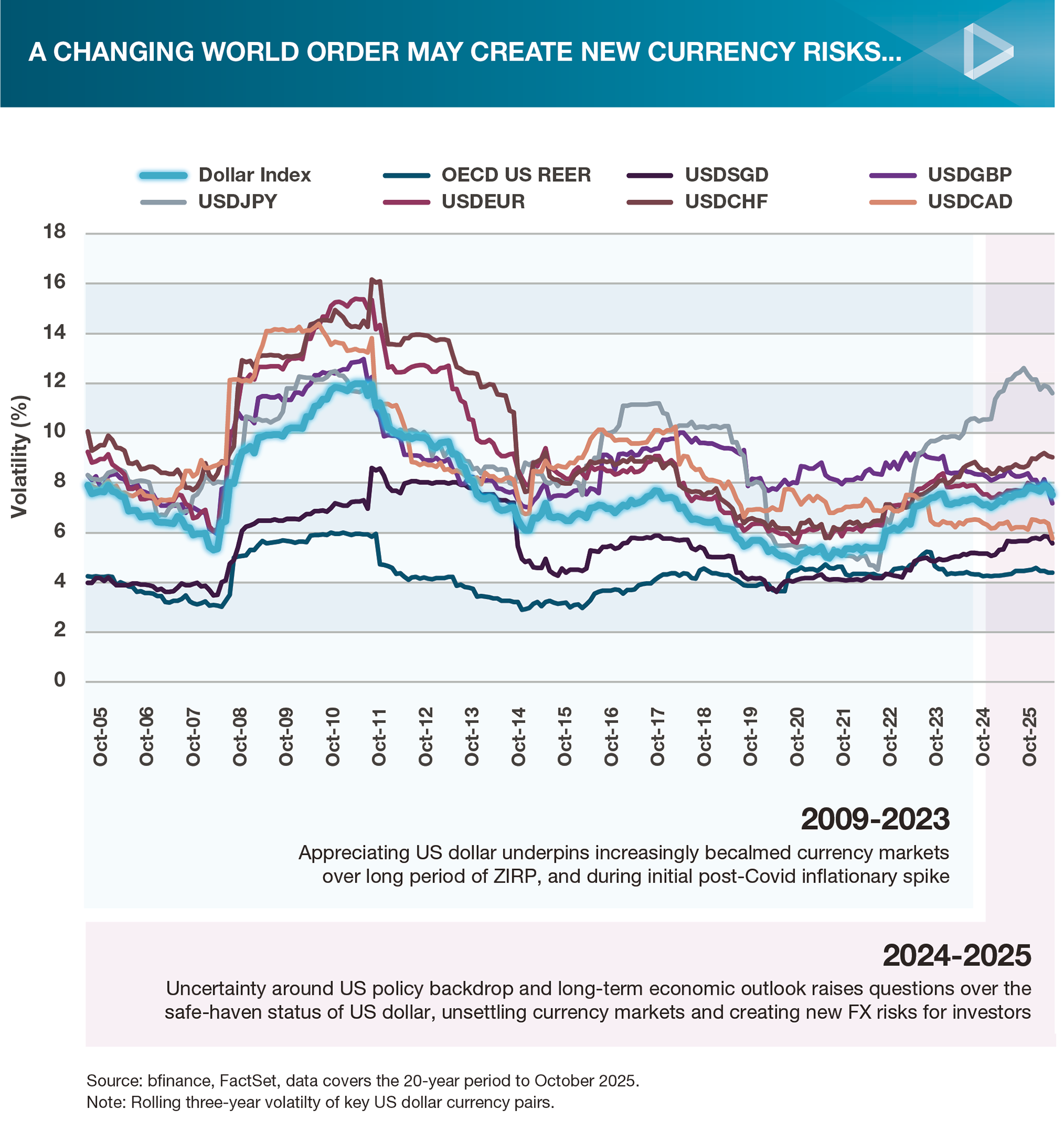
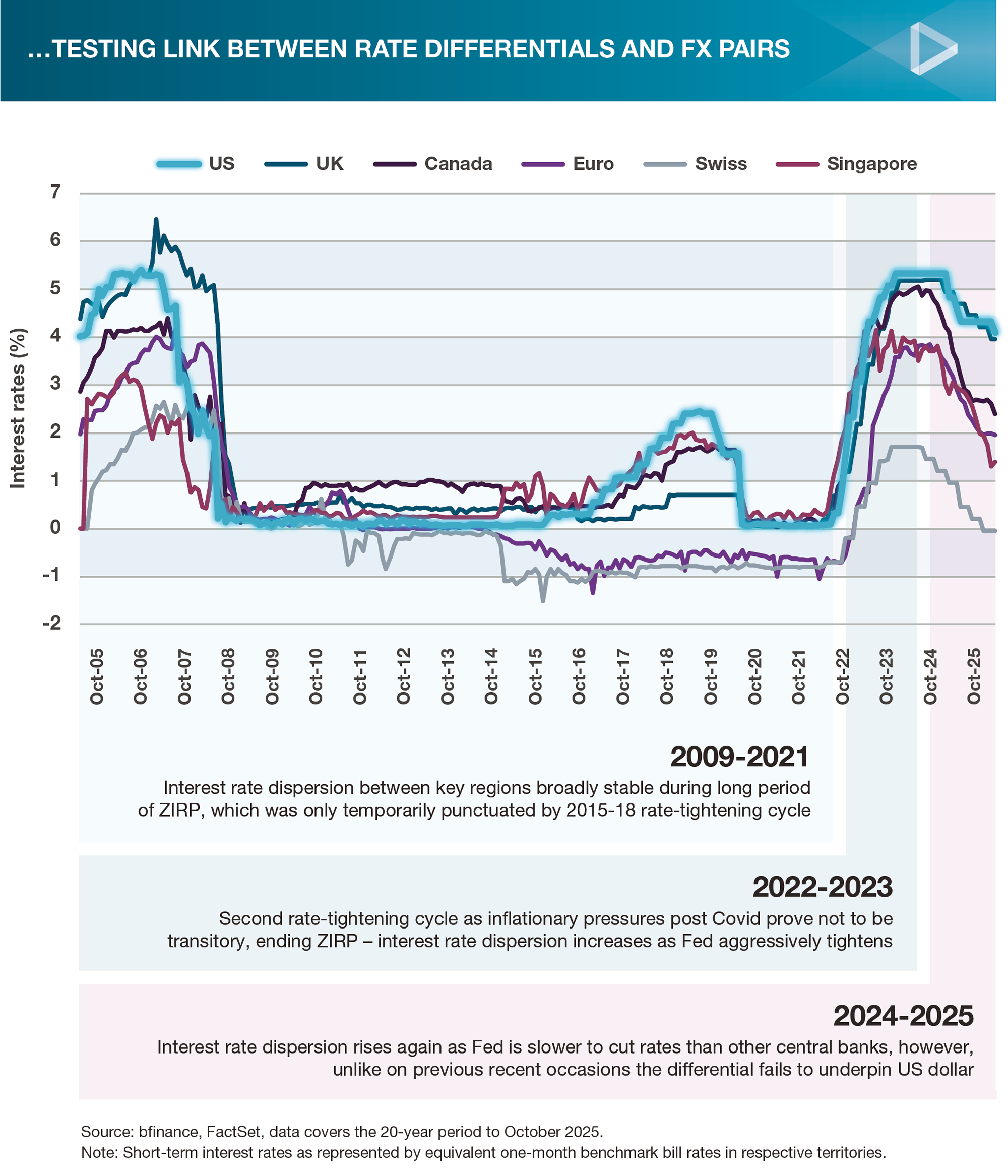
Currency-related questions rose up the agenda in 2022, when the end of the Zero Interest Rate Policy (ZIRP) era ushered in a period of rate divergence and higher intra-currency volatility. This transition did not greatly undermine existing strategy but did encourage moderate adjustment: FX hedges may have been tweaked; the attractiveness of dynamic approaches versus ‘set-and-forget’ strategies increased.
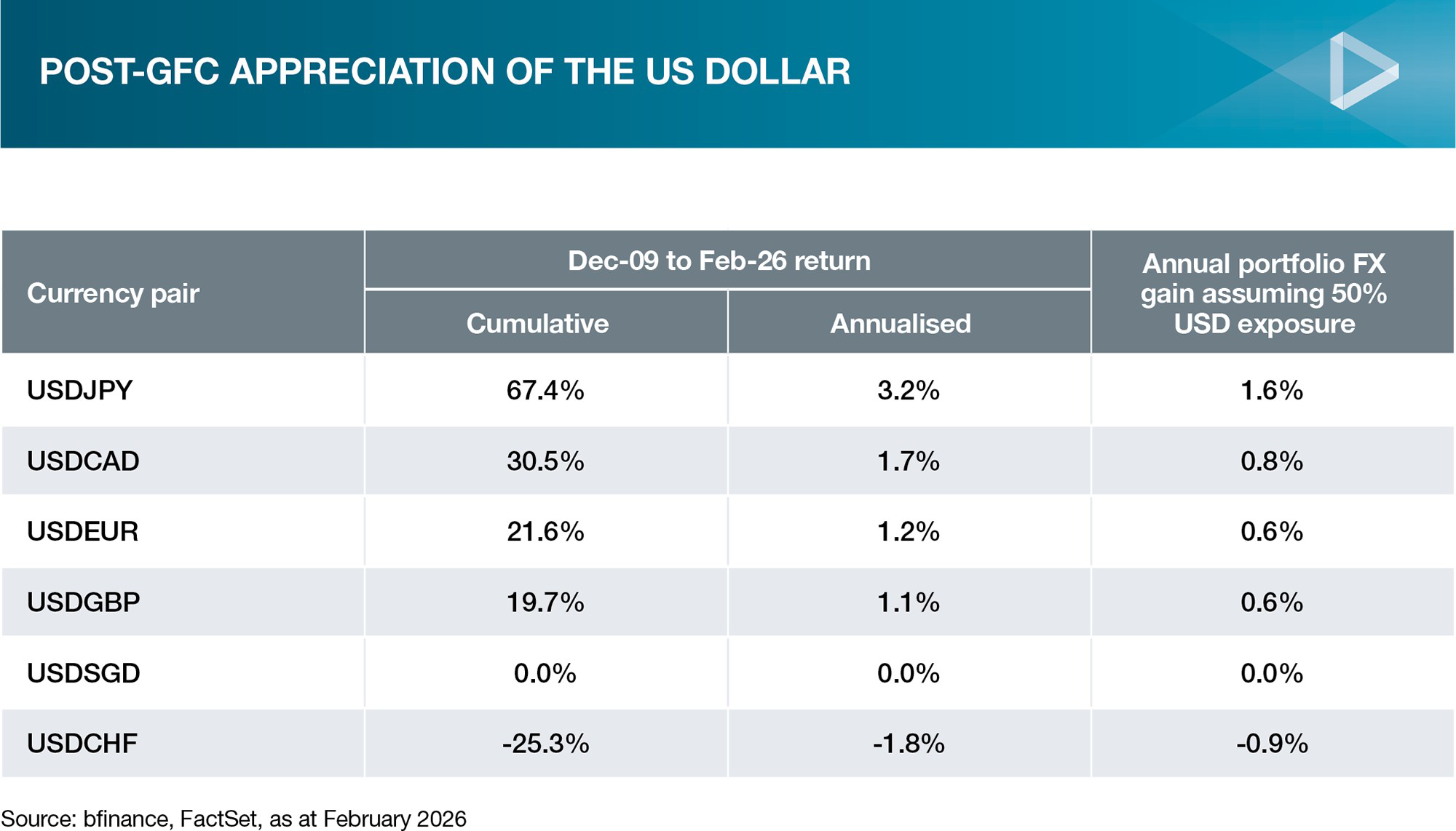
There was plenty of scope, however, for continued complacency. For example, many non-USD investors still benefited from maintaining low USD hedge ratios due to the dollar’s ongoing appreciation, as they had done throughout the post-GFC period (illustrated below). Moreover, the tendency for the dollar and certain other ‘safe haven’ currencies to strengthen when stock prices fall – the so-called ‘dollar smile’ or dollar safety blanket – continued to provide a natural buffer to risk asset shocks. Indeed, US exposures in many investors’ portfolios continued to grow in 2022-2024, driven by an increasingly US-heavy global equity market, growing allocations to illiquid investment strategies (many of which are US-biased) and a positive perception of US growth.
The questions raised by developments in 2025-6, however, are more fundamental. March-April 2025 was not the first occasion that US stocks and the US dollar both staged significant drops at the same time: although these dollar-smile-defying occurrences have been rare, March 2020 and May 2010 provided two fleeting examples. This time, however, does seem rather different. The US administration appears to be actively pursuing currency depreciation alongside tariffs in a bid to improve trade competitiveness. The colloquially-named ‘Mar-a-Lago Accord’ echoes the ‘beggar-thy-neighbour’ currency devaluations that plagued the pre-Bretton Woods era. By year-end, the USD had declined by more than 8% against a basket of currencies, albeit during the first week or so of the Iran conflict the greenback has retraced its 2026 year-to-date-losses.
Many non-US investors moved to increase their hedging of US currency exposures in 2025, raising questions of both strategy and cost (As Investors Rethink FX, Are Hidden Costs Being Overlooked?). While the growing hopes at the end of 2025 for rate cuts from the Fed had made it somewhat less expensive for non-USD investors to reduce USD risk, a surge in hedging activity (commented on by the likes of Deutsche Bank) exerts further downward pressure on the dollar’s value and may also create liquidity shortages in typically liquid trades, as a senior UBS trader recently warned. Meanwhile, USD-base investors are theoretically able to reap returns from dollar depreciation but are not necessarily nimble enough to take advantage of this theme. Investors that use USD as their base currency but require non-US purchasing power (e.g. to meet non-US liabilities or financial commitments) found themselves materially disadvantaged.
Heightened geopolitical tensions and protectionism are accelerating the fracture of post-war multilateralism and potentially pushing so-called ‘dollar privilege’ – a privilege sustained by consistency and stability more than economic fundamentals – to its limit. Economic and fiscal challenges are also evident, of course, and the USD is not alone among ‘safe haven’ currencies in this respect thanks to soaring debt and deficit levels in many countries. These are not problems that can be risk-managed away with ease.
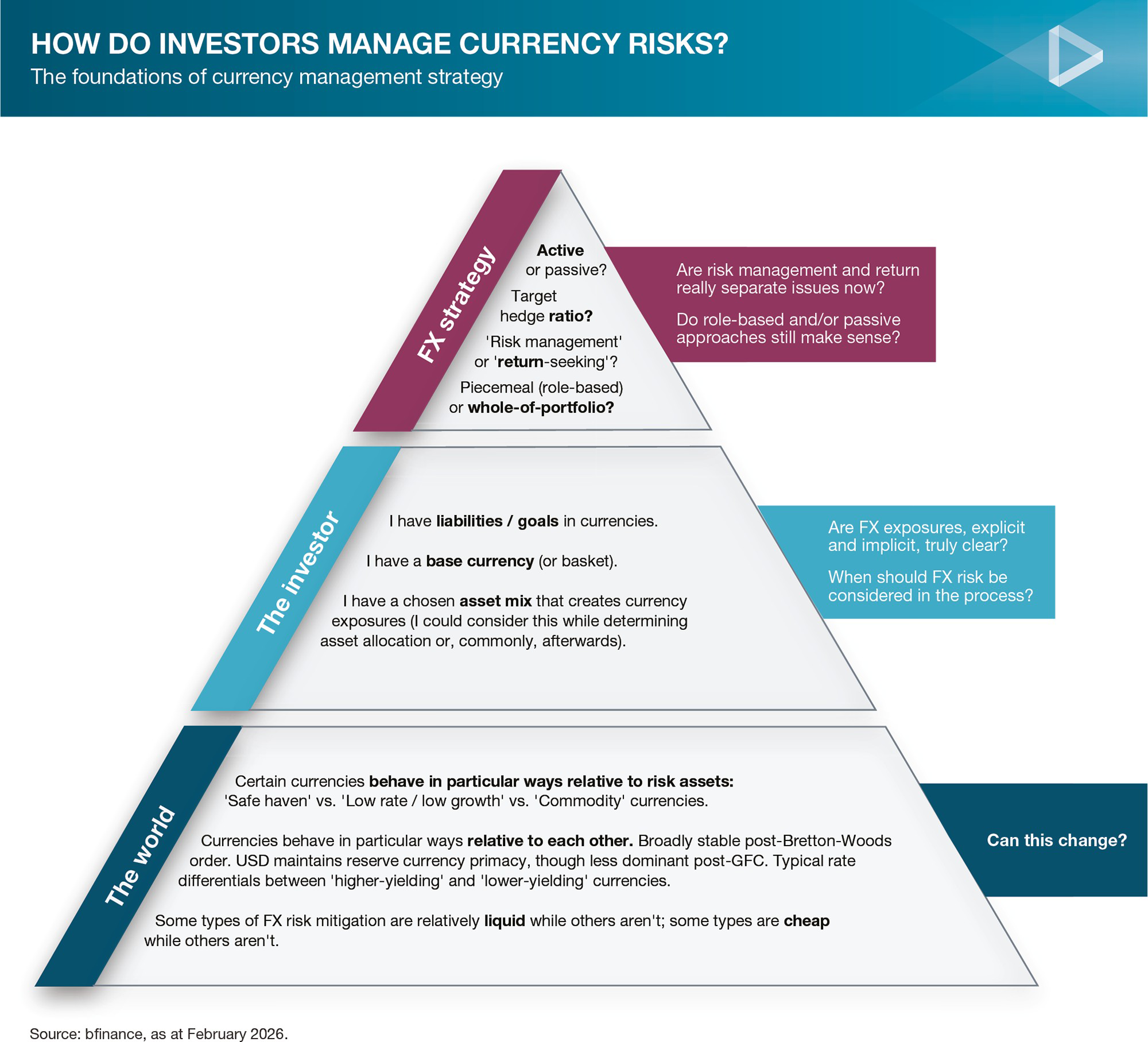
Generalisations are always problematic. This is especially true for the landscape of institutional investors in different countries – pension funds, insurers, family offices, endowments, sovereign wealth funds, foundations, the list goes on – with their diverse profiles and goals. That being said, we observe that many asset allocators’ investment policies still treat currency management as an afterthought – vaguely defined, inconsistently interpreted and somewhat disconnected from broader portfolio objectives. #NotAllInvestors
Policy documents are often intentionally ambiguous when it comes to setting target currency exposures: this may be viewed as an intentional choice to allow flexibility but can reflect a lack of strategic thinking or focus. Many investors are guided by a strategic hedge ratio, such as a 50:50 hedge, sometimes called the ‘hedge of least regret’. Yet this ratio may or may not be clearly justified within the investment policy. The subject may be handled at whole-of-portfolio level, but many investors deal with it on an asset class-specific basis (‘role-based hedging’), such as hedging bonds but not equities due to the presumed relationship between certain currencies and risk assets as well as the importance of predictability in the fixed income component.
When looking further into the practicalities of implementation, we find that there is often a lack of operational efficiency, both in high-level choices (where/how should exposures be managed) and finer details (execution quality, rebalancing frequency). ‘Cost’ is too-often viewed in a two-dimensional manner in a space where the visible fees represent only a tiny fraction of true cost. Certain challenges may be new and unfamiliar, such as the difficulties of hedging FX risk in private markets, where irregular NAV reporting can introduce substantial basis risk.
‘Currency as an afterthought’ is not inherently problematic: it was a perfectly valid response, for a long time, to a world in which the relationships between various currencies were often uneventful. They were not boring by accident: they were boring by design, underpinned by a world order that was intentionally created to foster stability, facilitate trade and promote growth. They may well be boring no longer.
Today, we would argue that currency management deserves the same strategic attention as asset allocation. Investors should test the validity of existing FX management approaches, giving sharp focus to the foundational precepts that underpin them.
Important Notices
This commentary is for institutional investors classified as Professional Clients as per FCA handbook rules COBS 3.5R. It does not constitute investment research, a financial promotion or a recommendation of any instrument, strategy or provider. The accuracy of information obtained from third parties has not been independently verified. Opinions not guarantees: the findings and opinions expressed herein are the intellectual property of bfinance and are subject to change; they are not intended to convey any guarantees as to the future performance of the investment products, asset classes, or capital markets discussed. The value of investments can go down as well as up.