English (Global)
  Français (France)
  Deutsch (DACH)
  Italiano (Italia)
  Dutch (Nederlands)
  English (United States)
  French (Canada)
bfinance insight from:

Ishan Issadeen
Head of Real Estate
M&A activity, such as the recent news of the combination of the Columbia Threadneedle and PATRIZIA UK property funds, and last year's merger of funds run by Federated Hermes and L&G fits a neat narrative. A common refrain is that the UK commercial property sector, worn down by a longer and deeper redemption cycle than its peers, must use M&A to restructure, reposition away from traditional assets towards next-generation sectors, and in doing so regain relevance.
As first published in Green Street News
That reading is not wrong, but it may be incomplete. We draw on the bfinance Platform database, which covers 165 open-ended core and core-plus real estate funds globally and around $500 billion of assets under management, to flag five charts which tell a different story. These datapoints suggest that the very features the 'stranded' narrative treats as weaknesses, namely a traditional, income-led and low-leverage tilt, can also be seen as sources of resilience.
That is a quality which asset allocators are prizing more highly in a less predictable world.
UK property fund returns have been more consistent…
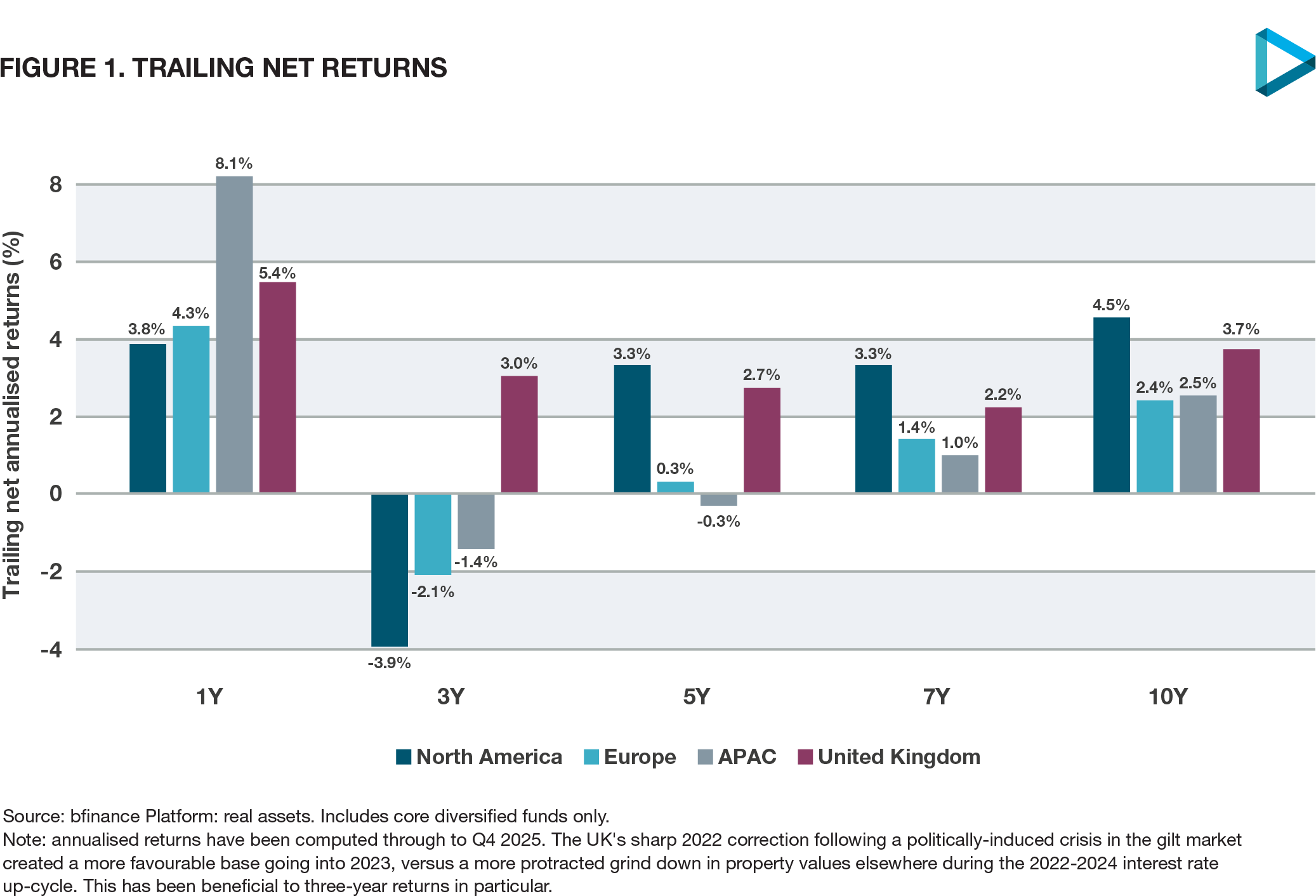
Consider returns first. Examining data for core diversified funds, over the past decade UK strategies have delivered steadier net returns than North America, Europe or APAC (see chart, below). Some of this steadiness is presentational, reflecting the smoothing effect of UK valuation policy whereby valuations are slower to adjust in the absence of comparable market transaction data.
Some is structural as the UK universe includes a selection of long-lease funds that are designed to generate stable, income-led returns. However, some of it is simply down to timing: the UK's sharp 2022 correction following a politically-induced crisis in the gilt market created a more favourable base going into 2023, versus a more protracted grind down in property values elsewhere during the 2022-2024 interest rate up-cycle. This has been beneficial to three-year returns in particular.
…underpinned by relatively higher income vs other regions
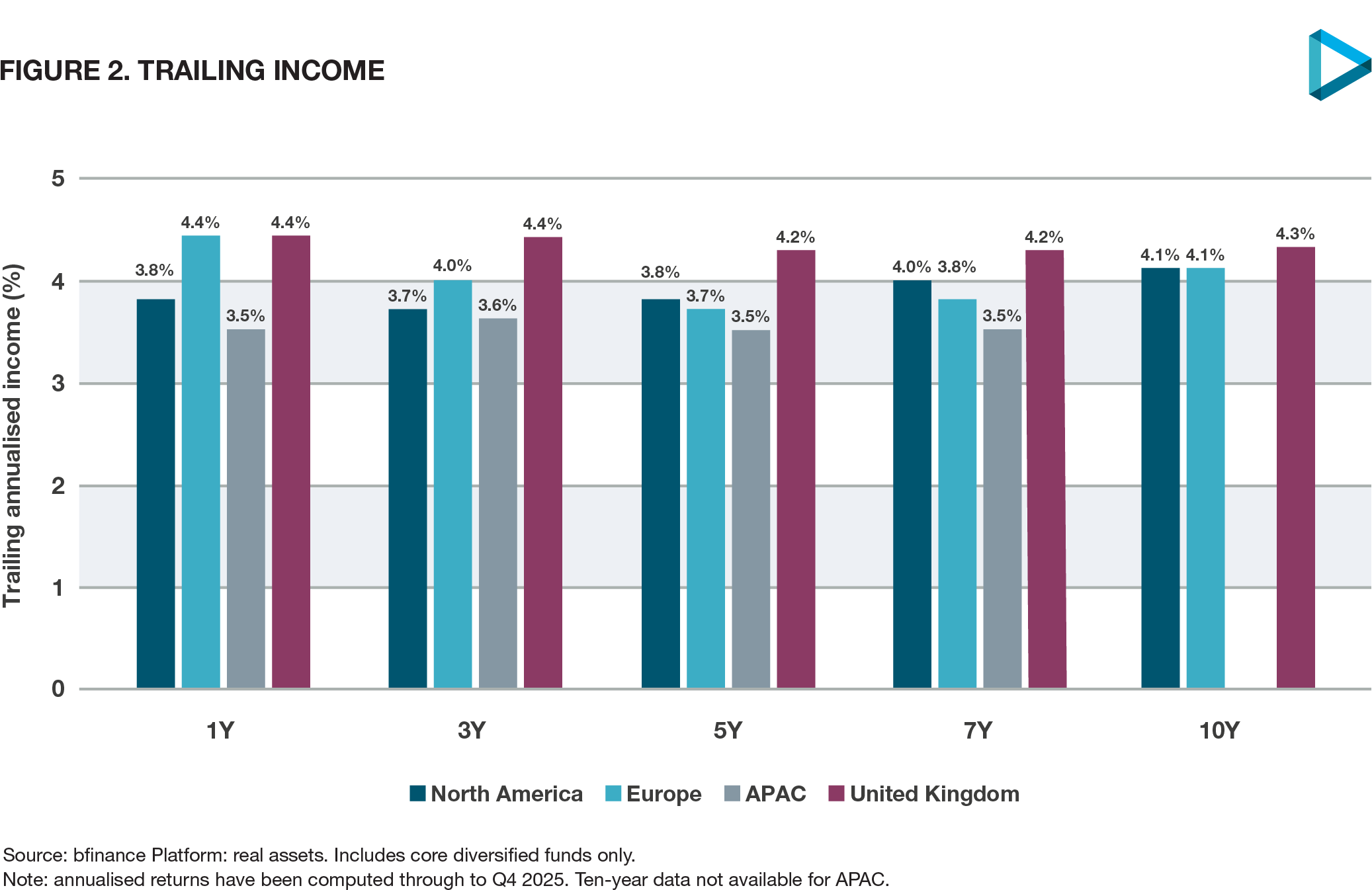
That steadier profile has come with more income, not less. UK funds have produced the highest trailing income of any region across every period shown (see chart, below). Three factors drive this. Most UK funds are unlevered, so there are no financing costs to offset against the income received. Long-lease strategies are income-led by design, with returns driven less by capital appreciation. And the UK's smaller weight to the lower-yielding multifamily sector lifts the average.
The absence of leverage is a standout point and is in sharp contrast to other regions: regulatory discouragement after the 2007/08 Global Financial Crisis, an investor base of UK pensions and insurers with their own restrictions, and a legacy of unlevered retail structures have all made low or no gearing the UK norm.
Long-lease property is a greater part of the UK property mix
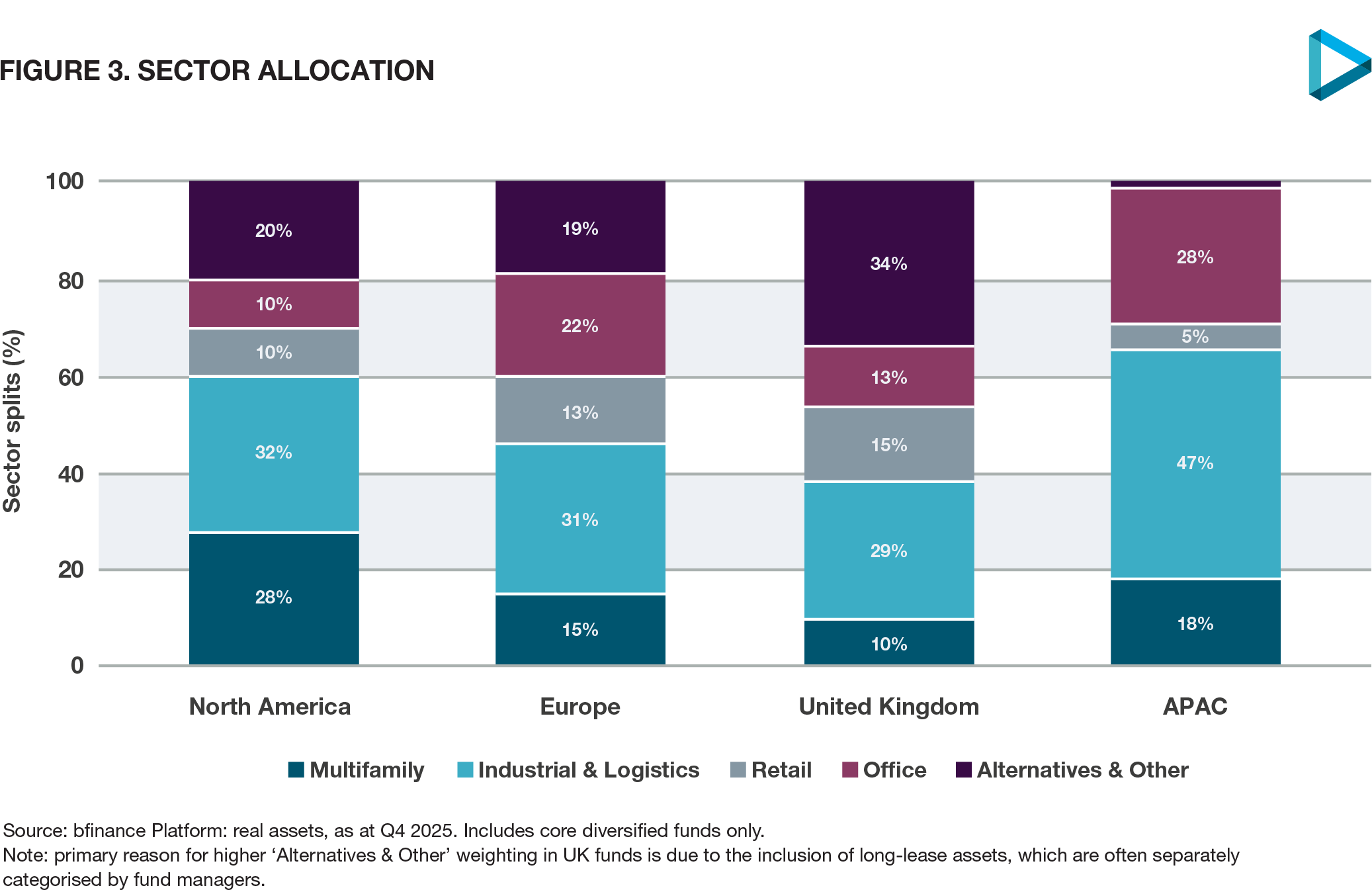
The UK carries a distinctly different mix from the US and Europe: the already cited low multifamily exposure reflects a build-to-rent sector that is younger (versus the US in particular), and UK funds are also relatively underweight to the office sector.
The latter is in part due to the inclusion of long-lease funds that focus on properties let on long, inflation-linked leases to high-quality tenants in areas such as supermarkets, logistics warehouses, healthcare facilities and government-backed properties. The outsized 'Alternatives & Other' exposure of UK funds is partly attributed to such long-lease assets as opposed to alternative sectors such as senior living, student housing, single-family living, healthcare, self storage and data centres, albeit this latter group is also seeing increasing traction within fund portfolios.
UK fund outflows have been greater...
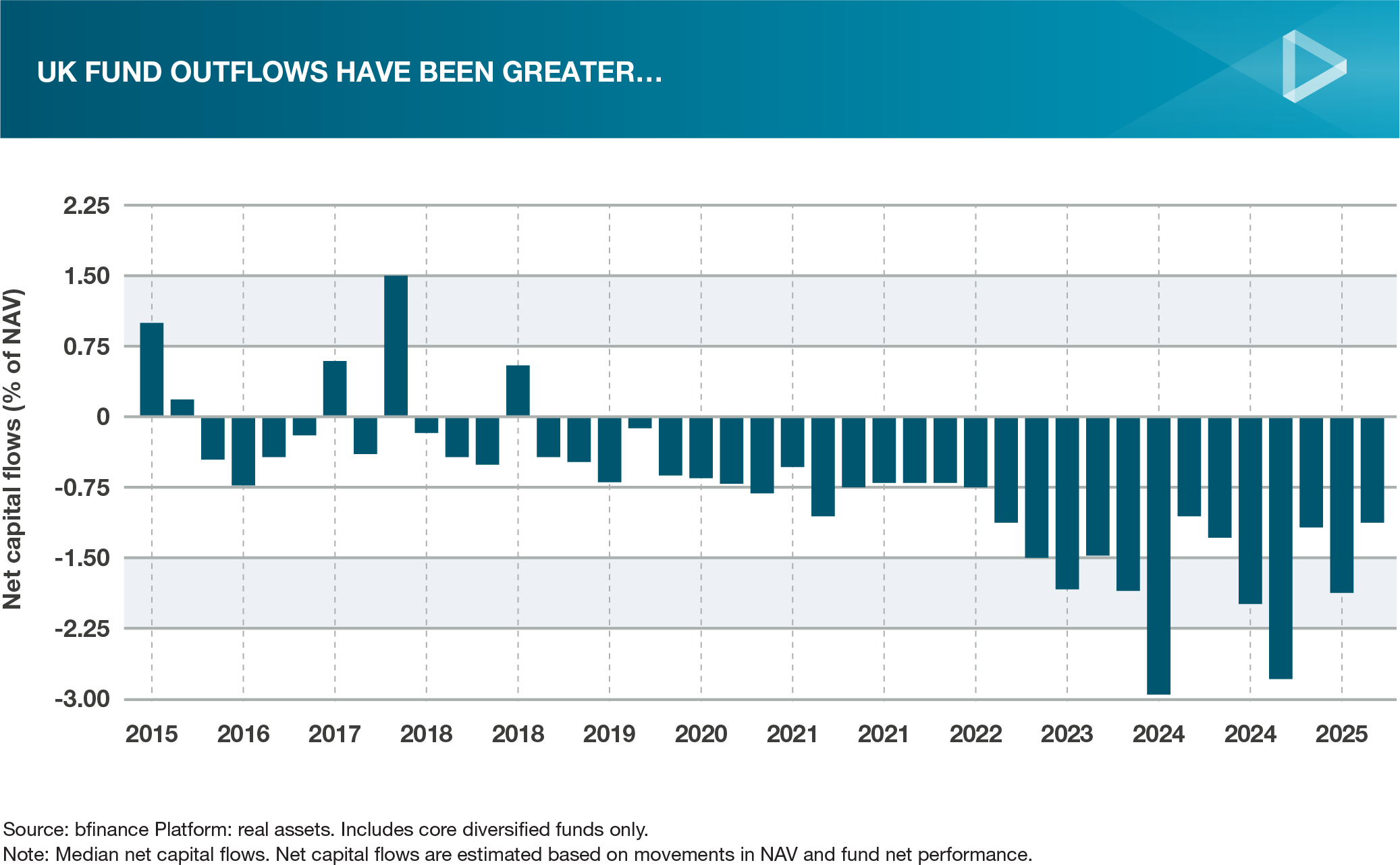
None of this is to dismiss the redemption story, which is real (see chart, below). UK funds have seen near-continuous net outflows since 2019, with the trend starting earlier and deepening to around 3% of net asset value within a single quarter at the 2024 low. A long list of factors has contributed: nervousness following daily-dealing funds gating investors, the macro drag of Brexit, the 2022 'mini-budget' (aforementioned gilt crisis), higher rates and the steady de-risking of UK defined benefit (DB) pensions.
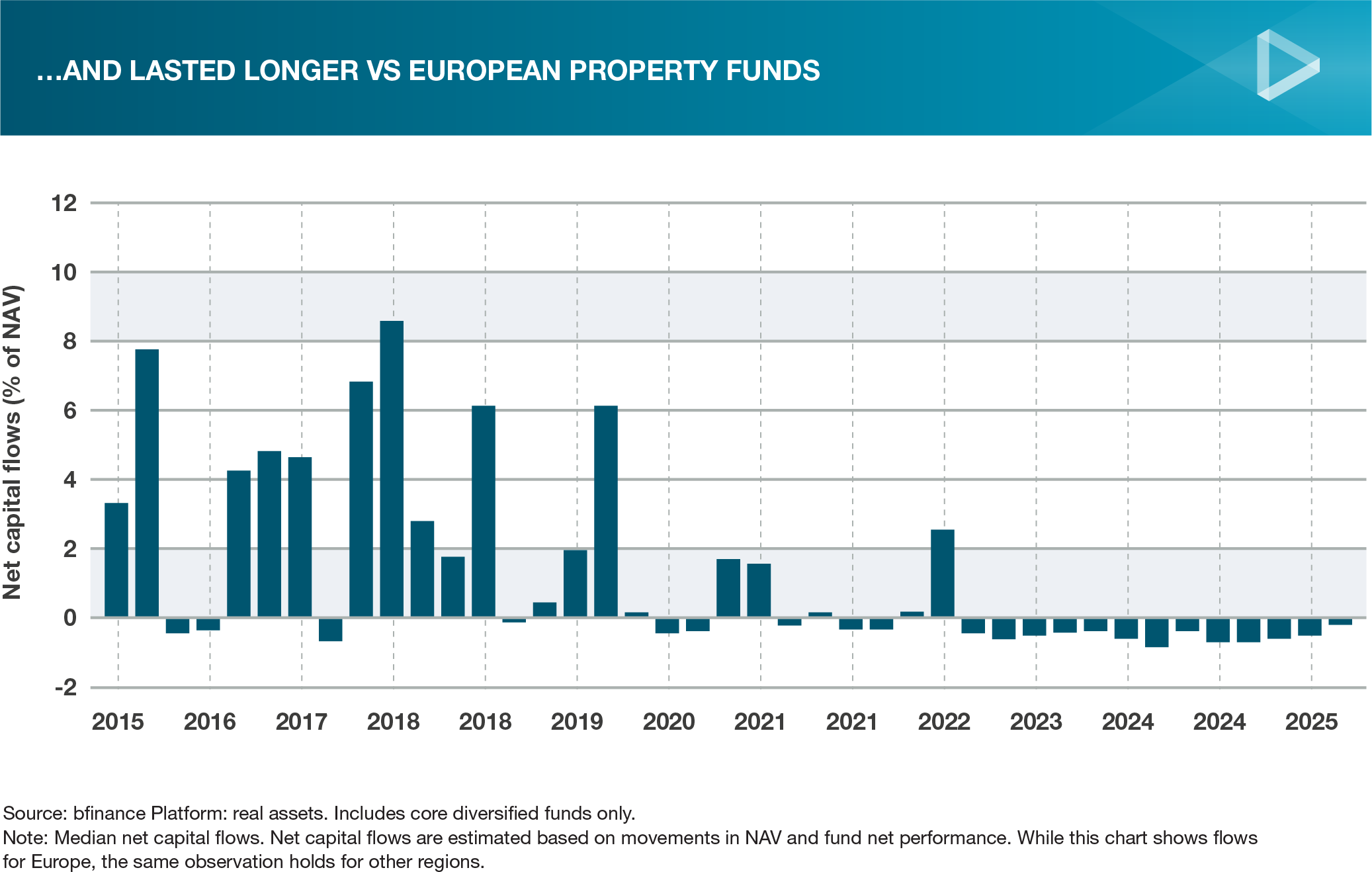
…and lasted longer vs funds from other regions
Set against Europe for example, the contrast is stark (see chart, below). European funds enjoyed strong inflows into 2019 and only mild, shorter-lived outflows thereafter, whereas the UK's outflows have been both larger and more persistent. It is this asymmetry, in part, that underpins the existential framing applied to the sector, and the argument that consolidation must be transformational if relevance is to be restored.
Persistent outflows have, much as in the US Core segment, left many UK funds anchored in legacy positions and less able, rather than less willing, to build exposure to alternatives, precisely because they have spent recent years managing redemptions rather than deploying inflows (see Back in the Black? Real Estate 'Recovery' Raises Strategy Selection Questions). The consensus reads that as a structural flaw.
Whether that is a bug or a feature depends on what an allocator is trying to achieve. Recent bfinance client work points to a shift towards resilience, as investors adapt to a more fragmented and less predictable world. For real assets specifically, the investment case increasingly rests on stable inflation-linked income and low correlation to public markets rather than on capital-appreciation stories. On those terms, a traditional, unlevered, income-heavy benchmark is not obviously the poor relation the M&A narrative implies.
Such a narrative also obscures other important points of differentiation, such as UK funds scoring well from an ESG perspective, partly as a result of buy-in from the Local Government Pension Scheme network. Larger UK DB schemes are also pursuing their own sustainability goals, alongside a push from regulators for more stringent building efficiency standards.
All this is not to say the UK sector needs no change, but simply to question whether the reflex to treat traditional as a synonym for stranded is a helpful one. Amid a search for resilience, allocators might reasonably ask whether a lower-leverage, higher-income UK property allocation has appeal, though the answer may depend on continued consolidation activity and a recovery in investor appetite to restore the liquidity conditions that would make re-entry practical.
Important Notices
This commentary is for institutional investors classified as Professional Clients as per FCA handbook rules COBS 3.5R. It does not constitute investment research, a financial promotion or a recommendation of any instrument, strategy or provider. The accuracy of information obtained from third parties has not been independently verified. Opinions not guarantees: the findings and opinions expressed herein are the intellectual property of bfinance and are subject to change; they are not intended to convey any guarantees as to the future performance of the investment products, asset classes, or capital markets discussed. The value of investments can go down as well as up.