English (Global)
  Français (France)
  Deutsch (DACH)
  Italiano (Italia)
  English (United States)
  English (Canada)
  French (Canada)
bfinance insight from:

Toby Goodworth
Managing Director, Head of Liquid Markets
The 'pull' of strong performance is combining with 'push' factors (related to concerns around the effectiveness of traditional asset classes) to drive investors towards hedge funds. It’s not often that both forces are in sync like they are today – such alignment has certainly been rare during my two-decades plus experience in the industry.
Against the backdrop of stretched equity valuations and tight credit markets, clients are looking at hedge funds to diversify both their equity and fixed income exposures. More broadly, hedge funds continue to draw interest as the diversification qualities of bonds remain under debate, while elevated allocations to illiquid private markets are throwing a spotlight on the more liquid alternative options.
The level of client conversations and engagement around hedge funds – which is often a pre-cursor to search activity at bfinance – signify to us pronounced near-term appetite for the asset class. As such, we expect similar or higher levels of client hedge fund search activity in 2026 than we saw 2025, itself the third year of strong appetite following a bounce-back from pre-Covid lows.
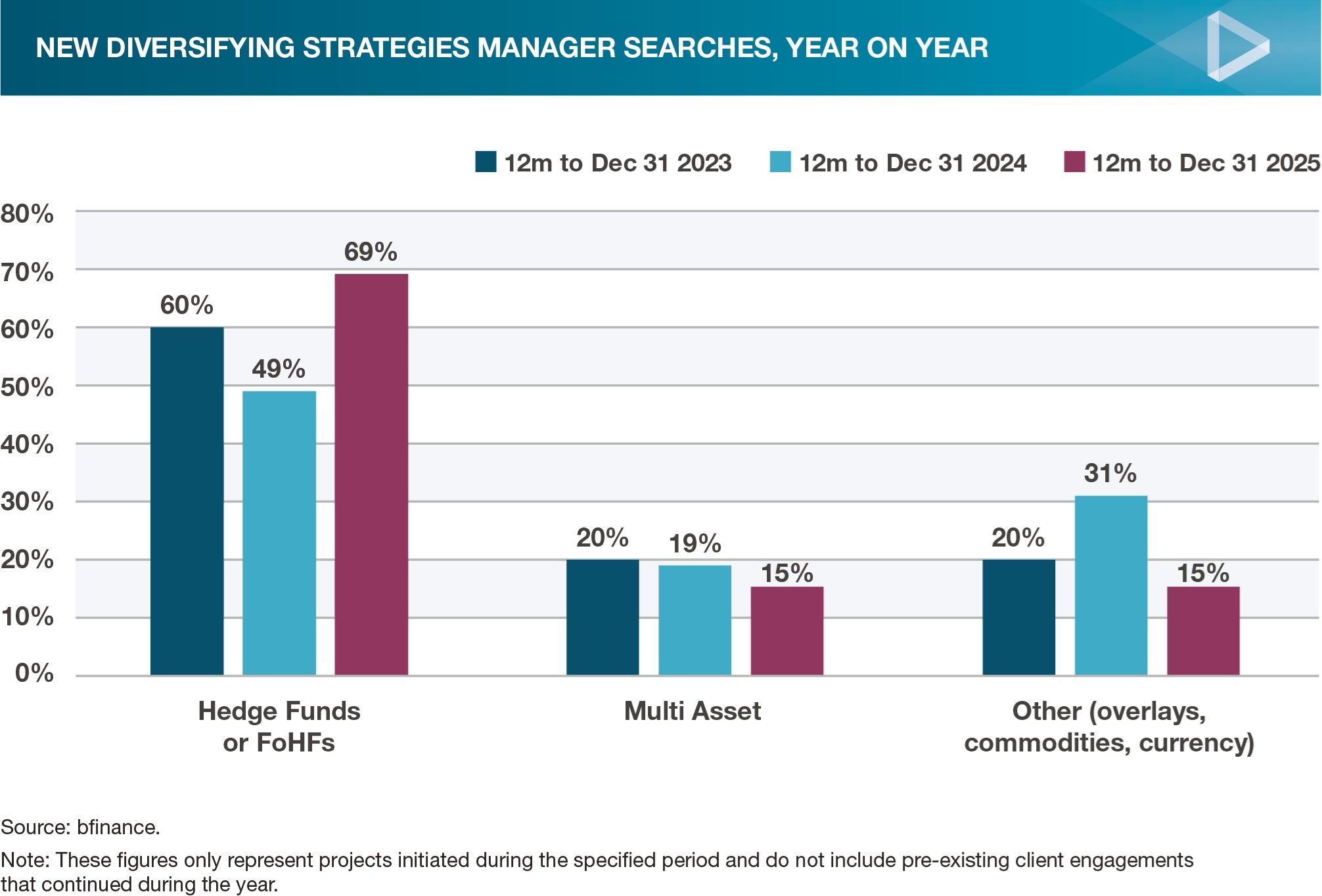
Our view of increased activity in the sector is not unique. It is very much in line with others across the industry – a recent report from one of the leading prime brokers cited record levels of satisfaction and interest levels at their most elevated since the 1990s.
Push factors drive activity from new hedge fund clients
A great strategic asset allocation rule of thumb quoted to me recently by a large industry participant was that whatever you might have allocated to hedge funds in the past, “just double it”. Whilst not the most technical of arguments, it clearly conveys current investor sentiment.
Client activity has not just been restricted to existing users of hedge funds either – we are also seeing new allocators to the asset class. We are at a point now where the messaging we are getting from these new clients is that they now can’t afford not to look at hedge funds, even if they haven’t used them in the past.
By client type, the biggest change in interest has been from wealth management groups. Typically, the ask here is to support them with the implementation of a new liquid alternatives programme, or to help refresh existing programmes. Again, this is driven by the mantra that these groups can’t afford to ignore these strategies in the current environment.
Potential for all hedge fund categories to perform well
In an effort to demystify the hedge fund landscape, we classify the myriad hedge fund strategies into a trio of return style groups – market independent/non-directional, directional and convex/divergent (See figure 4 on page 5 of our paper here: How to Build a Hedge Fund Allocation). We see a positive environment in 2026 for strategies within all three of these categories. Last year was dominated by market independent hedge fund searches, both market independent multi-strategy and equity market neutral.
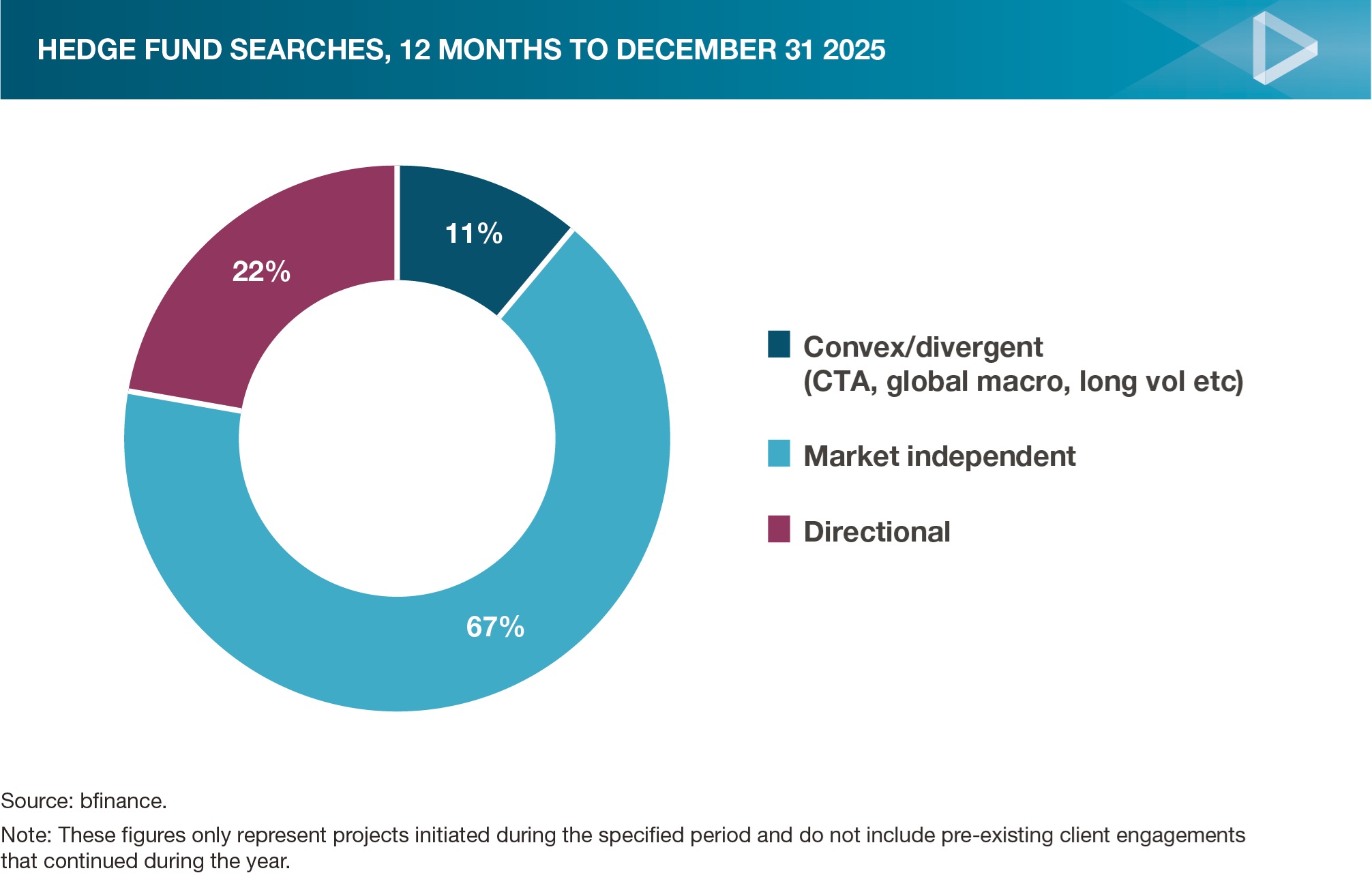
This made perfect sense as investors capitalised on the sustained high level of alpha these strategies have delivered, at a time when traditional risk assets have had less certainty about them. In addition to the strong performance pull (where elevated volatility and stock-level dispersion provided a rich opportunity set for long/short strategies), beta neutrality was a big push amid stretched equity valuations and tight credit markets.
We expect these strategies to remain a well-used portfolio tool in 2026.
Not all hedge fund strategies delivered high-single digit or double-digit gains last year. Notably, the first half of 2025 was a tough time for CTA and trend-following managers, with the turbulence of 'liberation day' causing an almost perfect storm.
Against that backdrop it was perhaps unsurprising that only 11% of our search activity was for these and other divergent strategies – and those searches mainly resulted from programme build-outs, where the overall solution required CTAs, rather than clients proactively searching for CTAs on a standalone basis.
Appetite for CTAs, however, has begun to rebound following strong performance from pure-play trend strategies in the first month of 2026, helping CTAs build on their valiant H2 2025 recoveries. We expect interest to continue to develop this year, due to the pull of improving performance and the usefulness of such divergent strategies within client portfolios.
Meanwhile, across the market independent and directional strategies, we should note that event driven managers are forecasting one of the strongest environments this century for M&A activity as regulatory headwinds in the US subside.
This should be good news at a high level for both directional event driven funds as well as market independent merger arbitrage strategies. Historically, we have seen somewhat limited client appetite in this area, but expect that to change going forwards.
Foreign exchange moves from afterthought to front of mind
Outside of the hedge fund arena, active FX overlays were another relative bright spot in 2025 that we expect to remain an area of strong client activity in 2026. Activity here centred on investors in pro-cyclical currency countries such as Australia and Canada and was quite varied by client type, spanning the more traditional pension plan type users, right through to larger single family offices.
Much of the appetite here has been driven by the current more volatile and disperse FX environment. We have seen clients abandoning FX hedging approaches that they had successfully used for many years through the less volatile low interest rate era. Typically these approaches were static hedging policies or simple internal hedging models, which appear to have now failed in the current more geopolitically volatile world.
As a result of the current environment, coupled with pronounced US dollar weakness last year, the general client consensus is that a more active approach to managing currency risk is likely to be beneficial. We are seeing clients change their investment approach accordingly by looking to appoint external FX specialists to manage portfolio currency risk.
Looking ahead to the rest of 2026, we expect strategic interest in FX overlays to remain elevated as long as macro uncertainty remains.
Important Notices
This commentary is for institutional investors classified as Professional Clients as per FCA handbook rules COBS 3.5R. It does not constitute investment research, a financial promotion or a recommendation of any instrument, strategy or provider. The accuracy of information obtained from third parties has not been independently verified. Opinions not guarantees: the findings and opinions expressed herein are the intellectual property of bfinance and are subject to change; they are not intended to convey any guarantees as to the future performance of the investment products, asset classes, or capital markets discussed. The value of investments can go down as well as up.