English (Global)
 Français (France)
 Deutsch (DACH)
 Italiano (Italia)
 English (United States)
 English (Canada)
 French (Canada)

bfinance insight from:

Managing Director, Head of Liquid Markets

Managing Director, Private Markets Advisory
Portfolio construction has become more complex in the turbulent twenties as the macroeconomic consequences of a less predictable world reshape markets – this is the clear message we’re getting from asset allocators. Client conversations, results from various polls and bfinance project data all seem to converge on the same question: ‘How should we allocate under new constraints?’
Less abundant liquidity, less predictable correlations and less assured sources of growth in a higher-for-longer interest rate environment are both raising the bar for risk assets and bringing into question foundational assumptions. Taking three themes in turn: liquidity and adaptability, real assets and the inflation hedge, and fee and cost optimisation, we examine the opportunities, threats and portfolio weak spots for asset allocators in 2027.
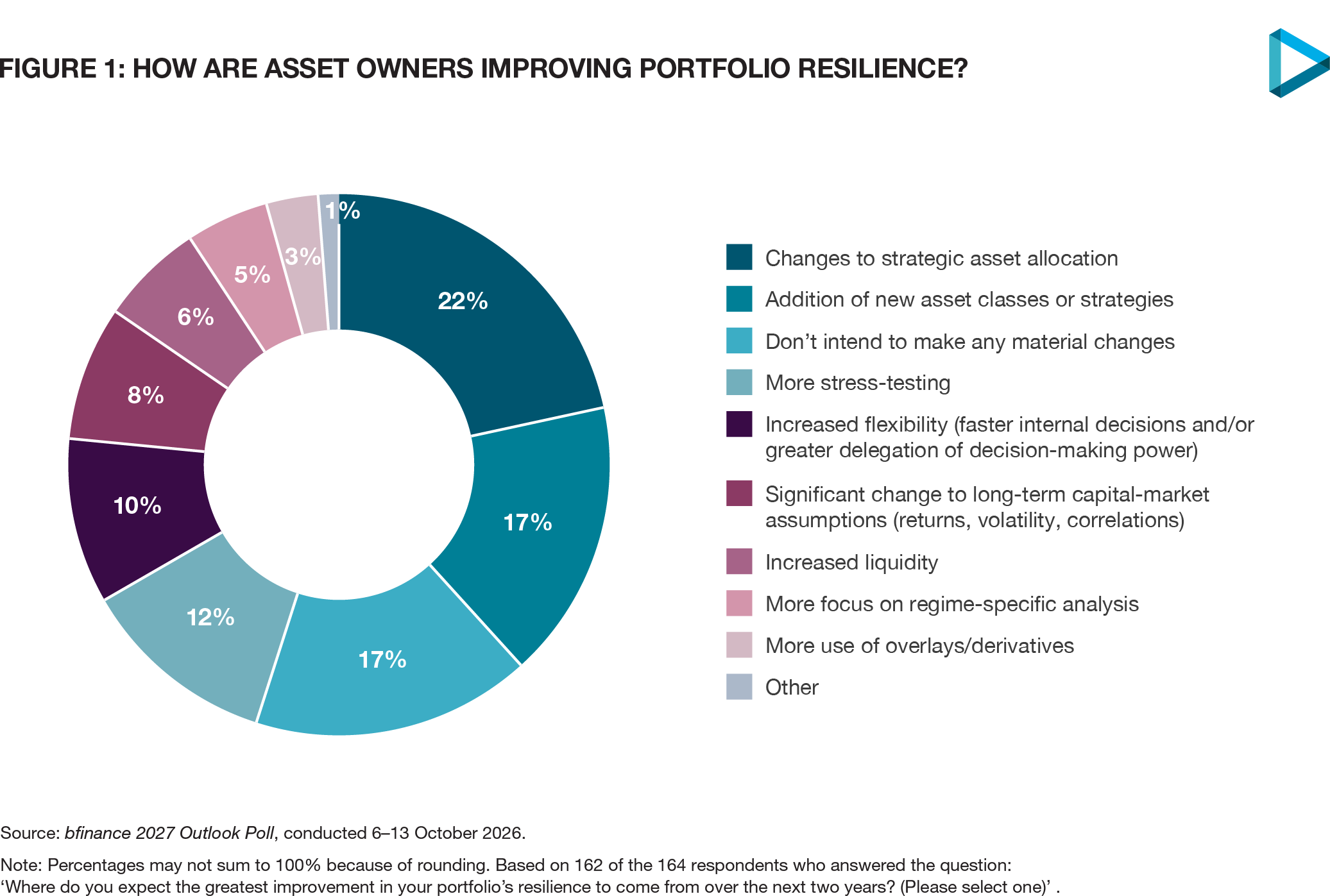
Insufficient liquidity ranked first among the factors respondents to the bfinance 2027 Outlook Poll said would limit their ability to react to market stress. More broadly, but related, asset allocators are adapting portfolios – with only a minority not intending to make material changes – as set formulae give way to a more active approach in search of portfolio resilience (see Figure 1, below).
THEME 1: Liquidity and adaptability
On many levels, resilience is the ability to adapt, and adaptability often requires liquidity – so it’s no surprise to us that our polling reveals liquidity is in demand both at a tactical (responsiveness to market stress) and strategic level. A net 7% of asset allocators tell us they intend to increase overall portfolio liquidity over the next two years, a 15-point reversal from a net 8% who reported decreases over recent years (see Figure 2, below).
That said, some of the adjustments to the turbulent twenties might require recalibrating. For instance, following the 2022 bond-equity correlation breakdown we suspect many allocators are light on duration, having trimmed exposures to government bonds as they leaned into private debt. And, judging by the swing to increase duration within public fixed income allocations over the next two years, there may be a desire to walk back on some of this.
Special 2027 Outlook topic
Artificial intelligence
While many of the themes of recent years – increasing allocations to infrastructure, private credit, and liquid alternatives – seem to be persisting, new ones are emerging. Could the 23-point swing towards fixed income duration (from a net 7% reporting reduction in recent years to net 16% expecting to increase duration over the next two) signal allocators seeing a weak spot in their portfolios to some of the less favourable economic scenarios? Are they buying back some insurance against an equity market correction linked to an economic growth disappointment, for instance?
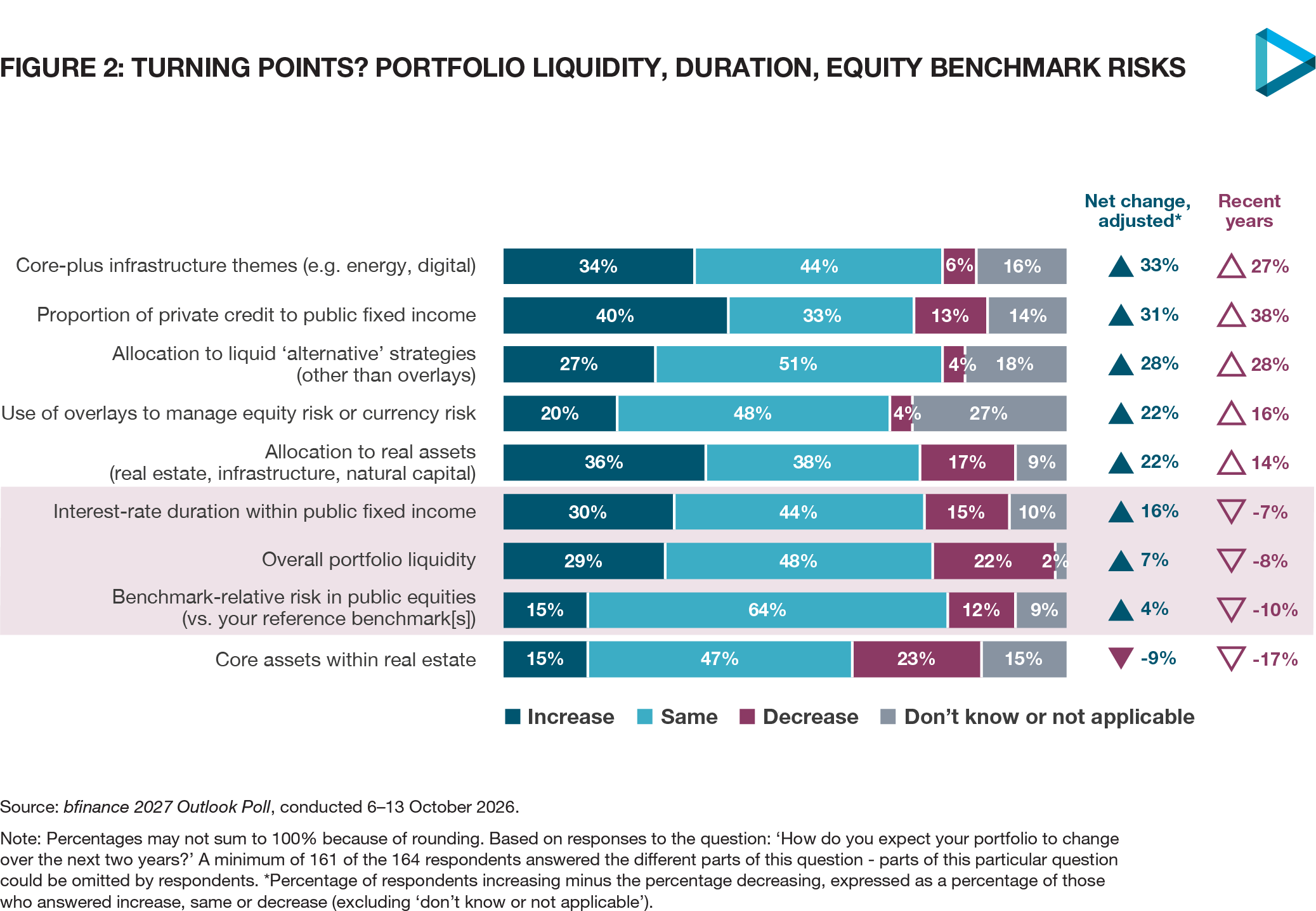
That said, doubts about the reliability of the bond-equity correlation remain and seem to be feeding into a desire to allocate across a broader range of asset classes or strategies. When this concern is combined with current fears around the reliability of broad equity market beta (note the swing towards benchmark-relative risk in public equities), it is no surprise sentiment towards liquid alternatives remains positive, with a net 28% of allocators seeking to increase allocations over the next two years.
Indeed, we see hedge funds as a key opportunity as ‘push’ factors driving investors to new assets and strategies converge with the ‘pull’ of strong performance. While performance dispersion is high, the most able hedge fund managers are capitalising on the resumption of useful levels of market volatility as the straitjacket of zero interest-rate policies (Zirp) has come off in a more fragmented, increasingly multi-polar world.
We group hedge funds, overlays and other liquid alternatives as ‘diversifying strategies’, a third pillar of portfolio construction rather than a substitute for equities or a replacement for bonds. Hedge funds can stabilise outcomes when traditional relationships such as the negative equity-bond correlation break down, or replace a portion of broad equity market beta with more consistent sources of return.
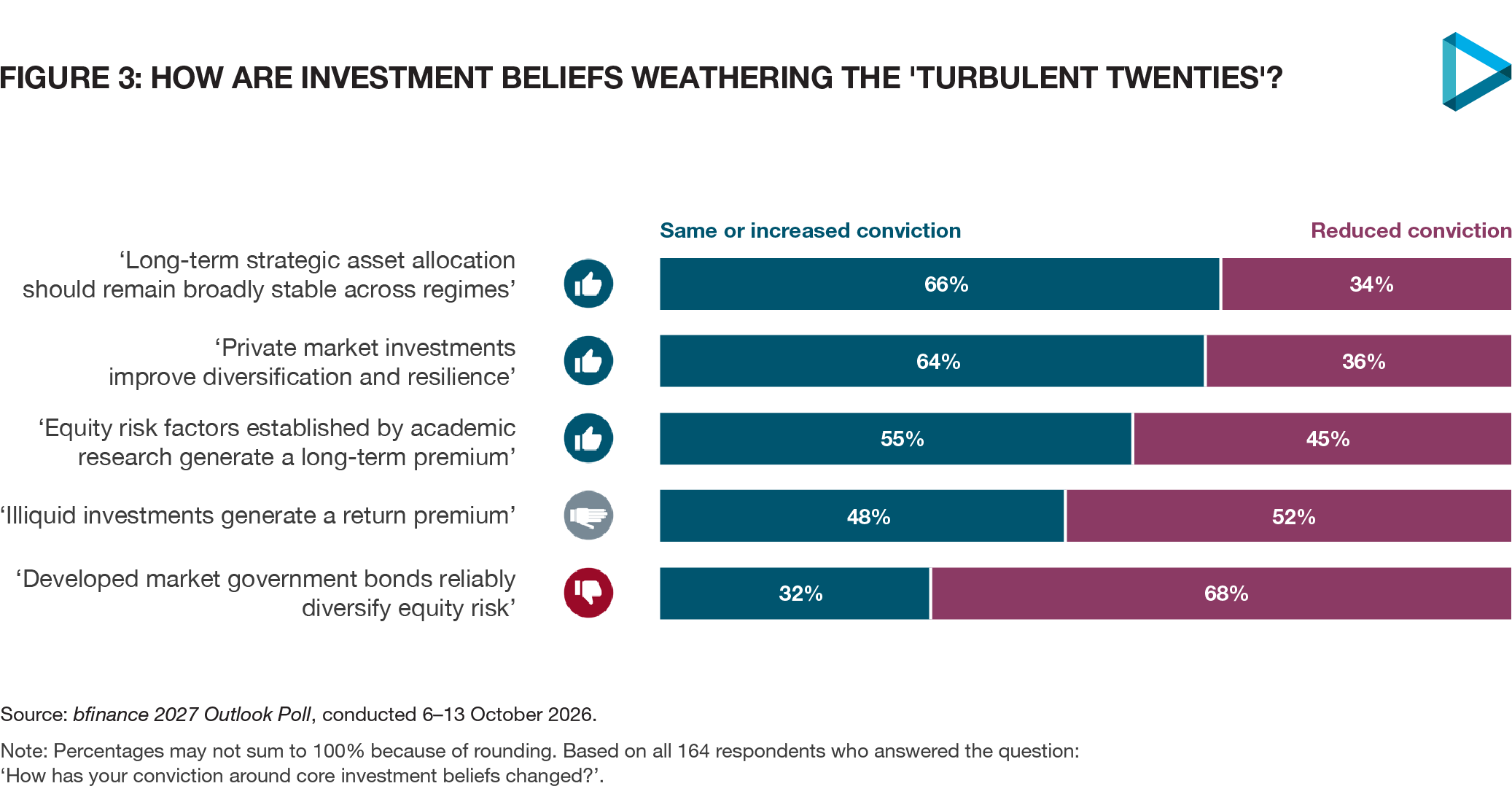
Despite a clear focus on portfolio liquidity in pursuit of greater portfolio resilience, higher interest rates have not reduced asset allocators’ conviction in the illiquidity premium. Conviction has remained broadly stable among all but those who believe US interest rates are moving onto a materially higher plane than implied by the Federal Reserve’s current estimate of the ‘neutral’ US interest rate (3.2%). They also seem secure in the diversification benefits of private markets (see Figure 3, below).
And while private credit may not add to portfolio duration, there does seem to be an enduring appreciation for floating-rate debt instruments able to adjust to higher-for-longer interest rate scenarios, where economic activity remains resilient, credit conditions favourable and defaults contained. It doesn’t surprise us that a net 31% of poll respondents are seeking to increase allocations (versus fixed income) over the next two years, albeit this represents some cooling of positive sentiment, from a net 38% increasing allocations in recent years (Figure 2).
While redemption pressures remain elevated, institutional investors have not been deterred by the ‘billions redeemed’ headlines around US semi-liquid private credit funds.
Private equity (PE) distributions have nearly halved over the past couple of years as higher-for-longer interest rates have contributed to a sluggish primary public equity market activity and PE exits. This exit challenge is supporting a buoyant secondaries market which now represents a valuable entry point to private markets for many investors. Secondary transaction volumes are on course for a third consecutive record year in 2026, creating opportunities across all four of the private market segments of private equity, credit, infrastructure and real estate.
Where diversification fails altogether overlays come into play – equity overlays may serve as a defensive backstop in highly concentrated markets, as one allocator fed back in the bfinance 2027 Outlook Poll: “[We’re] looking into adding a concentration risk buffer in the equity portfolio”. Meanwhile, tail risk protection strategies can guard against ‘black swan’ events.
Currency overlays can also be used to improve portfolio protections in a world where the dollar strengthen in one bout of volatility (Iran war) and falls in line with risk assets during another (‘Liberation Day’ sell-off in 2025). The dollar’s value as a natural buffer for non-US holders of US equities are in doubt, calling into the question the merits of a passive 50:50 strategic currency hedge of ‘least regret’.
Special 2027 Outlook topic
Currency overlays
THEME 2: Real assets and the inflation hedge
Increased fixed income duration may be part of the answer to the 18% of allocators who perceive an economic growth disappointment (accompanied by lower inflation) as the most problematic for their portfolios (see Figure 4, below). Meanwhile, private credit and inflation-linked real assets may provide some protection to those 10% concerned about the implications of higher-for-longer interest rates in a reflationary scenario, where both growth and inflation exceed expectations.
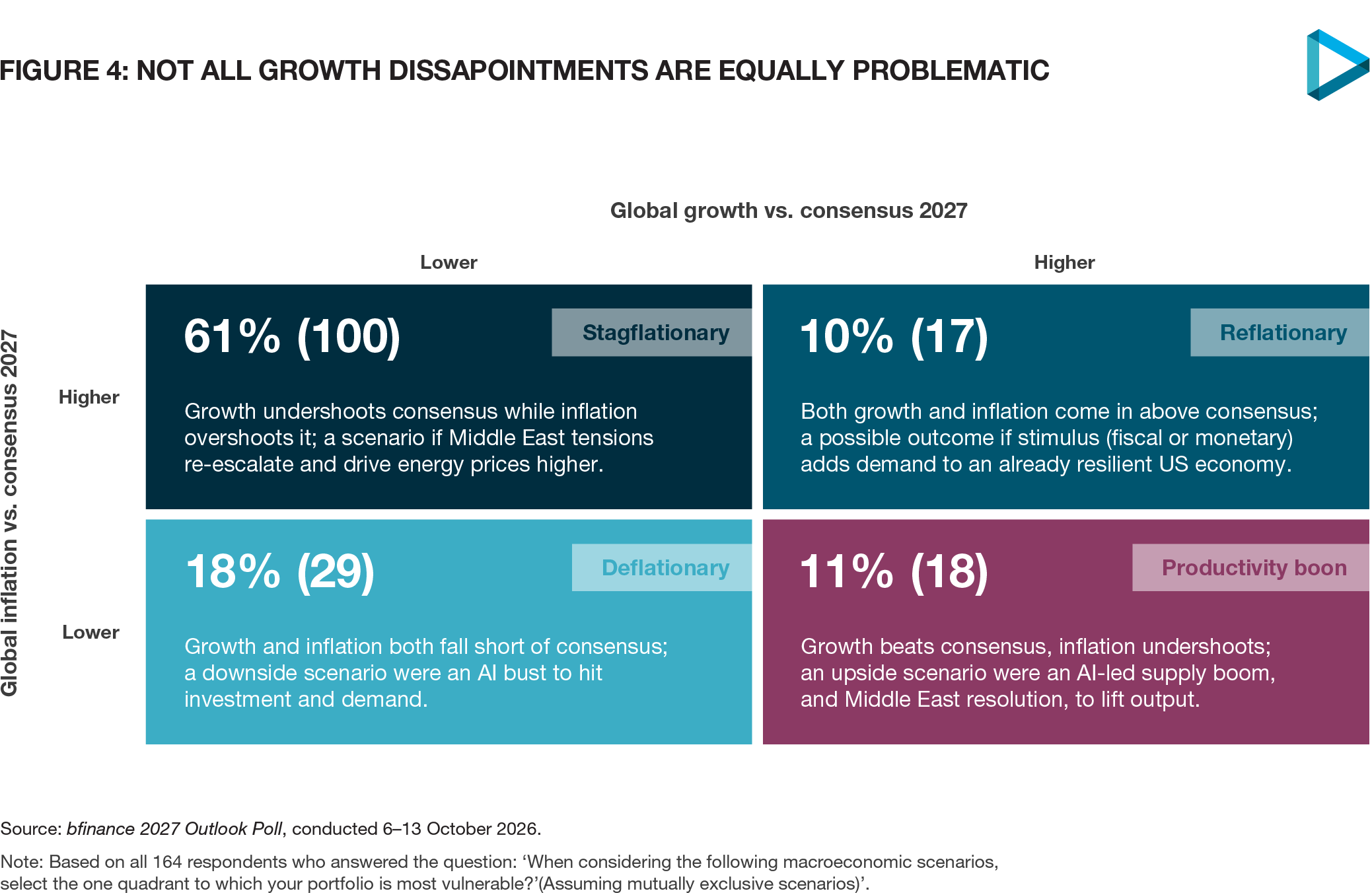
Few scenarios are as problematic for portfolios as stagflation, so it’s unsurprising 61% feel unprepared for it. Defences against it can only be partial, however real assets do provide some degree of protection to this pernicious combination of slower growth and rising prices, and allocators do appear to be repositioning towards them.
Special 2027 Outlook topic
Responsible investment
There has been an eight-point swing in favour of real assets (from a net 14% reporting an increase in allocations in recent years to a net 22% expecting to increase further over the next two – see Figure 2). This seems to have been driven as much by a cooling in negative sentiment towards real estate (eight-point swing to core real estate from -17% to -9%) as a further build in positive sentiment towards infrastructure – 33% plan to increase allocations to core-plus infrastructure over the next two years.
We have certainly noticed maturing attitudes towards infrastructure, with a growing emphasis on building out exposure across the asset class. Investors seem to have become more selective, adopting what we’re calling a ‘pragmatic barbell’, pairing large-cap strategies for stability with mid-cap strategies for returns. Wider performance dispersion in the latter group necessitates careful manager selection. Meanwhile, within real estate, we are seeing more interest in ‘active’ strategies, whether core plus or value add, that drive strong NOI (net operating income) growth rather than relying on the long-awaited recovery of the real estate cycle.
THEME 3: Fee and cost-optimisation pressures
Private market fees had been broadly stable at the start of the 2020s, even as public market costs declined. That stability is much less assured in the turbulent twenties and it appears that the near two-decade decline in public market fees during the Zirp years following the Global Financial Crisis may now be broadening out to private markets as fundraising has softened and distributions disappointed (see Figure 5, below).
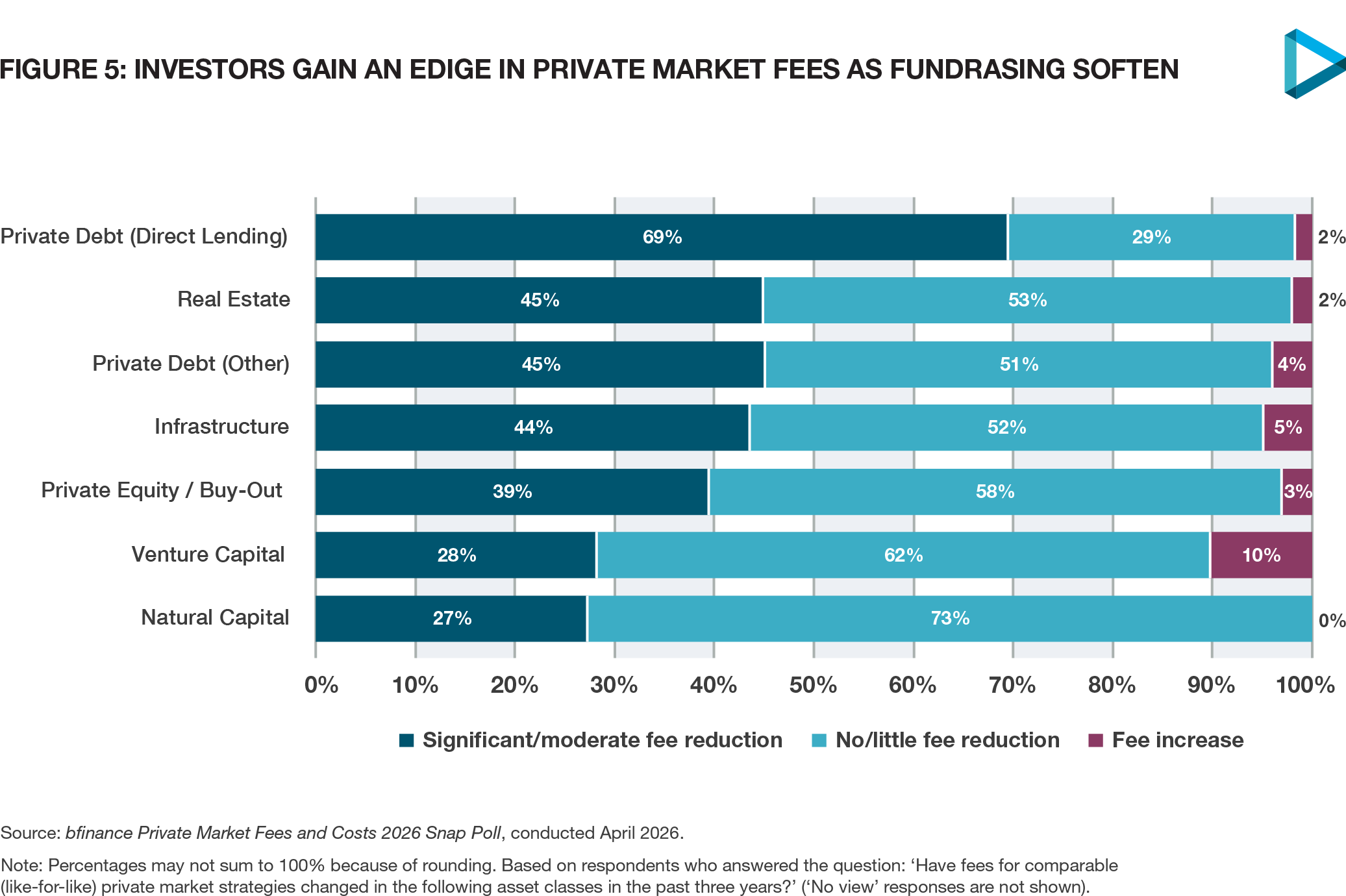
These trends will not be apparent in stated fees (which bfinance private markets project data finds to have remained broadly flat), but instead in the widening gap between quoted and actual prices paid. Such trends are most benefiting tactically astute investors able to employ various levers to secure reductions on the quoted fees. At the same time, our project data points to liquid markets confronting new pricing pressures.
Fees are just one area where a changing market environment is prompting asset allocators to challenge established assumptions. The turbulent twenties are not rendering established portfolio principles obsolete, but they are making them harder to apply mechanically. Correlations are less dependable, liquidity matters more, the hurdle rate for risk assets has risen and opportunities are becoming more dispersed. For asset allocators, resilience may therefore depend less on finding a new portfolio formula than on building greater adaptability into the existing one.
Important Notices
This commentary is for institutional investors classified as Professional Clients as per FCA handbook rules COBS 3.5R. It does not constitute investment research, a financial promotion or a recommendation of any instrument, strategy or provider. The accuracy of information obtained from third parties has not been independently verified. Opinions not guarantees: the findings and opinions expressed herein are the intellectual property of bfinance and are subject to change; they are not intended to convey any guarantees as to the future performance of the investment products, asset classes, or capital markets discussed. The value of investments can go down as well as up.