English (Global)
  Français (France)
  Deutsch (DACH)
  Italiano (Italia)
  English (United States)
  English (Canada)
  French (Canada)
bfinance insight from:

Peter Hobbs
Managing Director, Private Markets Advisory
There has been considerable excitement in markets around the rollout of Germany’s new fiscal spending plans. Last year’s historic Bundestag vote to exempt defence and security expenditure from debt rules – alongside the creation of a €500 billion off‑budget infrastructure and climate‑neutrality fund – has been widely presented as a crucial step toward restoring the competitiveness of the German economy.
Yet these earmarked public funds represent only part of the answer. Economists broadly agree meaningful ‘supply‑side’ reforms are essential to ensure that new capital can be deployed effectively into the domestic productive economy. Moreover, it is accepted public funding alone will cover only a portion of the financing gap, meaning that private capital will also be required
German investors set to increase overall infrastructure allocations
The introduction of the new German ‘Infrastructure Allocation’ (Sicherungsvermögen1) and launch of a ‘Germany Fund’, or Deutschlandfonds2, are designed to mobilise private capital. Without further supply-side reforms – in particular regulatory reforms – it remains open to debate, however, whether these initiatives alone can drive a significant increase in domestic, Germany infrastructure investment.
It is in this context that bfinance polled a range of German institutional and wealth investors, including pension funds, insurers, family offices, banks and corporates, to gauge their appetite for investing in German infrastructure.
While the poll tells us that German investors have strong appetite for the infrastructure asset class, the geographic focus remains on European and North American infrastructure, rather than specifically Germany. If the German economy is to benefit from the rising investor appetite for infrastructure, it would seem necessary for reforms to gain far greater traction.
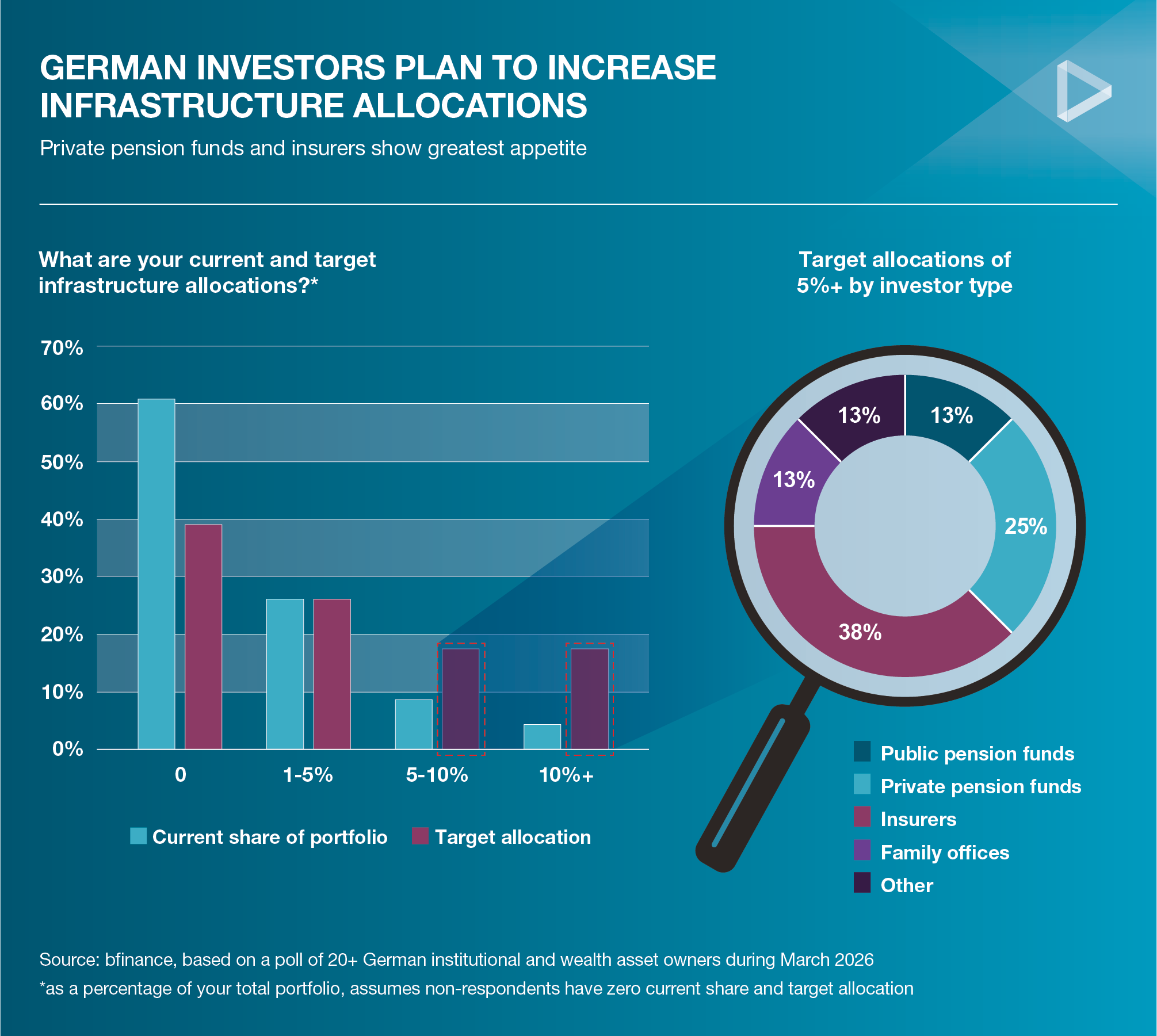
One of the most significant insights from the survey is the planned changes in the allocation to the asset class. On the one hand, there is set to be an increase of first-time investors to infrastructure, with around 60% of respondents currently having no allocation to infrastructure set to fall to around 40%. Meanwhile, existing investors are set to increase their allocations – more than a third of respondents (35%) have a target allocation of 5% or more, compared with less than 15% of respondents with a current 5%-plus allocation to infrastructure. This intention to step-up allocations is apparent across all investor types, with the most notable increase for insurers and private pension funds.
Are there any signs of a reversal in the so-called ‘reverse home bias’?
However, the positivity appears to mainly relate to global themes, such as the ‘megatrends’ of the energy transition and digital infrastructure – for more on these global trends read more in our latest report: Global Infrastructure Survey – Three Takeaways as Broad Enthusiasm Gives Way to Selectivity and Precision.
So, despite the changes in the regulatory environment to date, it seems the so-called ‘reverse home bias3’ persists for now. This finding concurs with other polling, which also indicates very few German institutional investors having a specific target allocation to Germany.
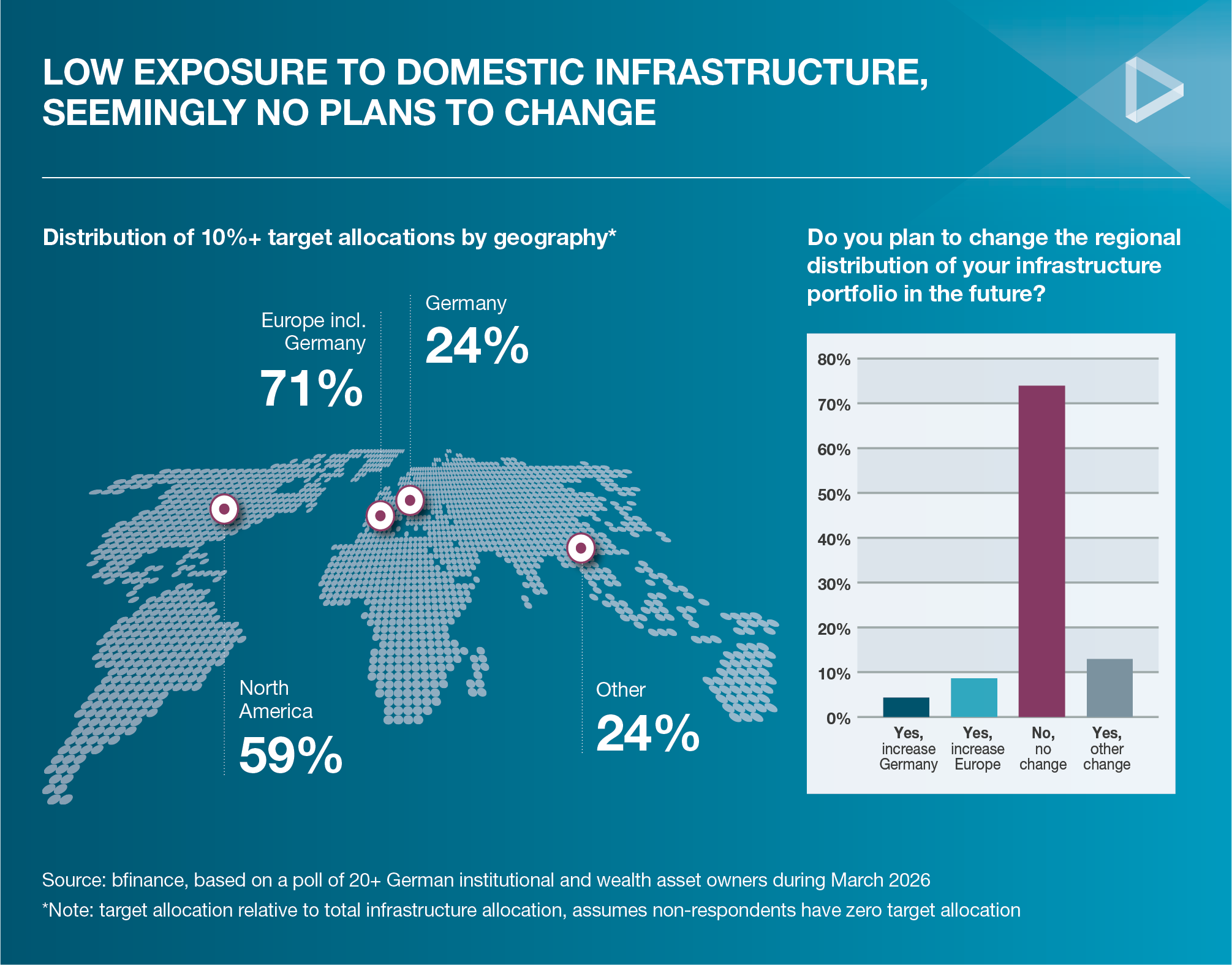
Investors appear to prefer broader ‘European’ infrastructure – of the respondents with regional allocations, more than two thirds have a 10%-plus target for Europe, as opposed to less than a quarter with a specific German target. A significant proportion (more than half of respondents) also have 10%-plus allocations to North America.
These low allocations to Germany seem set – almost three quarters of respondents do not intend to change regional allocations in the future.
A shortage of opportunities appears to be holding back investors
There are mixed views over the use of private capital to support infrastructure provision, with around two thirds of respondents having some concerns over the role it could play. A similar proportion agree, in part or completely, with the view that there are currently attractive investment opportunities in German municipal infrastructure. This category covers a range of domestic assets from roads and bridges, to utility networks, to schools, hospitals and administrative buildings.
There is more consensus around the view that Germany could learn from supply-side reforms from other countries to make municipal infrastructure more attractive as an investment opportunity, with the vast majority of respondents agreeing to such a view that lessons could be taken from other countries.
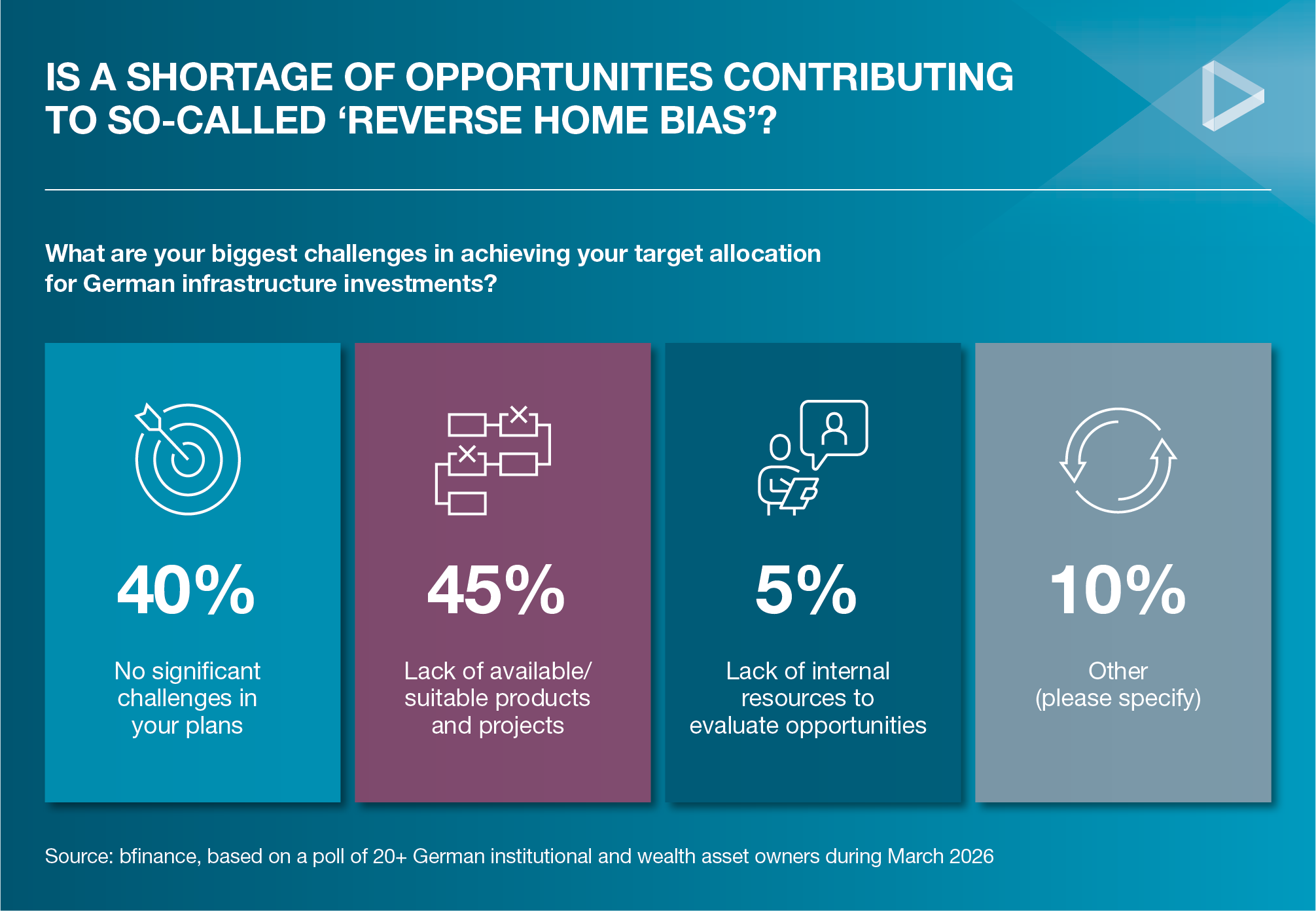
Around half of respondents cite a shortage of ‘suitable products and projects’ as a key challenge to achieving their target allocation to German infrastructure.
Based on this short survey, investors appear to be looking to the infrastructure asset class for the role it will play in the portfolio, rather than any Germany-specific role it could play. Investors have specific risk/return requirements, and obtain their exposure at a regional and global level.
If Germany itself is to benefit from the rising investor appetite for infrastructure, it would seem necessary for supply side reforms and incentives, such as those associated with the Deutschlandfonds, to gain far greater traction.
See full survey findings here: German infrastructure snap poll March 2026
[1] Dechert (2025) ‘New German infrastructure allocation comes into force’, February 2025.
[2] Deutsche Bank (2026) ‘Deutschlandfonds – a booster for private investment’, January 2026.
[3] BAI (2025) ‘Infrastructure Report 2025’, August 2025.
Important Notices
This commentary is for institutional investors classified as Professional Clients as per FCA handbook rules COBS 3.5R. It does not constitute investment research, a financial promotion or a recommendation of any instrument, strategy or provider. The accuracy of information obtained from third parties has not been independently verified. Opinions not guarantees: the findings and opinions expressed herein are the intellectual property of bfinance and are subject to change; they are not intended to convey any guarantees as to the future performance of the investment products, asset classes, or capital markets discussed. The value of investments can go down as well as up.