English (Global)
  Français (France)
  Deutsch (DACH)
  Dutch (Nederlands)
  English (United States)
  English (Canada)
  French (Canada)
bfinance insight from:

Mathias Neidert
Managing Director, Head of Fixed Income
Emerging market debt offers yields that are hard to ignore. Yet across 47 MAC strategies reviewed by bfinance, a half allocated less than 10% to it and a third less than 1%. This piece sets out why.
The question in this article's title comes up regularly when investors examine multi-asset credit (MAC) funds and notice that emerging market debt (EMD) is either absent or tightly constrained, despite headline yields that often look attractive relative to developed market (DM) alternatives.
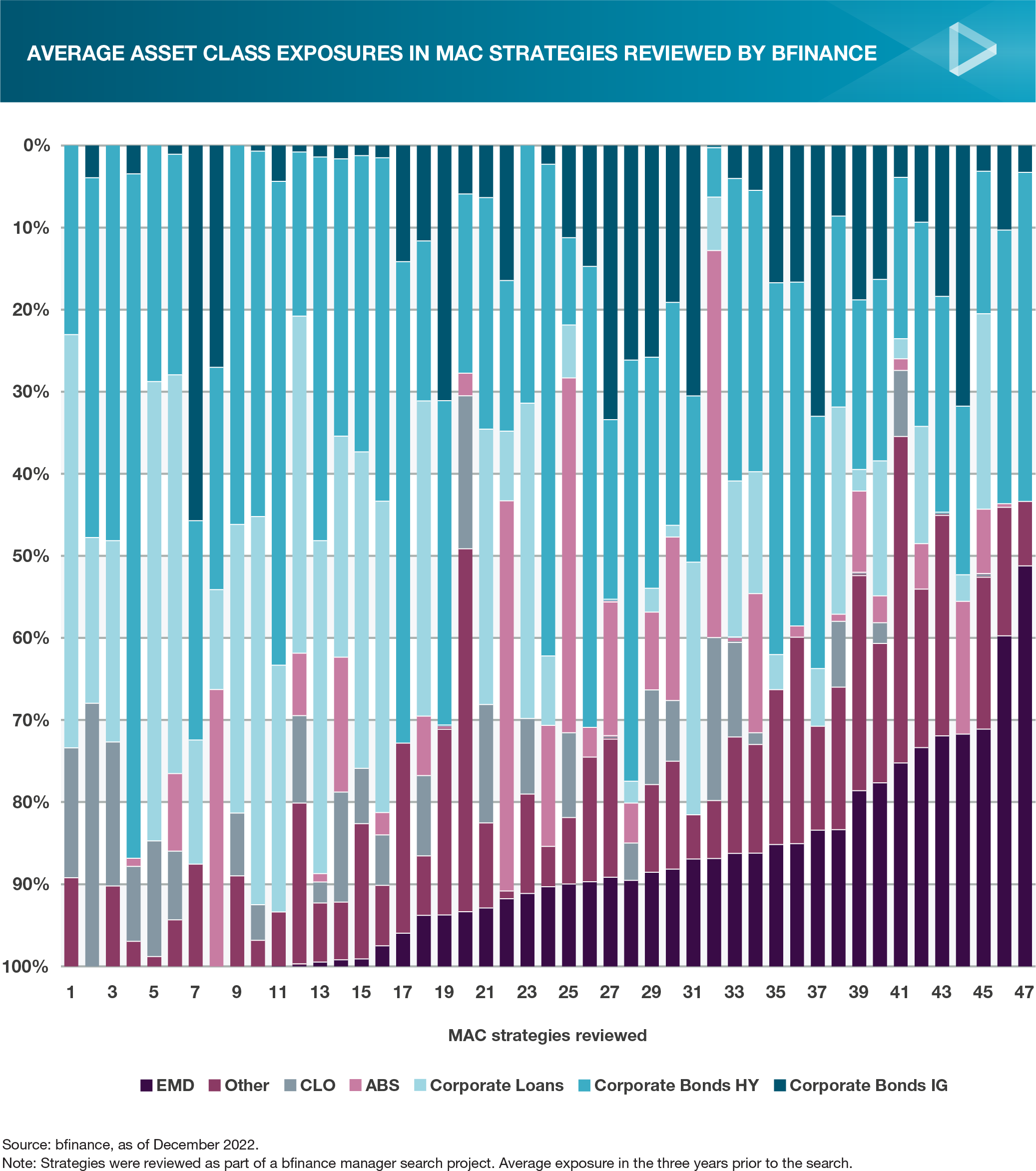
Average EMD exposure over three years across 47 MAC strategies from a past bfinance search (see chart, below) tells a clear story:
- 80% had less than 20%
- 50% had less than 10%
- 33% had less than 1%
What follows is an explanation of why we think this trend persists. Spoiler alert: It is grounded in how MAC strategies are designed and implemented, rather than a view on the merits of EMD itself.
Skill-set mismatch and operational barriers
Most MAC strategies are built to allocate dynamically across credit sectors – high yield bonds, loans, Collateralised Loan Obligations (CLOs), structured credit and sometimes private credit – while managing what is, at core, a single dominant risk factor: corporate default and spread risk. The portfolio manager's edge is in reading credit cycles, rotating between instruments and selecting issuers across the DM credit universe.
EMD embeds a different and more complex risk profile. Hard-currency sovereigns introduce sovereign risk, local-currency debt layers in FX risk and both carry significant macro and political risk. These risks can dominate total returns even when underlying credit fundamentals appear stable. So, while an allocation to EM corporate high yield may look like a credit call on paper, in practice it is often a macro and country call in disguise.
In most asset management firms, MAC teams and EMD teams operate as distinct units. MAC is staffed with corporate credit specialists: analysts who cover industry sectors, rate corporate issuers and analyse instruments across the capital structures. Meanwhile, EMD sits with sovereign analysts, FX strategists and country specialists who think in terms of current account dynamics, political risk calendars and central bank policy trajectories.
Combining these into a single product raises structural questions that are harder to resolve than they first appear. Questions like: Who owns the performance attribution? How are credit and macro calls reconciled when they conflict? How is the management fee allocated internally between teams? While these may sound like back-office details, in practice they shape how portfolios are actually constructed.
Some managers have resolved these issues successfully, but it typically requires a broader multi-asset platform, explicit macro and FX risk tolerance embedded in the mandate and clear internal rules around risk ownership. This combination is not the norm among MAC managers.
In short, far from viewing EMD unfavourably, it simply sits outside the investment process MAC teams have built and the risk framework they are comfortable running.
Rating mismatch: EM debt skews investment grade
A structural tension that is often underappreciated is that a significant proportion of emerging market debt is investment grade, while MAC strategies are typically designed around sub-investment grade credit risk.
Standard market indices bear this out. Around 50% of EM hard-currency sovereign debt is investment grade by market value. Roughly 60% of EM corporate debt sits above the sub-IG threshold. In local currency markets, the proportion rises to approximately 80%. We are not talking about niche segments here; they represent the largest and most liquid part of the EM debt universe.
In contrast, MAC strategies are typically designed to concentrate risk in sub-IG credit, maximise carry and capital gains from spread compression as well as allocate to sectors where rating migration, default recovery dynamics and technical supply-demand imbalances drive returns. Introducing a large investment grade bloc into this framework risks diluting the return profile without adding compensating value.
So even before macro or FX considerations enter the picture, the quality mismatch creates a clear case for excluding or capping EMD exposure in most MAC mandates.
Default and recovery: Sub-IG EM is not sub-IG DM
A natural follow-on thought is: If the rating mismatch is the problem, why not simply focus MAC allocations on sub-investment grade EM corporate credit? After all, it is corporate credit and carries the right risk profile on paper.
Some managers do, but sub-IG EM corporate credit introduces recovery uncertainty. MAC managers operating in the sub-IG space accept that defaults will occur because that is the inherent nature of the asset class. Their frameworks are built around modelling both the probability of default and the likely recovery value. In DM credit, those recovery assumptions rest on relatively stable legal infrastructure: well-established bankruptcy codes, senior creditor protections and transparent enforcement mechanisms.
In sub-IG EM corporate credit, that infrastructure is less reliable – or at least perceived to be. Local political risk, including the risk of nationalisation or selective enforcement, can complicate recovery assumptions. Bankruptcy regimes vary significantly across EM jurisdictions and have far shorter track records. Physical assets may be harder to access or realise in a foreclosure process. Equally, creditor protections that would be standard in a US or European high yield deal may be absent or untested in an EM context.
Many MAC managers therefore conclude that they are already taking meaningful default risk through their DM high yield and loan allocations and that adding EM default risk with less predictable recovery outcomes is not a trade-off the mandate is designed to bear.
Benchmarking, risk budgets and drawdown behaviour
MAC products are typically benchmarked against cash-plus-spread targets or blended DM credit indices. The risk framework is calibrated accordingly: volatility targets tend to sit in the mid-single digits, drawdown controls are tight and risk limits are designed around the return distribution characteristics of DM credit.
EMD presents two specific problems within this framework. First, it exhibits fatter tails. Drawdown events in EMD – such as taper tantrums, dollar spikes, sanctions and geopolitical escalations – tend to be sharp and regime-driven, with correlation structures that shift exactly when the portfolio is most stressed. Second, the contribution of an EMD position to overall portfolio risk is volatile and difficult to size using standard credit risk models, which are typically calibrated on DM data.
The practical consequence is that a modest EMD allocation can consume a disproportionate share of the risk budget during stress periods, crowding out flexibility elsewhere in the portfolio. This is particularly uncomfortable in a format that is sold, in part, on the promise of capital agility and active rotation.
Client communication also comes into play. When a MAC fund underperforms due to a sovereign default or an EM currency depreciation, explaining that to investors who expected a corporate credit product is a harder conversation than underperformance driven by DM credit spread widening. And benchmarking ambiguity can compound the problem.
Liquidity and implementation frictions
Many MAC strategies are structured to offer daily or weekly liquidity, with the ability to rotate exposures quickly and use standardised derivative instruments for tactical hedging. This imposes some constraints on where the portfolio can operate.
Frontier market debt can be thinly traded and smaller EM corporate issuers may have limited secondary market depth. Equally, local currency instruments can face FX market closures or capital controls during periods of stress and precisely when a MAC manager needs to adjust positioning. Even in more liquid EM segments, bid-offer spreads tend to widen sharply in risk-off environments, eroding the cost-effectiveness of quickly rotating exposures.
All this makes building a liquid, actively rotated EMD sleeve within a MAC product operationally demanding.
Bottom line
Multi-asset credit strategies tend to exclude or limit emerging market debt not because of a negative view on EMD returns, but because of a series of compounding structural mismatches in: skill set, organisational and operational design, credit quality profile, default recovery predictability, risk budget behaviour and liquidity.
When EMD does appear in MAC portfolios, it is typically a small sleeve – often capped at 5-15% – focused on hard-currency corporate credit and deployed opportunistically for carry rather than as a strategic allocation.
Structurally, EMD tends to fit better as a standalone allocation, as a dedicated sleeve within a broader unconstrained global bond mandate or as part of a wider multi-asset risk budget. In these set-ups, the macro, FX and sovereign risk dimensions can be more easily owned explicitly and managed with the right tools. Inside a traditional MAC format, those dimensions remain, at best, awkward guests.
Important Notices
This commentary is for institutional investors classified as Professional Clients as per FCA handbook rules COBS 3.5R. It does not constitute investment research, a financial promotion or a recommendation of any instrument, strategy or provider. The accuracy of information obtained from third parties has not been independently verified. Opinions not guarantees: the findings and opinions expressed herein are the intellectual property of bfinance and are subject to change; they are not intended to convey any guarantees as to the future performance of the investment products, asset classes, or capital markets discussed. The value of investments can go down as well as up.