English (Global)
  Français (France)
  Deutsch (DACH)
  Dutch (Nederlands)
  English (United States)
  English (Canada)
  French (Canada)
bfinance insight from:

Phil Cunliffe
Senior Associate
Increasingly, asset allocation models are treating Private Credit as a strategic asset class with its own clearly defined profile, rather than an implementation solution within a fixed income or alternatives portfolio.
While this is a positive shift, it can be challenging to establish a robust model: frameworks, capital market assumptions and cashflow expectations require careful interrogation.
Integrating illiquid investments into strategic asset allocation (SAA) models is never straightforward, as discussed in a 2025 white paper: Private Markets and the Asset Allocation Imperative. Recent pressures in the private credit market have, however, highlighted particular vulnerabilities surrounding the treatment of this asset class within SAA frameworks.
Below, we ask three foundational questions for including Private Credit in an asset allocation model. Firstly, how can capital market assumptions (returns, volatility, correlation with other major asset classes) be established? Secondly, how might cashflow expectations be defined? Finally, what is the relationship between strategic asset allocation and implementation? Ultimately, we argue that the key to a robust strategy isn't obtaining the perfect set of numbers to put into a conventional model. Instead, investors should seek a nuanced approach that increases tolerance to potential inaccuracies in those assumptions.
Question 1: "what capital market assumptions should we use?"
We increasingly observe investment banks, investment consultants and asset managers providing "expected returns" for the Private Credit asset class, although the scope of the asset class is not always clearly defined – often referring to unlevered senior corporate direct lending but sometimes used as a broader catch-all encompassing diverse sub-strategies. A number of these are shown in Figure 1, below.
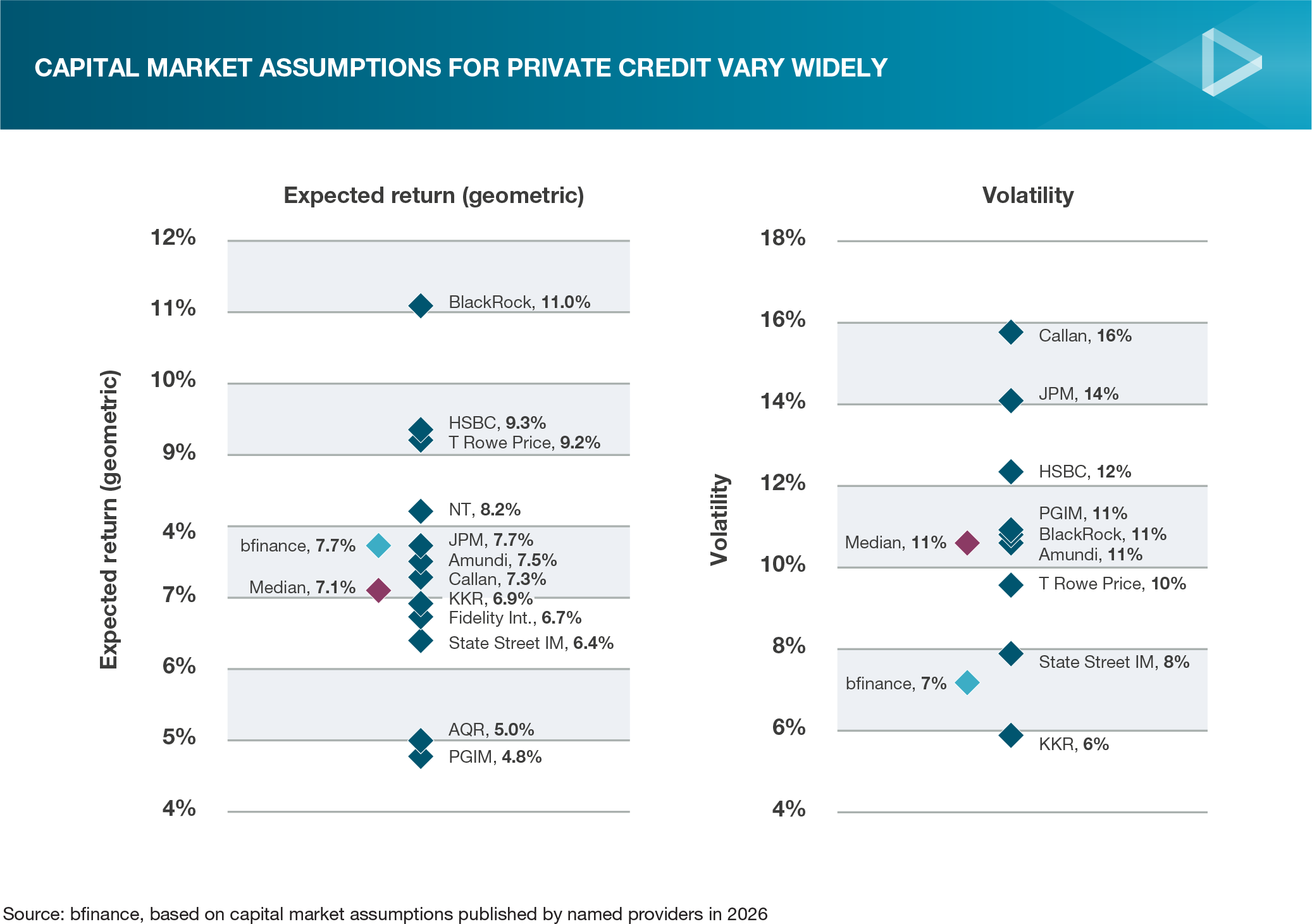
The first and most obvious takeaway from this set of data is that the numbers vary hugely depending on the supplier. This dispersion is itself indicative of the difficulty in forecasting such returns. Yet there are two deeper problems: the extent to which historical returns in this asset class are being treated as predictive of future outcomes and the narrowness of the risk and return metrics used.
The latter is not a trivial concern. Capital market updates typically publish expected returns on a geometric time-weighted return basis (geometric TWR), but providers do not offer a coherent set of return assumptions that span different dimensions including money-weighted return (IRR) and multiples (TVPI). In practice, while strategic asset allocation models typically use time-weighted return inputs, portfolio design for private assets tends to be built on expected IRRs and multiples, with GPs' own IRR and TVPI targets playing a role. It is true that consistency across these measures is challenging to achieve, as discussed in depth in the aforementioned white paper. Yet focusing only on one side or another constitutes a broken link between the various elements of investor decision-making. Indeed, narrowness may represent not just a modelling blind-spot but a governance problem.
One potentially straightforward or fundamentals-driven approach, from an asset allocator's perspective, is to frame expected private credit returns in a way that is explicitly intended to remain consistent alongside fixed income in the same model: this is illustrated in Figure 2.
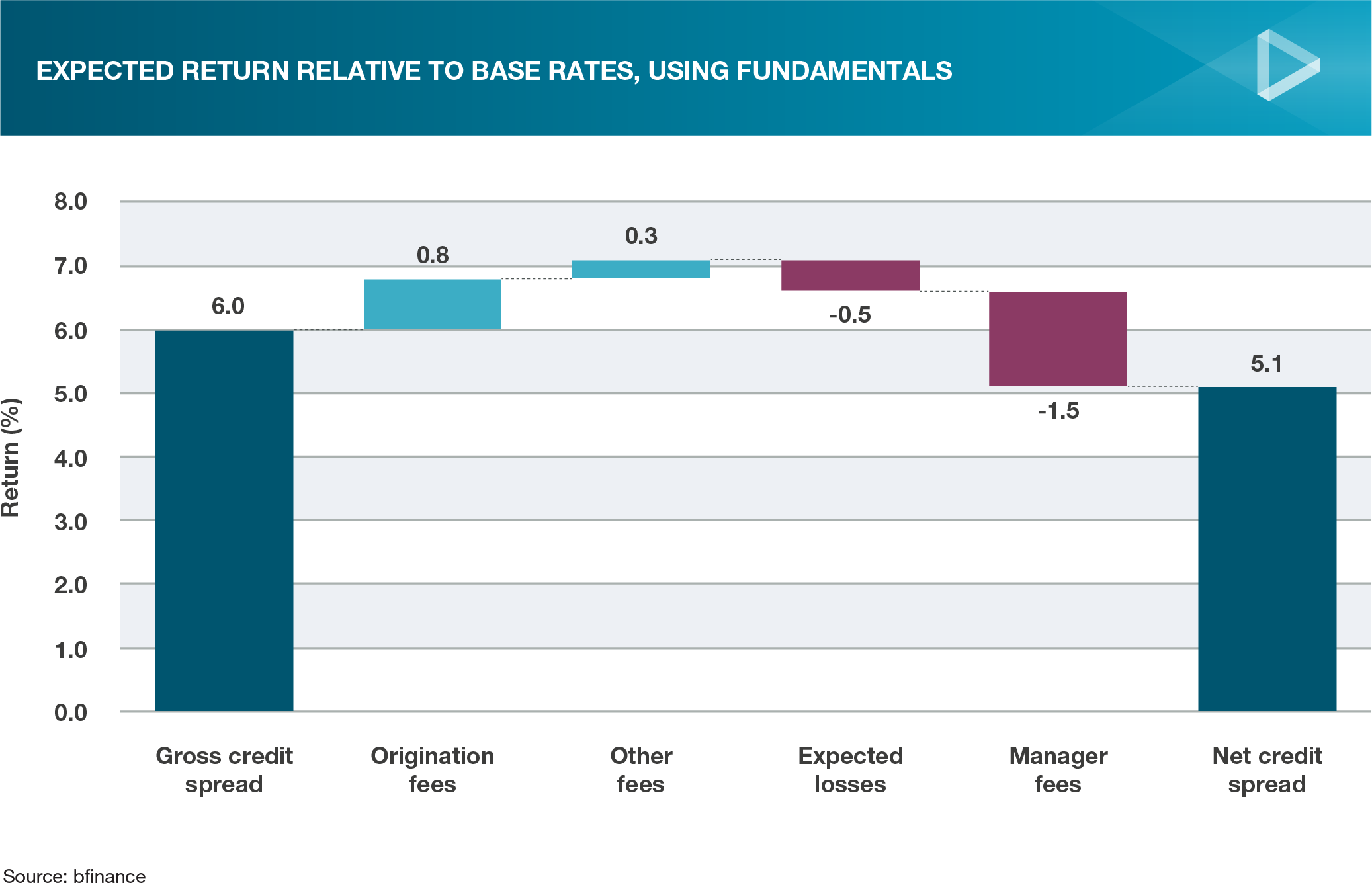
Here, however, another set of assumptions must now be sourced. These include expected credit spreads over base rates, expected ancillary income, expected losses and expected manager costs ('gross-to-net'). Again, we must consider: are those expectations robust? To what extent do they reflect past tailwinds versus today's outlook?
Moreover, this style of building an expected return may attempt to capture the overall net return that might be associated with an 'average' underlying loan but it does not describe a fund, let alone a private credit portfolio comprising multiple funds. Considerable friction separates each of these three elements.
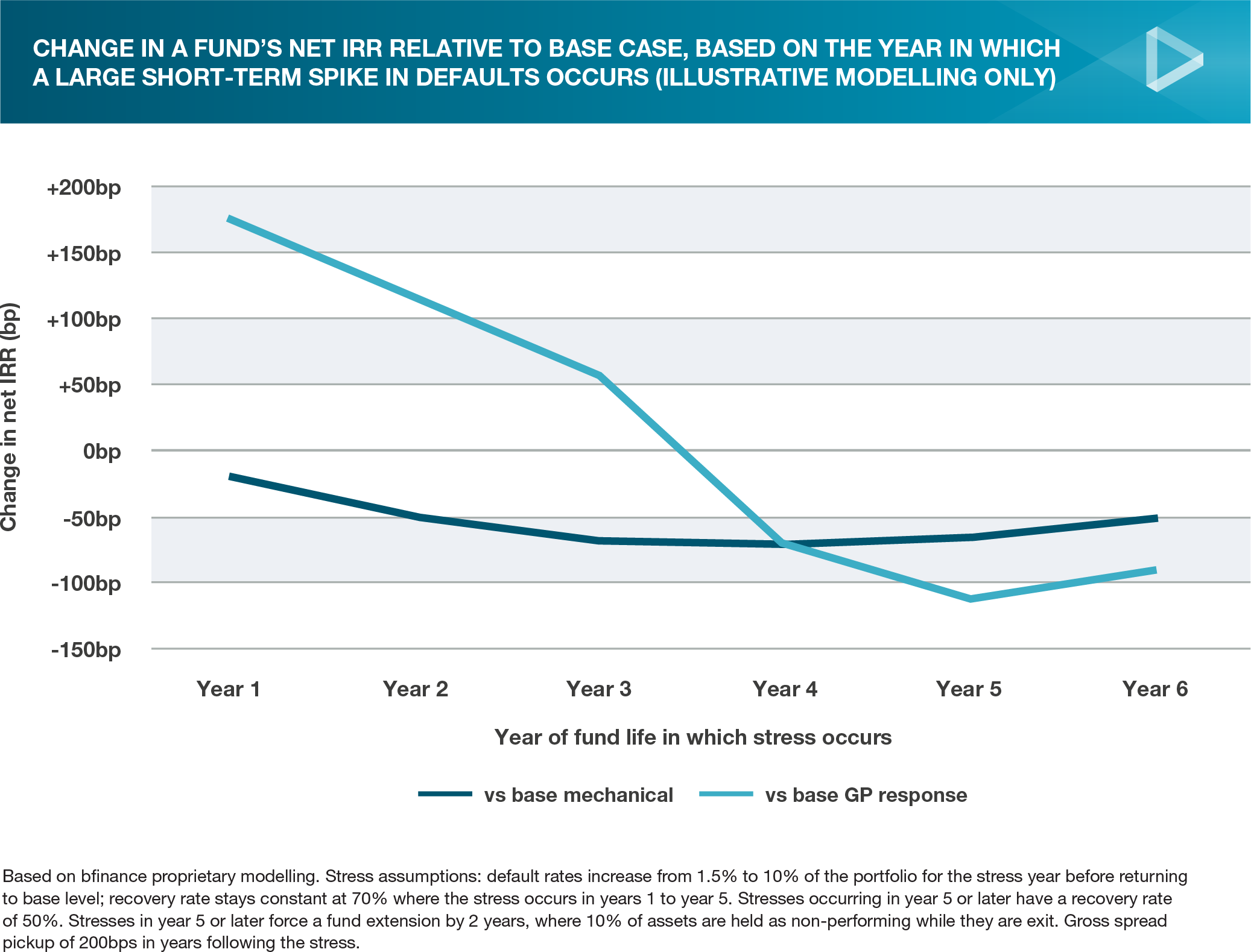
For example, if we consider the difference between the loans and the returns actually generated by funds in which they are housed, we must factor in prepayment speed and its effect on reinvestment, loan extensions (plus any fees associated with such extensions), payment-in-kind (PIK) usage, and portfolios that do not self-liquidate within term; these issues have become increasingly pressing in the 2025-6 period. None of these elements are captured in the 'credit spread' or 'credit loss' elements in Figure 2, of course. In addition, we can think here about the relevance of vintage risk: a major-but-temporary short-term spike in the market default rate that occurs in year five of a closed-ended fund can be highly detrimental; a similar spike occurring early on in a fund's life can be beneficial since it allows the GP to deploy into a repricing market. This effect is shown by the (illustrative-only) modelling in Figure 3.
Asset allocation optimisers do not just use expected returns: volatilities and correlations are just as important, if not more so. The collated capital market assumptions in Figure 1 show volatility assumptions ranging from 6 to 16%, while equity market correlations for the same dataset range from roughly 0.4 to 0.7.
Yet this data is highly problematic. When it comes to private credit, correlation is perhaps the least reliable input that is available to a strategist. A marked portfolio value at a given point in time in private markets is not the same as a 'price' in public markets: correlations drawn from a private market return series will severely understate the relationship to the public markets, overstate the diversification benefit and support a larger allocation than the risk warrants. Alternatively, volatility and correlation assumptions can be drawn from public proxies. We prefer the latter approach, with some modest adjustment for differences that genuinely do exist (seniority, covenants, early intervention). Most importantly, the allocation's explicit sensitivity to correlation assumptions should be tested.
Overall, capital market assumptions should be treated as anchors, not answers. The objective should not be obtaining a set of numbers that are believed to be sufficiently robust. Instead, the goal should be to understand what would cause the foundations beneath any of those assumptions to hold or break, with deliberate constraints that hold the investor's vulnerability at acceptable levels in case the assumptions prove over-optimistic.
Question 2: "how can we set cashflow expectations?"
Cashflow assumptions are critical when integrating private credit into asset allocation. Many of the problematic elements discussed above, such as changes to the pace and timing of borrower payments, will affect cashflows much more rapidly and directly than they affect overall returns.
Unfortunately, this is the input that is most often treated as implicit within asset allocation models. To be specific, the cashflow expectation is usually derived from the return assumption rather than set independently. Yet the past three years have shown how fragile that chain is: repayments slowed, deployment slowed with it, distributions to investors diminished, and a growing number of funds are now reaching the end of their term with sizeable portfolio value still outstanding.
Delayed distributions can affect IRRs: based on our modelling, shifting a closed-end fund's distributions back by a single year can take expected net IRR from 8.9% to 6.8%, while leaving total proceeds (TVPI) almost unchanged. Yet the bigger problem for the asset allocation strategist is the effect on liquidity and ALM models: these are much more sensitive to the cashflow numbers than the return number. Moreover, there is a knock-on impact for portfolio construction, since an investor receiving insufficient distributions may reduce its participation in upcoming private credit vintages, increasing vintage (or 'timing') risk – the dangers of which are mentioned above.
Instead of basing cashflow expectations on return expectations, three assumptions should be stated explicitly and stressed separately: the deployment profile/timing, the distribution profile, and the terminal assumption.
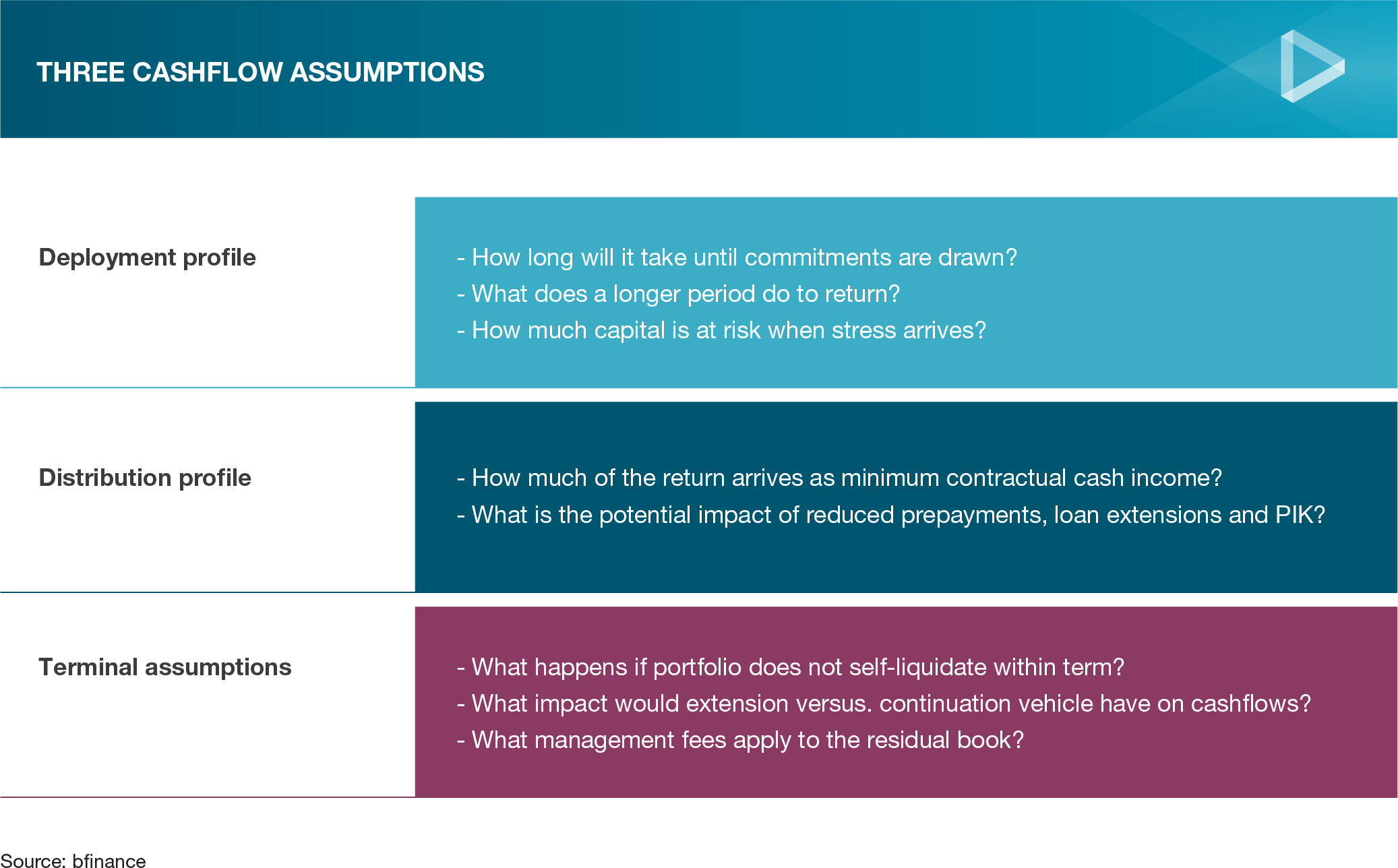
A pragmatic approach may involve explicitly modelling a 'slow case' for this cashflow profile rather than applying a haircut to a central case – not because the 'slow case' is viewed as likely but because the cashflow consequences would be large and cannot be inferred from the return number. This might, for example, involve four-year deployment periods, skewing distributions further toward the end of fund lifespans and assuming a residual that is carried two years beyond fund terms.
Question 3: "what is the relationship between strategic asset allocation and implementation?"
Producing assumptions – and trying to improve an asset allocation model's resilience to errors in those assumptions – represents part of the puzzle. Yet there is a key aspect missing: what is the real-life portfolio that will actually be built?
Private debt is not one asset class. Alongside corporate direct lending, an investor may wish to consider the hugely varied attractions of opportunistic lending, asset-backed finance (e.g., real estate debt, infrastructure debt, or NAV lending) and more. An SAA that incorporates private debt using a set of assumptions that were based on senior secured corporate debt has already pre-empted an implementation decision without acknowledging it.
As such, it may be more pragmatic to model a representative portfolio alongside the Strategic Asset Allocation at the outset rather than treating portfolio modelling as a subsequent 'downstream' step. This model portfolio would likely be reviewed more frequently than the SAA itself, but the discrepancies between the two can be identified and this gap can be governed.
Figure 5 illustrates how a model portfolio might be constructed that complements a specific set of SAA assumptions. Here, the 'central exposures' (which should dominate the portfolio) will be closest to the SAA central case. 'Central diversifiers' should remain broadly consistent with the central case but diversify the sources of risk such as economic sensitivity, borrower type, collateral type and more. Finally, 'return enhancers' represent a deliberate move away from the central case.
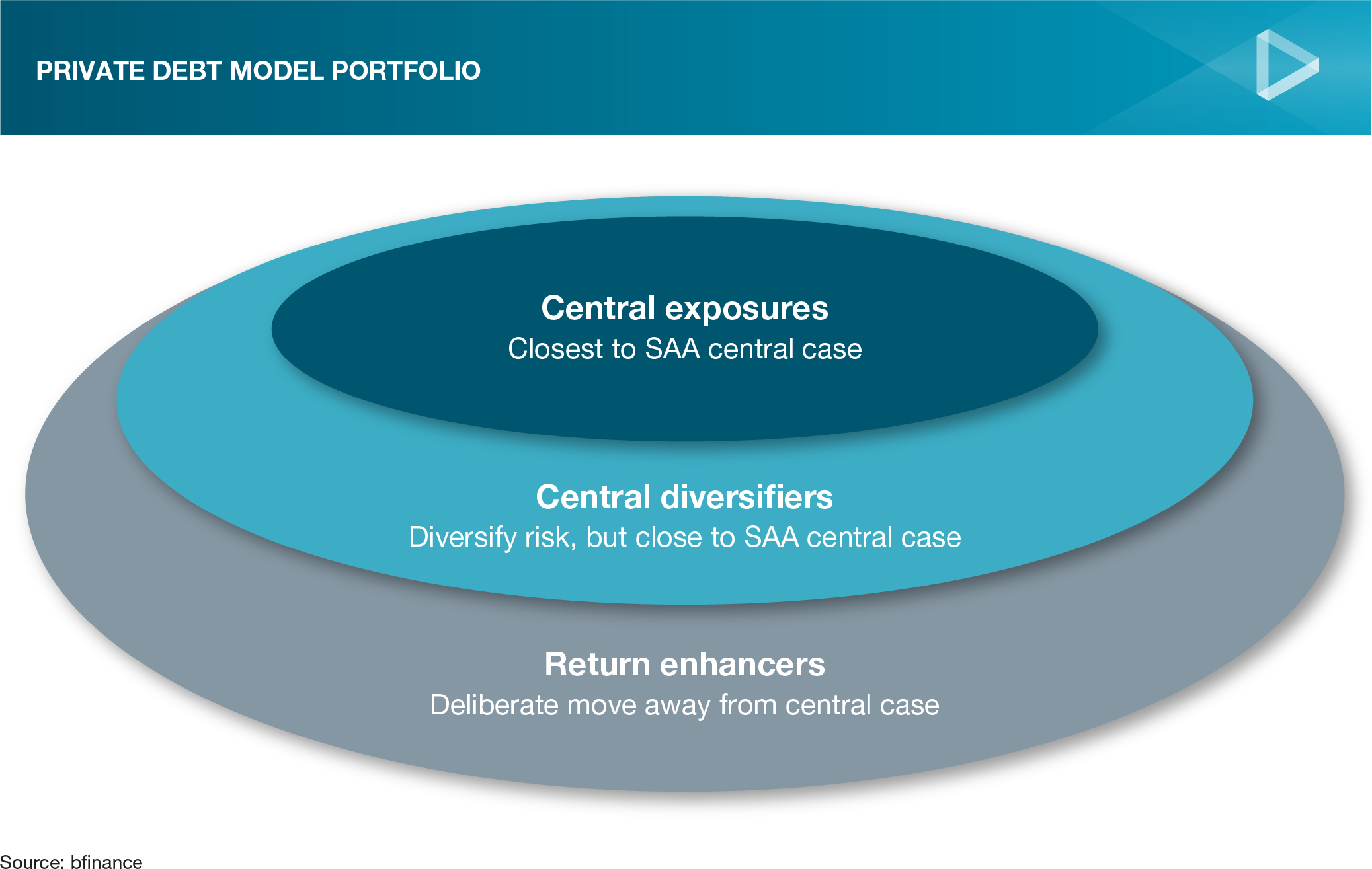
This consideration of implementation at the strategy stage has several advantages. It grounds the allocation in what is investable. It allows the strategist to assess the potential impact of non-core strategies up-front rather than having their inclusion treated as a pure implementation decision by an asset class team, thereby strengthening governance. It enables specific implementation matters, such as vintage risk and the importance of regular pacing, to be surfaced for consideration at the strategic level rather than overlooked. Arguably, boosting the bond between SAA and implementation is more important than ever in today's environment, where slower distributions and heightened dispersion are placing this crucial relationship under pressure.
Conclusion: amid uncertainty, prioritise resilience
Integrating private credit into an asset allocation framework is not a straightforward task. We do have certain preferences in methodology, such as building expected returns from fundamentals, using public proxies to underpin volatility and correlation estimates, explicitly stating (and stress-testing) cashflow assumptions, and constructing model portfolios up-front rather than treating divergent implementation as a downstream decision. Yet the most important ingredient for success, as recent conditions remind us, is reducing the model's dependence on whether specific assumptions ultimately prove to be over-optimistic or not. Resilience, not optimisation, should be the watchword.
Important Notices
This commentary is for institutional investors classified as Professional Clients as per FCA handbook rules COBS 3.5R. It does not constitute investment research, a financial promotion or a recommendation of any instrument, strategy or provider. The accuracy of information obtained from third parties has not been independently verified. Opinions not guarantees: the findings and opinions expressed herein are the intellectual property of bfinance and are subject to change; they are not intended to convey any guarantees as to the future performance of the investment products, asset classes, or capital markets discussed. The value of investments can go down as well as up.