English (Global)
  Français (France)
  Deutsch (DACH)
  Italiano (Italia)
  English (United States)
  English (Canada)
  French (Canada)
bfinance insight from:

Duncan Higgs
Managing Director, Head of Operational Solutions

Bradley Budd
Senior Director, Wealth
Wealth managers face mounting pressure to deliver more for less. Cost-aware clients, digital disruption and regulatory demands for “fair value” are turning fee compression into a defining challenge in private wealth – and turning the screw on margins. Are firms truly equipped to manage this squeeze strategically, or are they simply absorbing the impact? Here, we look at three levers that can help to preserve profitability in an era of change.

Figure 1: Three cost-reduction levers
Fee compression across the wealth industry appears to be continuing – or even accelerating. Recent research from Cerulli Associates shows that the long-quoted “1% advisory fee” is becoming increasingly rare, with 83% of advisors expecting to charge under 1% for clients with more than $5 million in assets by 2026; the trend is most pronounced among HNW and UHNW clients. Meanwhile, EY’s 2025 Global Wealth Report shows that a growing share of clients now question the value that is being delivered and are more willing to switch providers if pricing expectations are not met. The emergence of robo-advisors and the rise of direct-to-consumer investment platforms have helped to reset the industry’s baseline pricing, making investors far more aware of low-cost alternatives, while heightened regulatory scrutiny on value for money has raised the bar on transparency.
At the same time, wealth clients increasingly expect broader services—including tax planning, estate coordination and holistic financial advice—as part of the package, not to mention sophisticated technology portals and access to performance-boosting alternative investments. This tension, in an environment of already-thin margins, creates a core strategic challenge.
First: clarify the competitive position
Before (or while) looking at potential efficiency savings, it is worth seeking robust data regarding competitor pricing. Effective benchmarking—not only covering peers’ fees but the products and services that are actually being provided for at that price-point—can help to define appropriate goals for the business and support discussions with clients. Narratives about “competitive pricing” are far more convincing, in the context of client retention efforts, when backed by clear (ideally independent) competitor assessment.
The essential partner to comparison, however, is transparency. Cerulli reports that around 25% of investors still do not understand how they are being charged, and industry experience suggests that the true figure may be far higher. Closing this gap is essential not only for meeting rising regulatory expectations around fair value, but also for improving retention and even defining strategy. Transparency goes beyond simply disclosing costs: it involves clarifying how fees are structured, where value is created, and how underlying costs contribute to overall client outcomes.
Three levers for cutting cost
Targeting cost efficiency within the deeper layers of a wealth manager’s proposition can unlock meaningful recurring value. Across many portfolios, underlying product fees, trading costs and structural inefficiencies create 50–80 bps of annual drag – often exceeding the advisory fee itself.
1. Optimise underlying product economics
An independent review of underlying fund pricing can help to tackle what is still one of the largest drivers of total portfolio cost. Savings can be achieved here, either in the form of reductions to headline fees or an increase in rebates/retrocessions received depending on outcomes. Analysis can identify themes such as the use of higher-cost share classes, sub-optimal rebate terms, missed potential for volume discounts or breakpoints, instances where fee clauses are not correctly applied and inefficient trading.
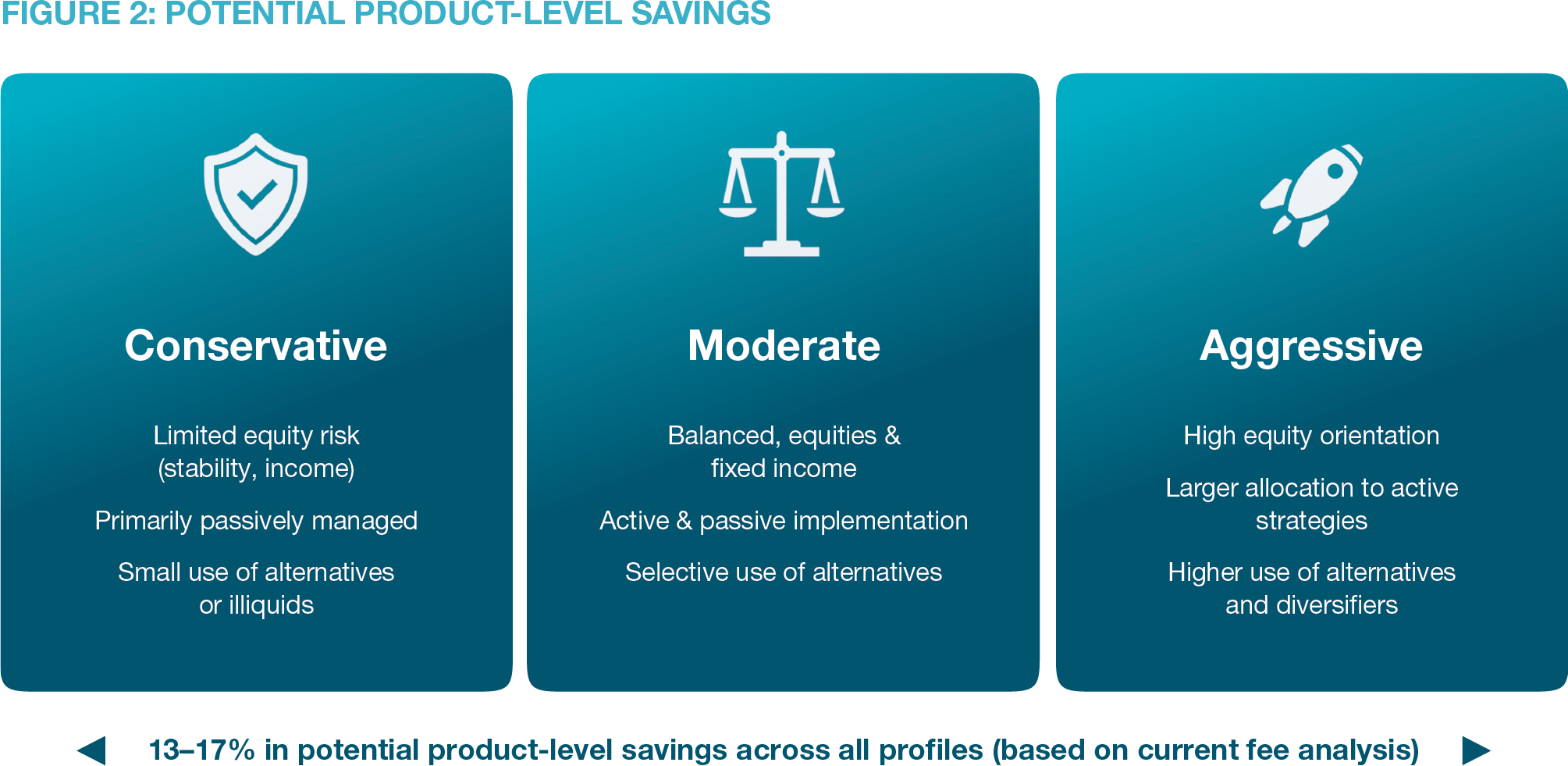
There may be particularly large scope for improvement within private markets (an increasingly substantial component of wealth managers’ offerings): the cost complexity of asset classes such as private equity, private credit and real estate—with their carry and waterfall mechanics—provide fertile ground for error and unnecessary leakage.
2. Operational efficiency in structures
Legacy fund ranges, outdated share classes and fragmented platform architectures can introduce unnecessary cost, duplication and operational drag. This issue can be particularly glaring as firms scale – whether via organic client AuM growth or through mergers and consolidation. The changing use of technology is also central to this subject: technology can be part of the solution, or (where implemented poorly) can compound the existing problems.
Structural reviews can lead to the consolidation of overlapping vehicles, the retirement of obsolete strategies and the simplification of platform offerings, reducing ongoing administrative costs and creating a more resilient product architecture. Such improvements also lay the foundations for stronger governance and oversight, which support the transparency imperative as regulatory expectations evolve.
3. Reduce trading costs
FX costs often receive little attention, yet they can be a material area of hidden leakage within global wealth portfolios. Custodian and banking spreads on currency conversions frequently sit well above competitive market levels, creating avoidable drag for clients with international exposures. Even where teams manage this in-house there are potential efficiencies to be gained. By benchmarking FX execution and introducing genuine competition, wealth managers can unlock meaningful savings.
Few firms position FX optimisation as part of their value proposition, yet it resonates strongly with cross-border clients and signals attention to detail that strengthens trust. Equity and bond trading efficiency can also be scrutinised, whether these are handled directly or at the underlying product level: if the latter, benchmarking can help to support effective fee renegotiation.
Scale is not a silver bullet
The industry has been turning to scale as part of efforts to improve profitability. Focus Financial Partners, Hightower and Creative Planning in the US — and Evelyn Partners or RBC Brewin Dolphin in the UK — illustrate the trend of private-capital-backed aggregation. Scale offers potential efficiencies: access to lower fee share classes, shared technology, centralised compliance and common platforms.
But material value still sits in the layers of the cost stack. While scale can enhance a firm’s ability to pull the levers noted above, efficiency is far from inevitable. For example, many mergers fail to rationalise overlapping fund ranges, leaving AUM fragmented across duplicate strategies and weakening the very scale benefits the takeover was meant to achieve. With an effective strategy, firms can convert aggregation into a durable competitive advantage rather than relying on size alone to protect margins.
Conclusion
Fee and margin compression are now structural realities. Disciplined cost governance has become a strategic necessity – not a discretionary exercise. By addressing underlying product fees, trading costs and structural inefficiencies, firms can unlock recurring savings and protect healthy margins, while also evidencing rigour and competitiveness to clients.
Important Notices
This commentary is for institutional investors classified as Professional Clients as per FCA handbook rules COBS 3.5R. It does not constitute investment research, a financial promotion or a recommendation of any instrument, strategy or provider. The accuracy of information obtained from third parties has not been independently verified. Opinions not guarantees: the findings and opinions expressed herein are the intellectual property of bfinance and are subject to change; they are not intended to convey any guarantees as to the future performance of the investment products, asset classes, or capital markets discussed. The value of investments can go down as well as up.