English (Global)
  Français (France)
  Deutsch (DACH)
  Italiano (Italia)
  English (United States)
  English (Canada)
  French (Canada)
bfinance insight from:

Henry Cotton
Senior Associate

Bradley Budd
Senior Director, Wealth
How can investors guard against the risk of underperformance in semi-liquid private market funds? While some degree of liquidity-related performance drag may be intrinsically necessary (and indeed acceptable), sub-optimal practices can greatly exacerbate the risk of inferior results. Tight scrutiny of governance, liquidity management and cost can help to close the gap.
Potential performance detractors in semi-liquid funds
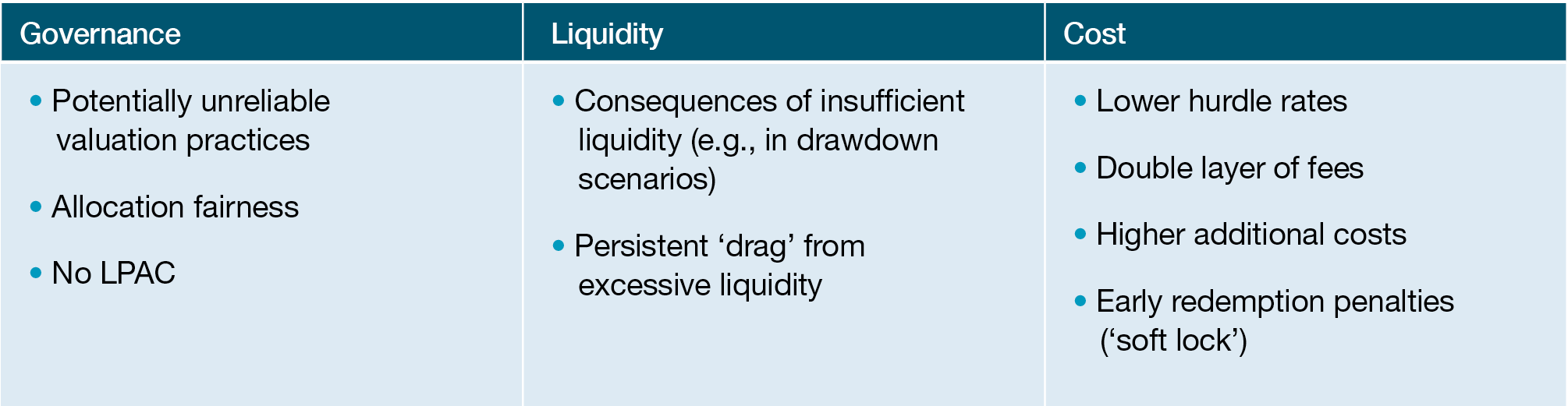
It can be highly challenging to set performance expectations for semi-liquid private market funds. The sector is growing and maturing rapidly, as explored in recent white papers (Private Markets for Private Wealth: Democratisation vs. Retailisation and Navigating Potential Pitfalls in Semi-liquid Private Equity), with growing demand from wealth, mass affluent, retail and DC pension investors. As such, live track records are typically too short to permit robust scrutiny.
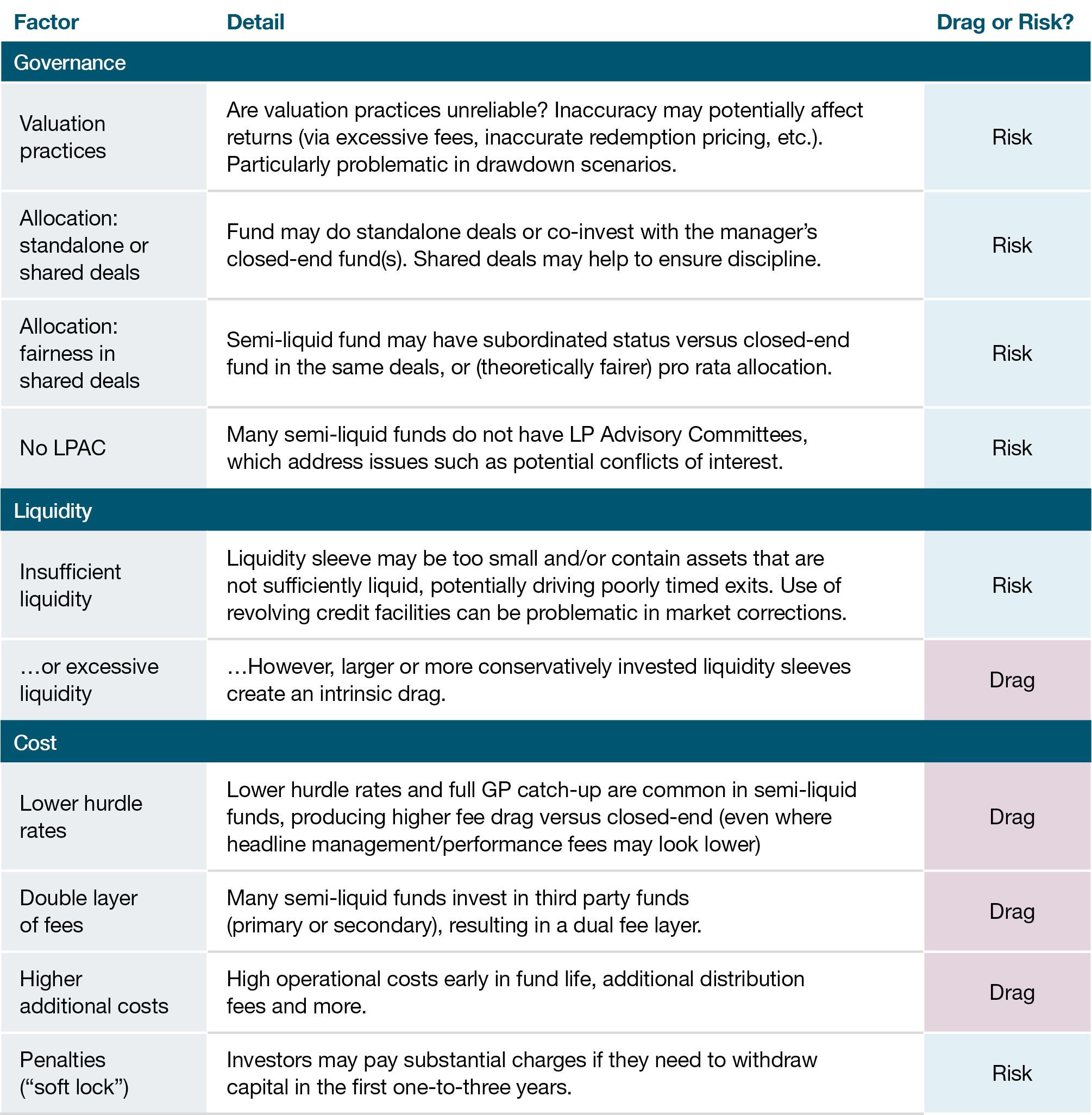
On the surface, the stated performance intentions for semi-liquid private market funds may appear to be similar to (or only marginally below) their closed-end counterparts, although their hurdle rates are often—it should be said—rather lower. In practice, however, there are a number of potential performance detractors: factors that either create a direct drag on return or amplify the risk of poor outcomes.
Performance drag or performance risk?
Q&A with Henry Cotton and Bradley Budd, bfinance Wealth
You draw attention to the potential for less robust valuation practices. What do you see happening in practice?
Valuation practices across the semi-liquid fund universe are inconsistent, which makes performance assessment particularly challenging. Some wealth products rely on third-party assurance (typically on a quarterly and annual basis) across a range of acceptable values, but this is not the same as a full, independent third-party audit (typically annual), which is common for open-ended institutional funds.
This is a really important issue. Inaccurate valuations can misrepresent unrealized returns, distort entry and exit pricing, complicate liquidity planning, skew performance attribution, and even affect fee calculations. These risks are particularly material for strategies that focus on capital appreciation.
[Further reading: The Valuation Question: Operational Risk in Private Markets.]
Is there an issue with “fairness” in capital allocation?
Investors should pay close attention to the capital allocation process and, specifically, how wealth products/investors are treated versus institutional funds or separate accounts. There are managers that do this well but, in some cases, we do have serious concerns. The reality is that fund managers are often more motivated to ensure strong performance for flagship strategies.
Semi-liquid funds can either pursue transactions themselves (‘standalone’) or participate with other pools of capital across a manager’s platform (sometimes referred to as ‘co-investment’). The co-investment approach can help to ensure that deals are tied to an institutional-level performance incentive structure, since the closed-end fund may have a higher hurdle rate. It can also help to ensure discipline on pursuing attractive exits.
However, where deals are shared, investors should understand whether certain funds are being prioritised or the manager is using a ‘pro rata’ allocation approach. The ‘pro rata’ approach is theoretically more equitable for retail investors but is not (yet) commonplace in practice.
This is not a simple subject. Even when there may be a ‘pro rata’ policy that appears fair on paper, it may limit the semi-liquid fund’s ability to deploy capital efficiently. For example, if inflows cannot be absorbed rapidly, excess cash may accumulate beyond the liquidity sleeve, negatively impacting performance.
The liquidity question is clearly a complex one, with potential performance risks resulting from ‘too much’ or ‘too little’ liquidity. How are semi-liquid funds approaching this issue?
Managers are taking quite different approaches on this topic. Some prefer to keep the “liquidity sleeve” tight to minimise that drag, while others prefer a more developed buffer to protect the portfolio from redemption waves. The fact is that there is a direct link between redemption pressure and fund performance, since liquidity constraints can magnify return outcomes; realistically, redemption waves are more likely to come during periods of market correction.
These differences are not necessarily apparent from a quick scan of a term sheet. Many funds indicate that their liquidity sleeve represents 10-20% of portfolio NAV, for example, but the positions within that sleeve can have very different liquidity profiles: some include illiquid loans, which provide yield but cannot be immediately liquidated in more urgent situations.
Access to liquidity: comparing ten semi-liquid infrastructure funds
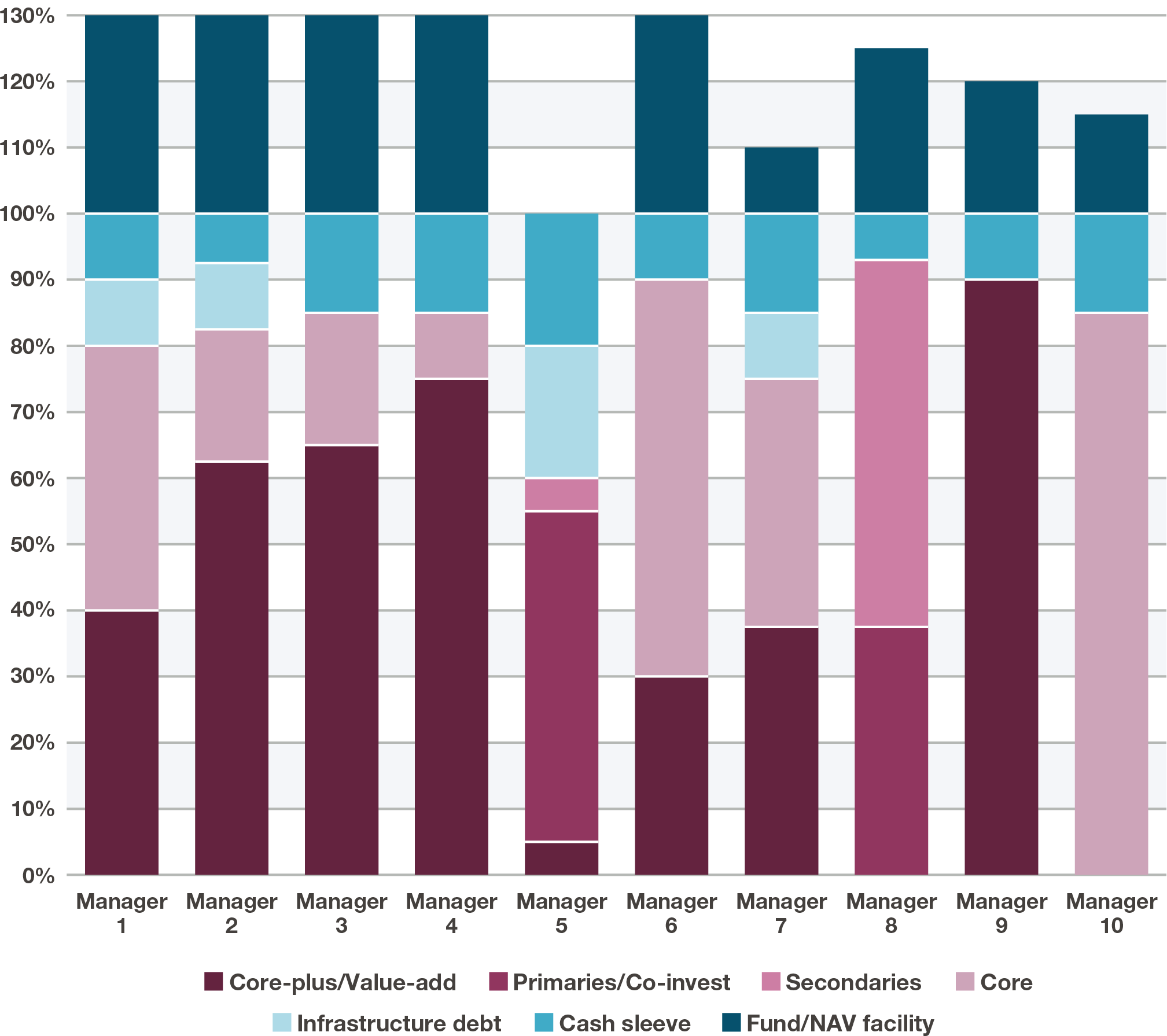
Indicative fund portfolio composition of ten semi-liquid infrastructure funds.
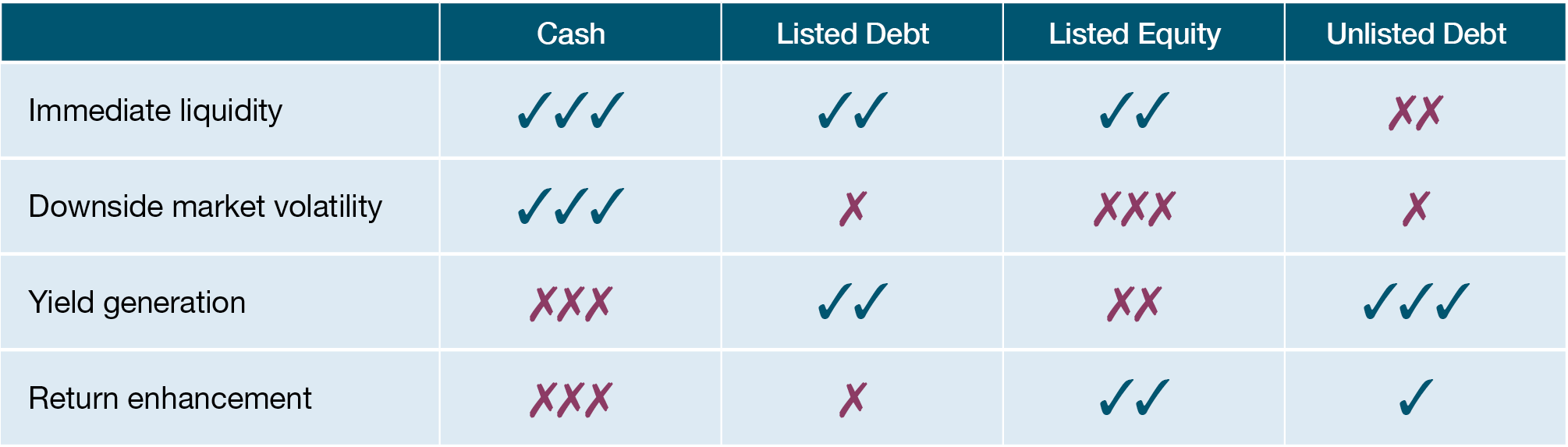
Indicative liquidity profiles of typical components of semi-liquid private markets fund liquidity sleeves.
Investors should also be cautious about the extent to which the strategy might rely on additional provisions (beyond the assets themselves) to provide liquidity. For example, a fund will typically have access to a revolving credit facility, but using leverage to fund redemptions during a period of market correction would be likely to compound poor performance. There are examples of managers using balance sheet capital to build out, seed and warehouse a new semi-liquid portfolio, but examples of this being used as a liquidity source (particularly for retail investors) are limited in practice.
It’s worth paying particular attention to alignment (or misalignment) between liquidity provisions and fund terms. “Semi-liquid” products do not guarantee meaningful liquidity: redemption limits (typically 3-5% per quarter) are often subject to the manager’s discretion; most funds have soft lock provisions penalising investors for early withdrawals; some have hard locks prohibiting withdrawals entirely within the first one-to-three years.
You point to the higher costs of semi-liquid funds. What can investors do to address this?
Costs are typically higher for semi-liquid strategies, for a variety of reasons (as noted in the table above). Even where headline management/performance fees might appear to be similar or lower, this does not tell the full story: it’s important to look at all cost layers.
That being said, costs can be mitigated. Larger retail investors can often access more fee-efficient (“I-class”) shares, which do not carry a distribution fee and do not include sales charges. Discounts can be made available with newer funds coming to market. Consultant-driven aggregation can produce lower pricing. Multi-manager strategies may, on occasion, provide “fee-free” co-investments as part of the fund strategy, reducing embedded costs, though investors interested in this aspect should pay close attention to the manager’s approach to allocating such opportunities. Over the longer term, we would hope to see fee compression as this sector matures.
Conclusion
Investors seeking to understand the factors that may detract directly from returns and/or amplify the risk of poor returns should look beyond term sheets. Even products that appear similar on paper may differ greatly in terms of their structure and philosophy. Closer examination of governance, liquidity provision and cost can help to bring clarity and provide confidence in prospective opportunities.
Important Notices
This commentary is for institutional investors classified as Professional Clients as per FCA handbook rules COBS 3.5R. It does not constitute investment research, a financial promotion or a recommendation of any instrument, strategy or provider. The accuracy of information obtained from third parties has not been independently verified. Opinions not guarantees: the findings and opinions expressed herein are the intellectual property of bfinance and are subject to change; they are not intended to convey any guarantees as to the future performance of the investment products, asset classes, or capital markets discussed. The value of investments can go down as well as up.