English (Global)
  Français (France)
  Deutsch (DACH)
  Italiano (Italia)
  English (United States)
  English (Canada)
  French (Canada)
IN THIS PAPER
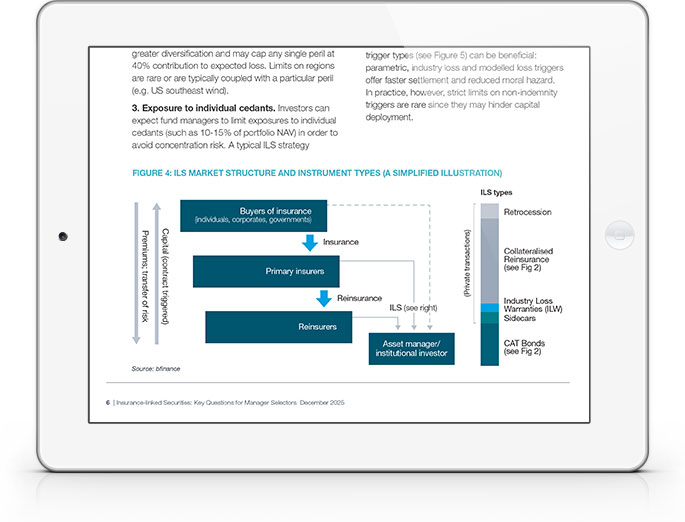
Sector recap and useful tools: A concise overview of the catastrophe bond and private ILS sectors, including a detailed glossary of terms to demystify relevant jargon and assist investors in navigating the landscape.
Reviewing recent developments: Many ILS fund managers experienced difficulties in 2017-2022, precipitated by a series of catastrophic events that placed risk models under strain and led to investor disappointment. The asset class has subsequently recovered strongly and newer ILS sub-categories (e.g. cyber risk) have evolved. Yet to what extent have crucial lessons been learned?
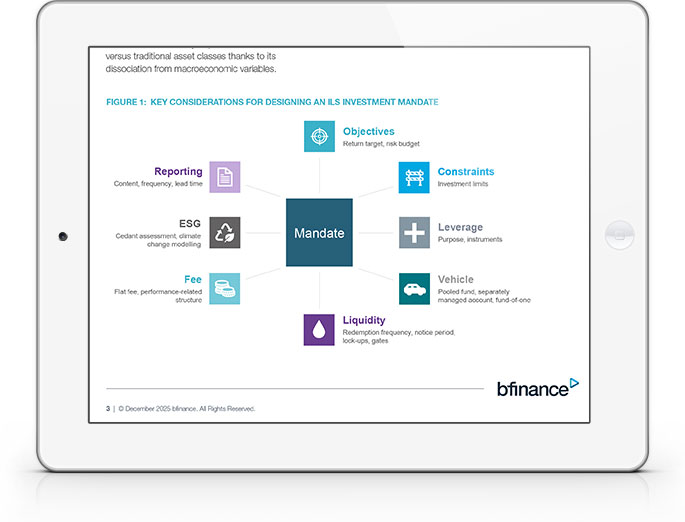
Key considerations when designing an ILS investment mandate: This report sets out eight key areas of focus and the difficulties involved in setting parameters. What risk/return objectives are suitable, given the potential damage that can be caused by inappropriate targets? How should constraints and limits be defined (peril-specific limits, trigger types, etc.) in order to balance the importance of risk mitigation with the need to keep a suitably broad opportunity set? Are fund managers' liquidity provisions sufficiently aligned with their underlying portfolios?
WHY DOWNLOAD?
The Insurance-linked Securities (ILS) sector has recovered strongly, with catastrophe bond issuance hitting record levels. While institutional investor appetite has also been resurgent, allocators are keen to avoid pitfalls that scuppered performance in previous years. Manager selection in ILS involves distinct challenges, with unique investment risks and significant operational complexity to consider.
Among bfinance’s global investor client base, recent demand for ILS strategies has been particularly strong. Although pricing has softened somewhat, with rate-on-line levels coming off their historic highs, returns are still elevated when compared with the pre-2020 period. Higher-for-longer interest rates have supported attractive yields, while the sector demonstrated its ability to provide diversification versus traditional asset classes thanks to its dissociation from macroeconomic variables.
Yet asset owners looking to invest in catastrophe (cat) bonds and/or private ILS transactions should be wary to avoid ill-suited strategies. The investment universe is broad and evolving, with new trends including the emergence of the cyber risk segment. ILS investment strategies vary greatly in terms of their objectives and underlying risks, contributing to significant performance dispersion.
Success hinges on thoughtful mandate design. This report aims to provide institutional investors with a practical guide to ensure a targeted approach to ILS manager selection and identify strategies that align with their return expectations, risk appetite, liquidity needs and operational capabilities.
Important Notices
This commentary is for institutional investors classified as Professional Clients as per FCA handbook rules COBS 3.5R. It does not constitute investment research, a financial promotion or a recommendation of any instrument, strategy or provider. The accuracy of information obtained from third parties has not been independently verified. Opinions not guarantees: the findings and opinions expressed herein are the intellectual property of bfinance and are subject to change; they are not intended to convey any guarantees as to the future performance of the investment products, asset classes, or capital markets discussed. The value of investments can go down as well as up.