English (Global)
  Français (France)
  Deutsch (DACH)
  Italiano (Italia)
  English (United States)
  English (Canada)
  French (Canada)
Policymakers are seeking to turn investors’ attention closer to home in pursuit of resilience – Germany is at the forefront of efforts to redirect private capital. Sluggish productivity, geopolitical fragmentation and tight public budgets are prompting governments to bolster the resilience of domestic economies through incentivising private capital to back priority projects.
bfinance insight from:

Matthias Grimm
Senior Director, Client Consulting

Peter Hobbs
Managing Director, Private Markets Advisory

Anish Butani
Managing Director, Head of Infrastructure
Policymakers are seeking to influence allocation to sectors or assets able to deliver both financial returns and tangible local outcomes. Achieving so-called 'place-based investing' objectives, however, is proving elusive without suitable structures and incentives in place.
The implementation of Germany's €500 billion off-budget infrastructure and climate-neutrality fund is illustrative of the challenges. Financing the upgrade of municipal infrastructure – such as public buildings, roads, bridges and transport systems – is a key objective for the fund.
However, a lack of credible, scalable strategies to access such opportunities is emerging as a 'supply-side' constraint holding back the involvement of private capital.
Less than half of the estimated €200 billion-plus municipal infrastructure backlog will be covered by the fund's €100 billion allocation to this area, a gap that German allocators have so far proved reluctant to fill.
New fund won't cover municipal funding gap…
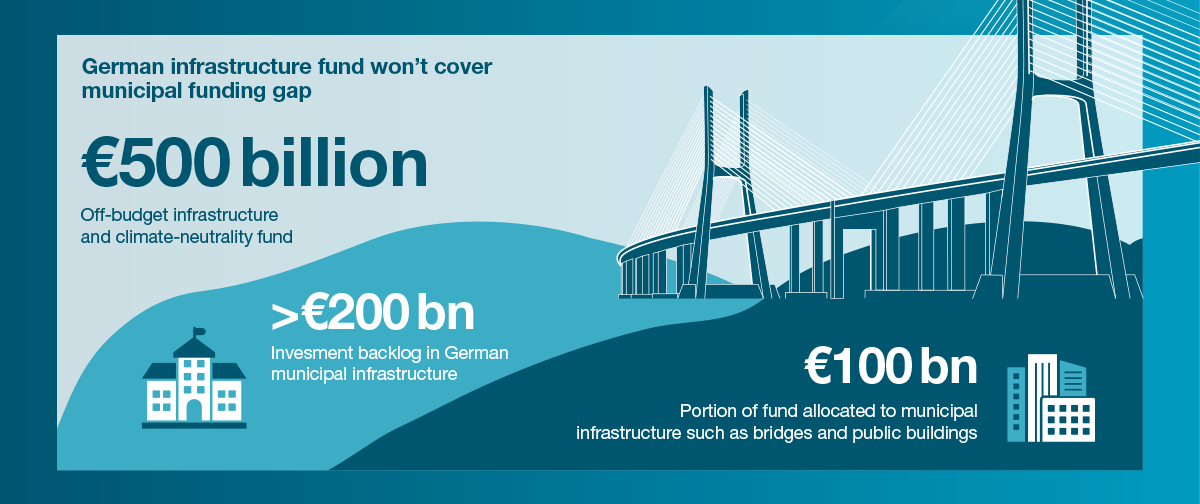
Germany urgently needs investment in infrastructure. While the government has established a €500 billion fund to address this, it will not be sufficient. Overall investment demand is three to four times higher, making private capital essential.
…as the so-called 'reverse home bias' persists
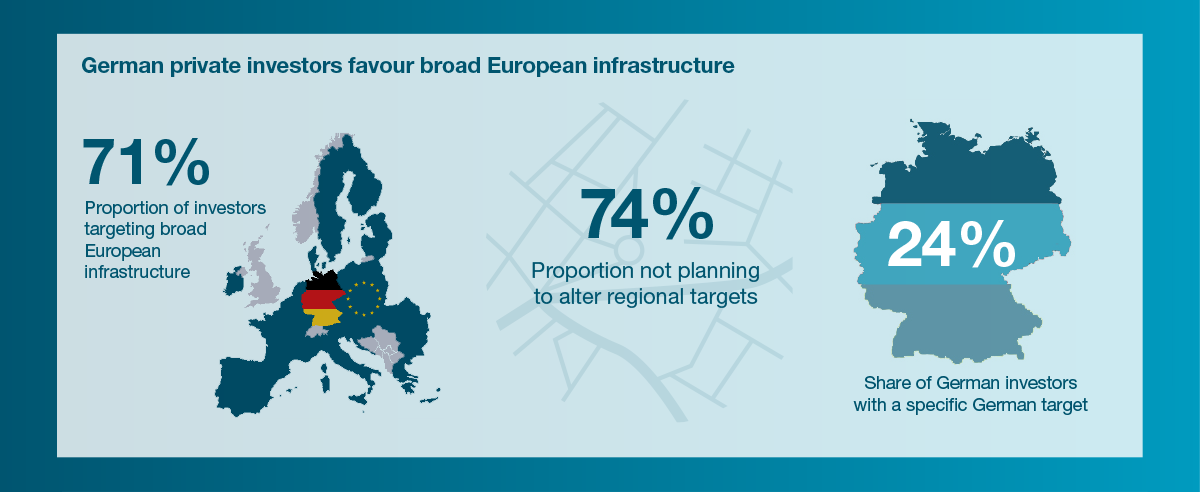
Despite the changes in the regulatory environment to date, it seems the so-called 'reverse home bias' persists - very few German institutional investors have a specific target allocation to Germany.
For more see: German Infrastructure: What Will It Take to Unlock Domestic Investment Opportunities?
Supply-side reforms required to attract capital
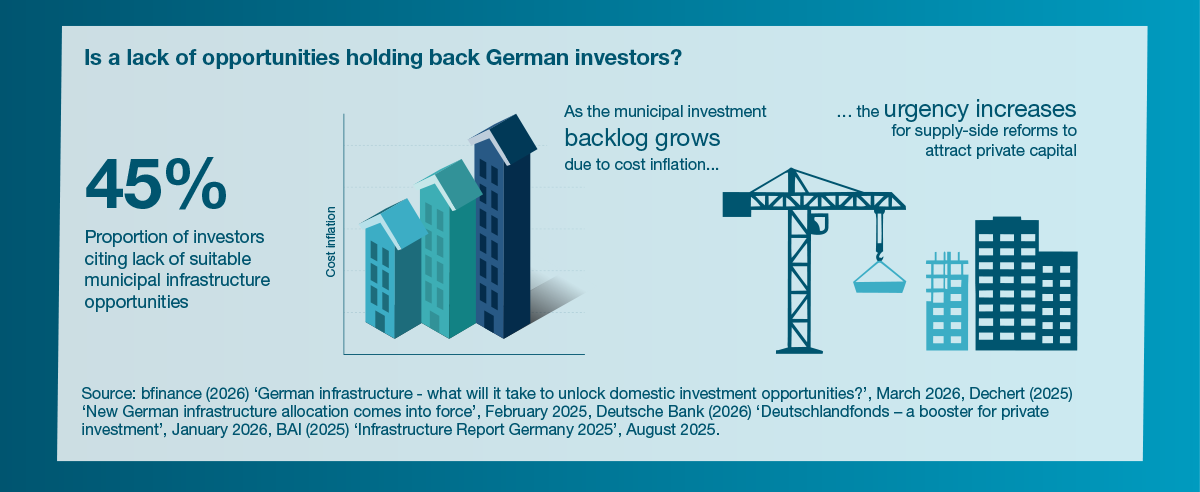
A shortage of opportunities seems to be a key challenge for those German investors with a target allocation to German infrastructure in achieving it. For now, domestic investors appear to be looking to the infrastructure asset class for the role it will play in the portfolio, rather than any Germany-role it could play.
For the global perspective on infrastructure see: Global Infrastructure Survey: Three Takeaways
Important Notices
This commentary is for institutional investors classified as Professional Clients as per FCA handbook rules COBS 3.5R. It does not constitute investment research, a financial promotion or a recommendation of any instrument, strategy or provider. The accuracy of information obtained from third parties has not been independently verified. Opinions not guarantees: the findings and opinions expressed herein are the intellectual property of bfinance and are subject to change; they are not intended to convey any guarantees as to the future performance of the investment products, asset classes, or capital markets discussed. The value of investments can go down as well as up.