English (Global)
  Français (France)
  Deutsch (DACH)
  Italiano (Italia)
  English (United States)
  English (Canada)
  French (Canada)
bfinance insight from:

Ruben Mutsaers
Senior Director, Investment Solutions
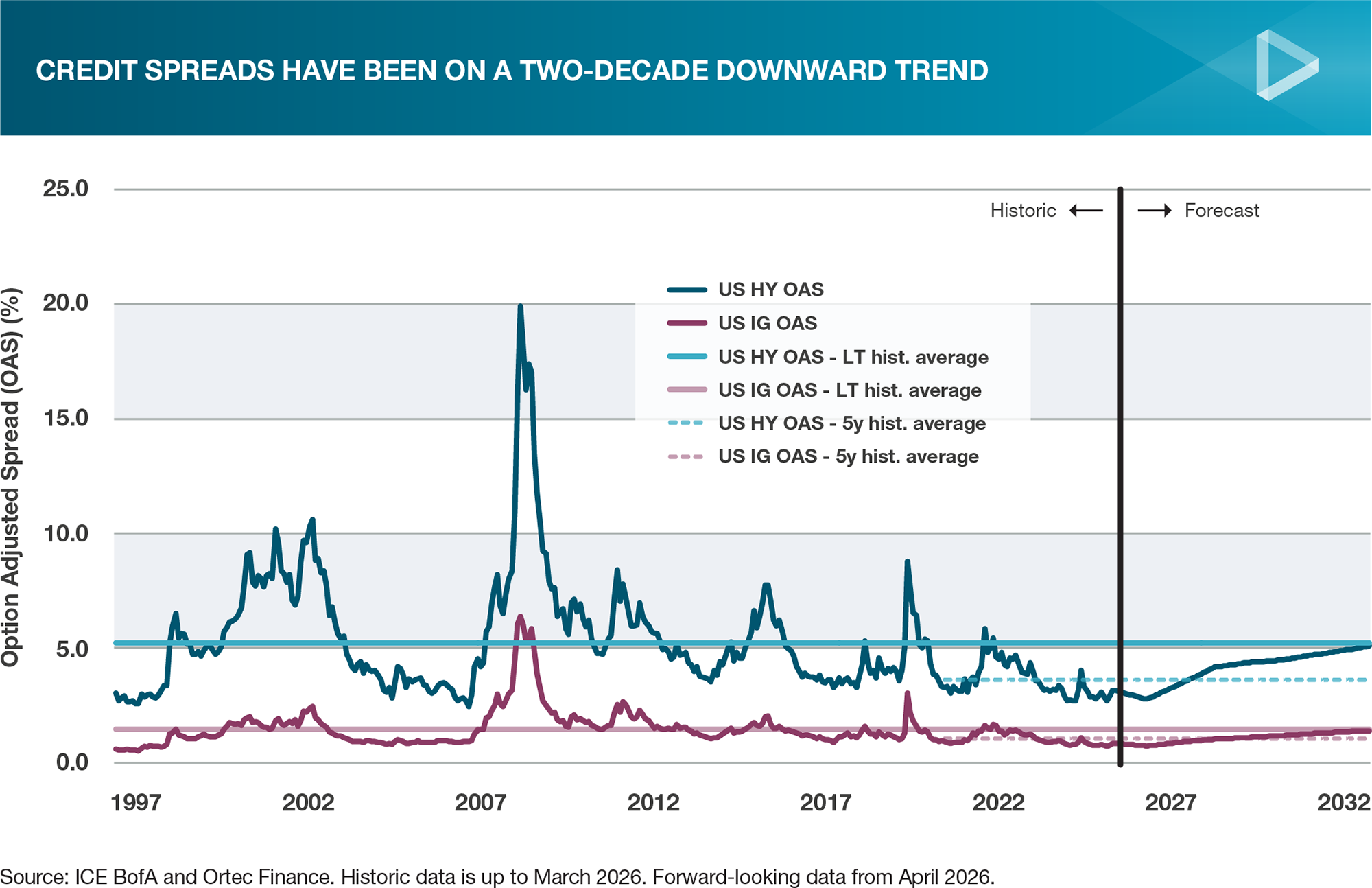
Since the 2007/08 Global Financial Crisis, aggressive monetary easing, prolonged low interest rates and repeated policy backstops have compressed risk premia. Strong investor demand for yield, post-crisis bank regulation shifting credit to markets, and improved corporate balance sheets have further supported tighter spreads, despite episodic shocks.
Assessing the potential impact of spread normalisation is critical for investors allocating to credit markets. That is why we're asking what a modest assumption of spreads reverting back to their post-Covid average might mean for fixed income returns.
Many view investment grade (IG) credit as a means to enhance total return or income relative to government bonds. Meanwhile, high yield (HY) exposure may serve investors seeking higher income or a lower risk growth component within a risk asset portfolio.
Tight credit spreads reduce income, but more importantly, they can significantly diminish total returns when spreads widen – often abruptly rather than gradually.
Practitioners frequently highlight tight spreads, but do not always quantify the degree to which total return may be affected – and over what horizon. Our analysis indicates that the three-year expected annual return (arithmetic) for IG credit sits only 0.50% above government bonds, while HY could underperform government bonds. This is largely a consequence of anticipated spread widening.
Investment horizon matters
For credit investors, the relevance of this analysis is highly dependent on time horizon and behaviour. The weak three-year expected returns largely reflect an assumed full liquidation over that period and the impact of spread normalisation from currently tight levels. For investors with a short-term horizon, this points to limited near-term value.
However, many institutional investors allocate to higher yielding credit on a long-term, potentially buy-and-hold basis, where interim spread widening may depress mark-to-market total returns but can ultimately support higher forward yields. In this context, long-term outcomes are more closely driven by yield-to-worst, adjusted for defaults and recoveries, rather than interim price movements.
Breaking down the expected return components
Bond returns can be decomposed into yield and the impact of duration (rate changes):
- The total yield comprises a base rate (from the government bond yield curve) and a credit spread, forming the income portion of total return.
- Duration impact includes both base rate movements (government yield shifts) and credit spread compression or expansion. Bond prices respond to changes in both base rates and spreads, reflecting interest rate and spread duration – this forms the capital portion of total return.
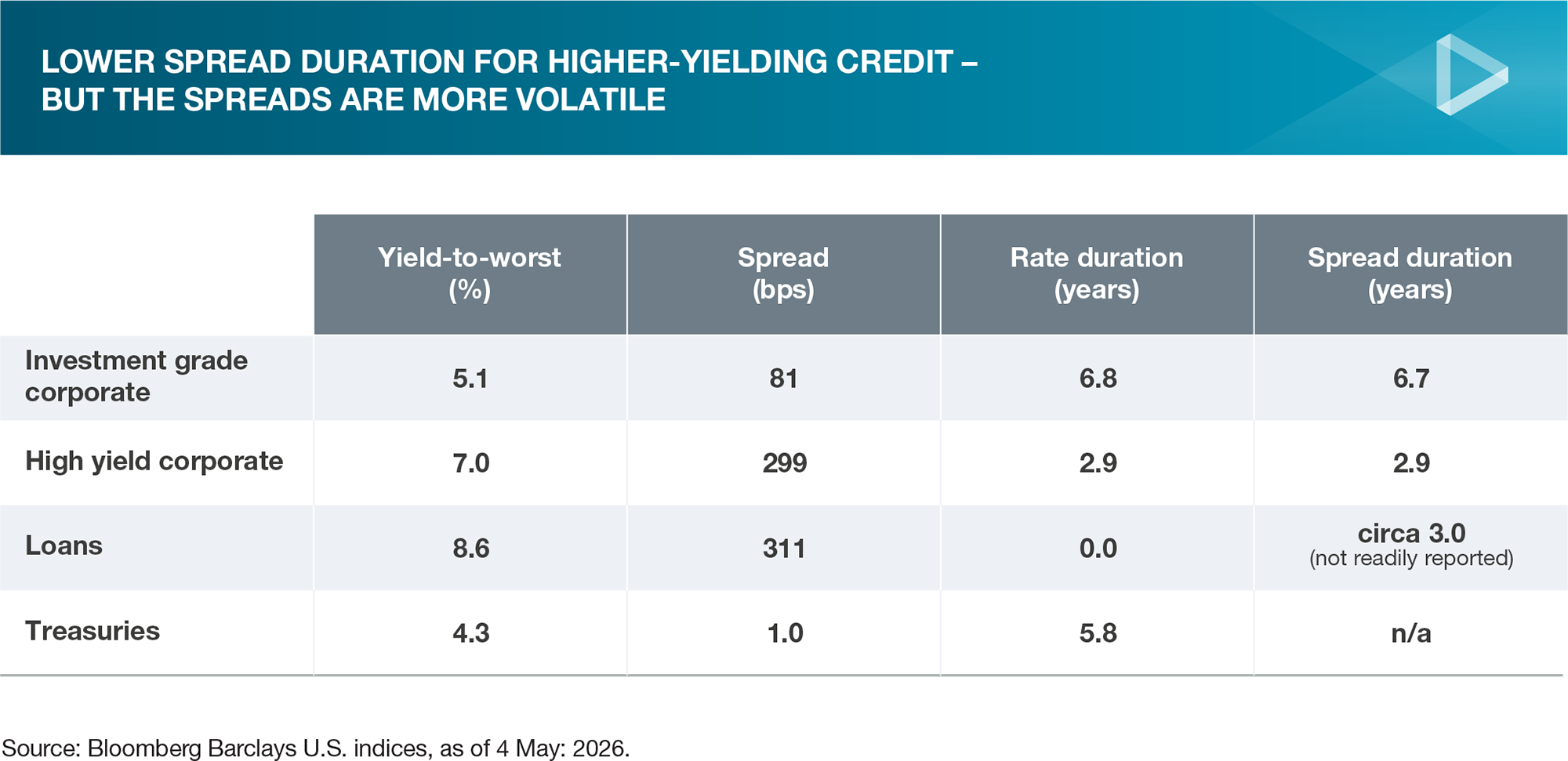
IG credit typically exhibits higher interest rate duration than HY, as IG issuers can issue longer-dated debt. This results in greater sensitivity to interest rate changes and, over the next three years, our base case is for a minor impact from interest duration on IG credit prices due to rising base rates.
HY, by contrast, offers a materially higher credit spread yield due to lower credit quality. At this stage in the cycle, with spreads exceptionally tight, the higher spread duration is expected to exert a significant negative impact on returns over the coming three years – a dynamic that affects IG, but is more pronounced in HY.
That is not to say that IG is immune to spread widening – the table highlights a spread duration of 6.7, however, while the spread duration is high, the actual volatility in spreads is less pronounced.
Loans, owing to their floating rate structure (with coupons resetting quarterly), are not affected by interest rate duration. However, widening spreads do impact returns via spread duration.
Taken together, higher yielding credit appears to offer little relative value from a credit risk widening perspective. Of course, that is assuming that credit spreads widen – the three-year expected returns reflect a widening back to the average level of credit spreads since the Covid crisis. For HY, this would be a widening to a 419 basis points (bps) spread in 2029 from 319 bps as of March 2026. This leads to HY bonds underperforming government bond debt over a three-year period.
How can this outcome occur?
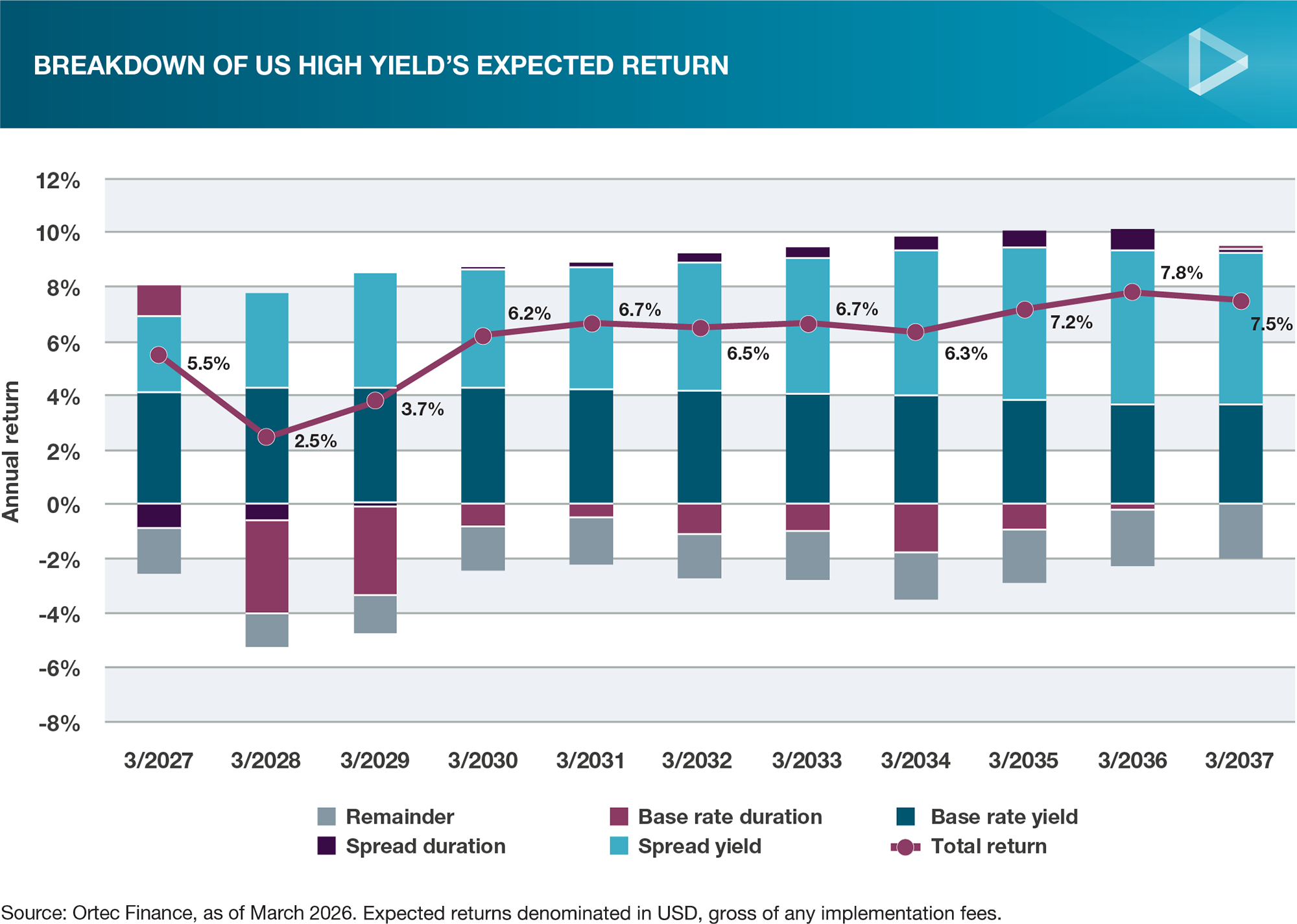
To form a view on expected return, return is broken down into five components, representing yield and duration effect from base rates and yield and duration effect stemming from credit spreads as well as a remainder component reflecting credit migrations and other idiosyncratic return sources.
Importantly, these yield and duration building blocks of return are individually broken down into their maturity components – the dynamics on the short-end of the yield curve are different to dynamics on the long-end of the curve.
This is visualised by the expected change in the HY credit spread curve, where it is the expectation that the short end of the spread curve would widen less than maturities beyond three years. From a duration perspective this is important, as spread widening on the longer end of the curve has a larger impact on the expected return.
On the base rate side, it is the expectation that the yield curve will remain relatively stable with the US curve moving upwards by 20 to 40 bps across the curve – hence there is expected to be a limited contribution from base rate movements over the next three years. Of course, a continued energy supply shock caused by the Iran war could lead to an inflation flare-up and push the long-end upwards.
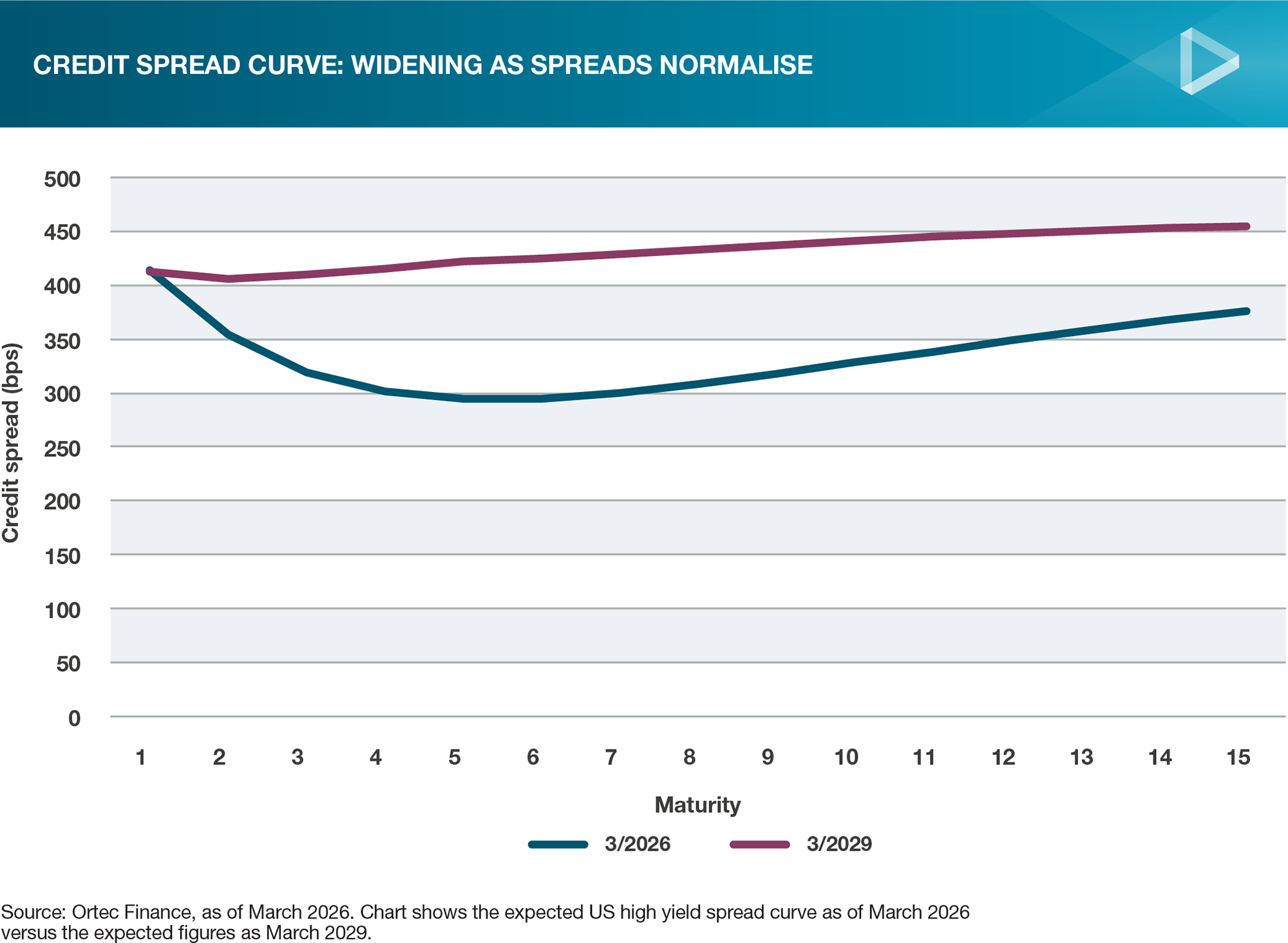
Via these expected changes in the credit curve, the spread duration effect can be computed by multiplying the respective maturity bucket with the change in yield curve for that particular maturity point.
Breaking down the impact of spread widening by maturity shows that a large proportion of negative expected return stems from four-year to seven-year maturity – perhaps a comforting thought for allocators to short duration HY credit mandates.
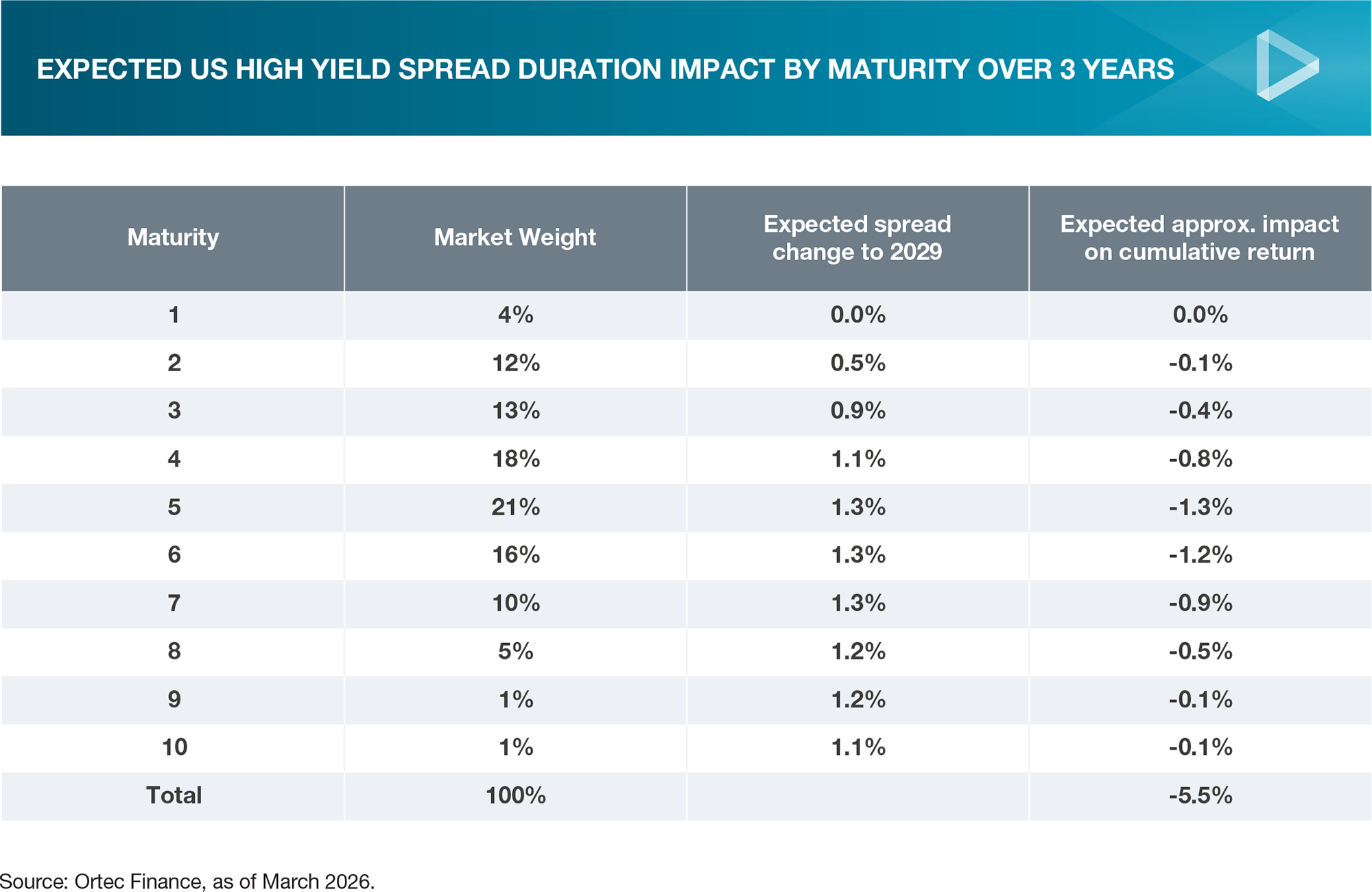
The above shows that HY credit appears relatively unattractive from a total return perspective, even under conservative assumptions of steady (higher-for-longer) base rates and spread widening back to its recent 5-year average over a 3-year period.
Capital market assumptions tend to assume a mean reversion to long-term means. In this case we assume a reversal to recent averages over a 3-year period, with a longer-term trend towards a long-term historic spread level of circa 5%. While that sounds dramatically poor for long-term HY expected returns, the spread duration impact over the long-term is offset by increased yields, with estimated total return from 2030 onwards back in the 7% range once spreads have normalised.
Sense check
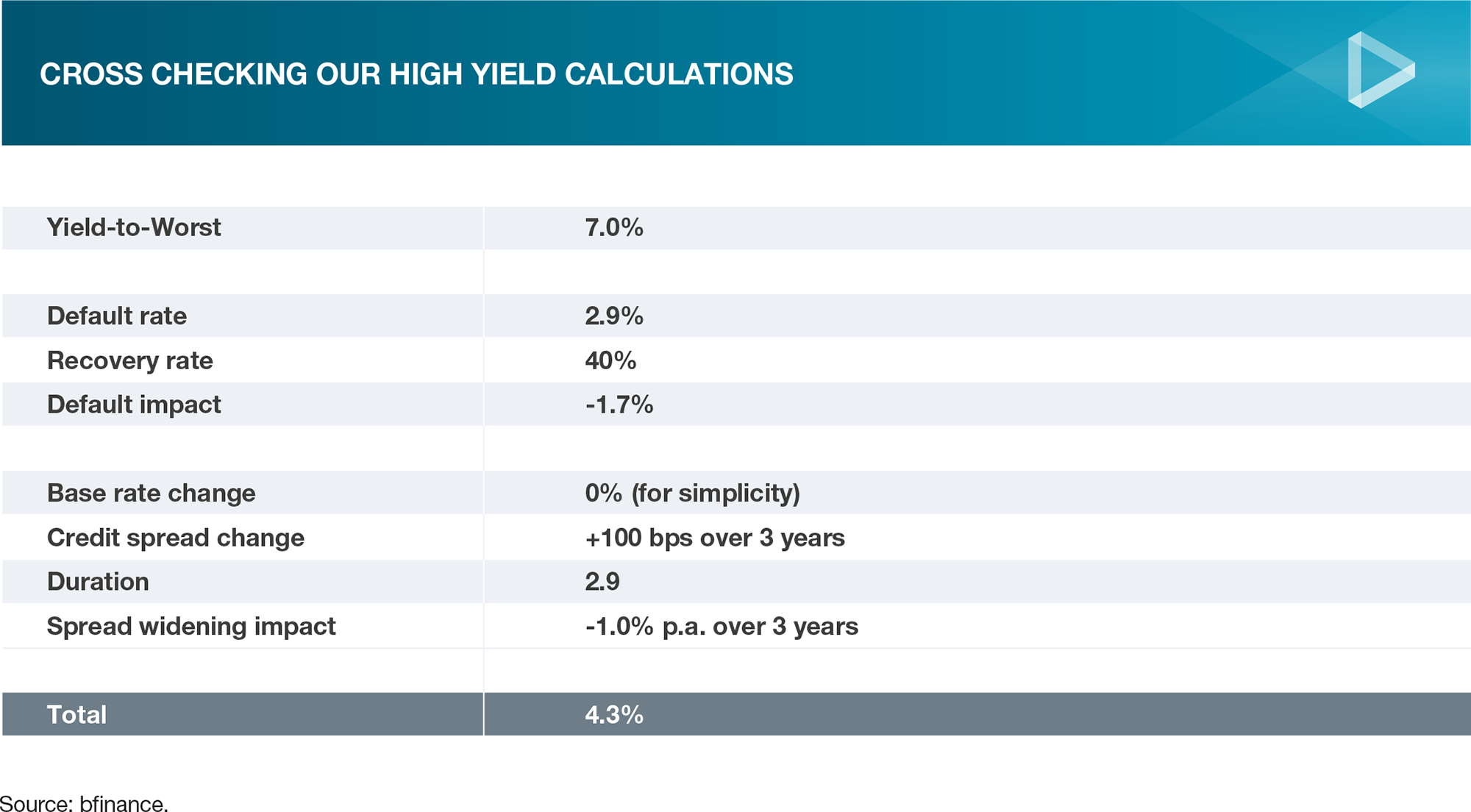
A simple way to get to an approximate expected return for fixed income is to consider the market's current yield-to-worst, adjust for expected defaults and yield curve changes at the duration point.
Abrupt spread widening
These pathways may apply on average while credit spreads can widen abruptly over a brief period for then to come back down in a calmer fashion. This is where specific scenario stress testing enhances analysis that is based on 'average pathway' capital market assumptions.
Such sudden movements in spreads are often triggered by market shocks or a sharp reassessment of credit risk, which may not be reflected in gradual, average-based models. Incorporating stress testing and scenario analysis allows investors to better understand potential downside risks and identify how portfolios might behave in volatile conditions.
This approach is particularly valuable for capturing the impact of events such as defaults, liquidity crunches, or geopolitical uncertainties, where traditional models may underestimate the speed and severity of spread changes. By considering these possibilities, investors can make more informed decisions and build resilience into their strategies.
Opportunities in credit markets
The credit market is one of the most diverse markets in the world, where relative value can be exploited by nimble investors with sufficiently broad mandates. These articles may be of interest to you:
- Fixed Income: Time to Re-evaluate Credit Exposures, Consider CLOs?
- Emerging Market Debt: Extracting Potential Amidst Complexity
Important Notices
This commentary is for institutional investors classified as Professional Clients as per FCA handbook rules COBS 3.5R. It does not constitute investment research, a financial promotion or a recommendation of any instrument, strategy or provider. The accuracy of information obtained from third parties has not been independently verified. Opinions not guarantees: the findings and opinions expressed herein are the intellectual property of bfinance and are subject to change; they are not intended to convey any guarantees as to the future performance of the investment products, asset classes, or capital markets discussed. The value of investments can go down as well as up.