English (Global)
  Français (France)
  Deutsch (DACH)
  Dutch (Nederlands)
  English (United States)
  English (Canada)
  French (Canada)
bfinance insight from:

Kieren Bussey
Senior Associate, Operational Solutions
Disappointing distributions, weak returns and a softer fundraising climate now appear to be putting real pricing power in investors’ hands. That is a key finding of the bfinance Private Market Fees and Costs 2026 snap poll. A large percentage of investors have observed a recent decline in fees for ‘like-for-like’ private market strategies, according to the survey of 84 LPs from around the globe.
LPs report that private market pricing may, at last, be moving firmly in their favour. In a new survey of 84 allocators from more than twenty countries, more than two thirds of respondents said that they had experienced "significant" or "moderate" fee reductions in comparable Direct Lending strategies during the past three years. Meanwhile, nearly half of respondents noted "significant" or "moderate" fee reductions in Infrastructure and Real Estate, followed closely by 39% reporting fee reductions in Private Equity. Overall, 74% of LPs note significant or moderate fee reductions in at least one of the asset classes shown below.
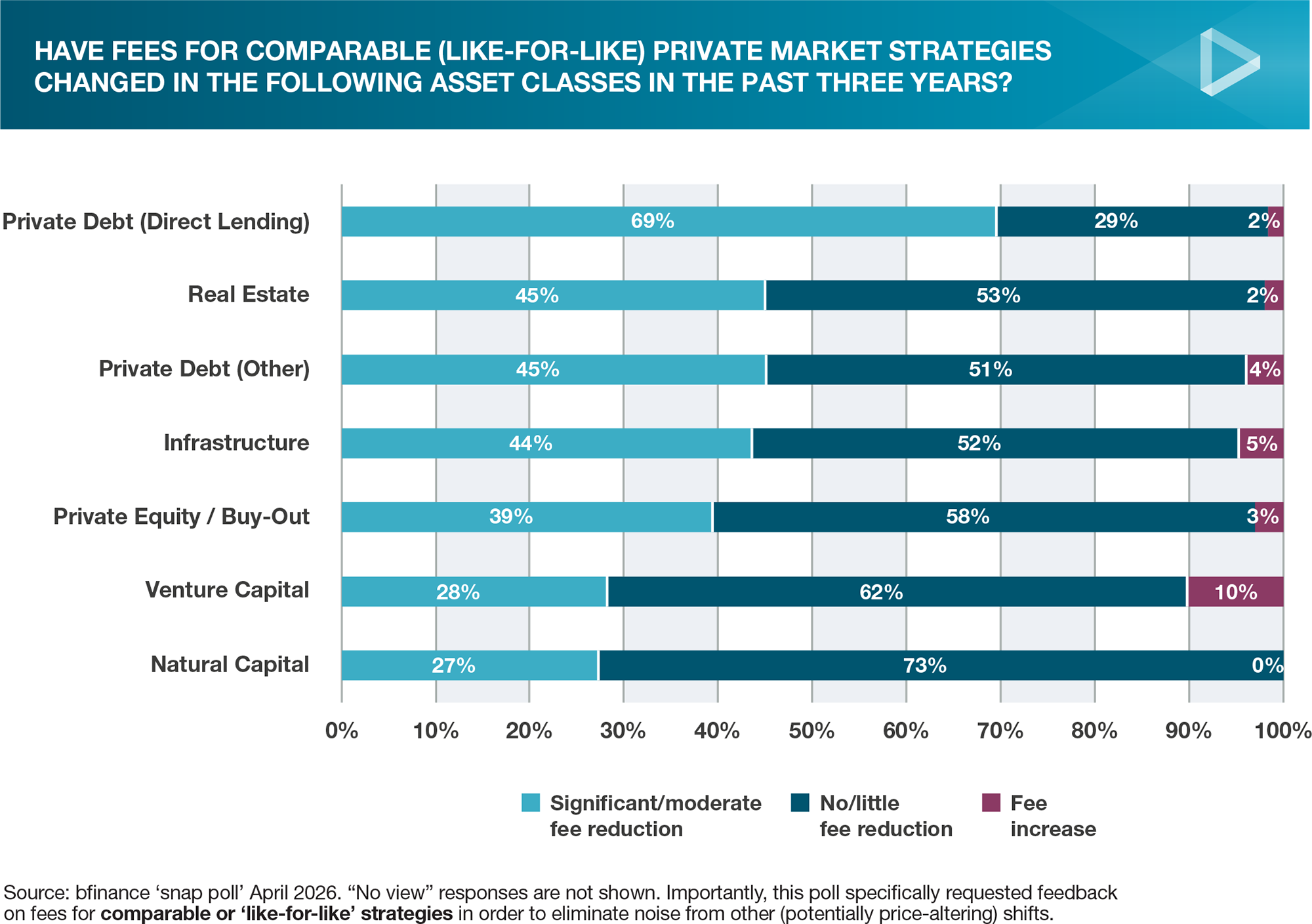
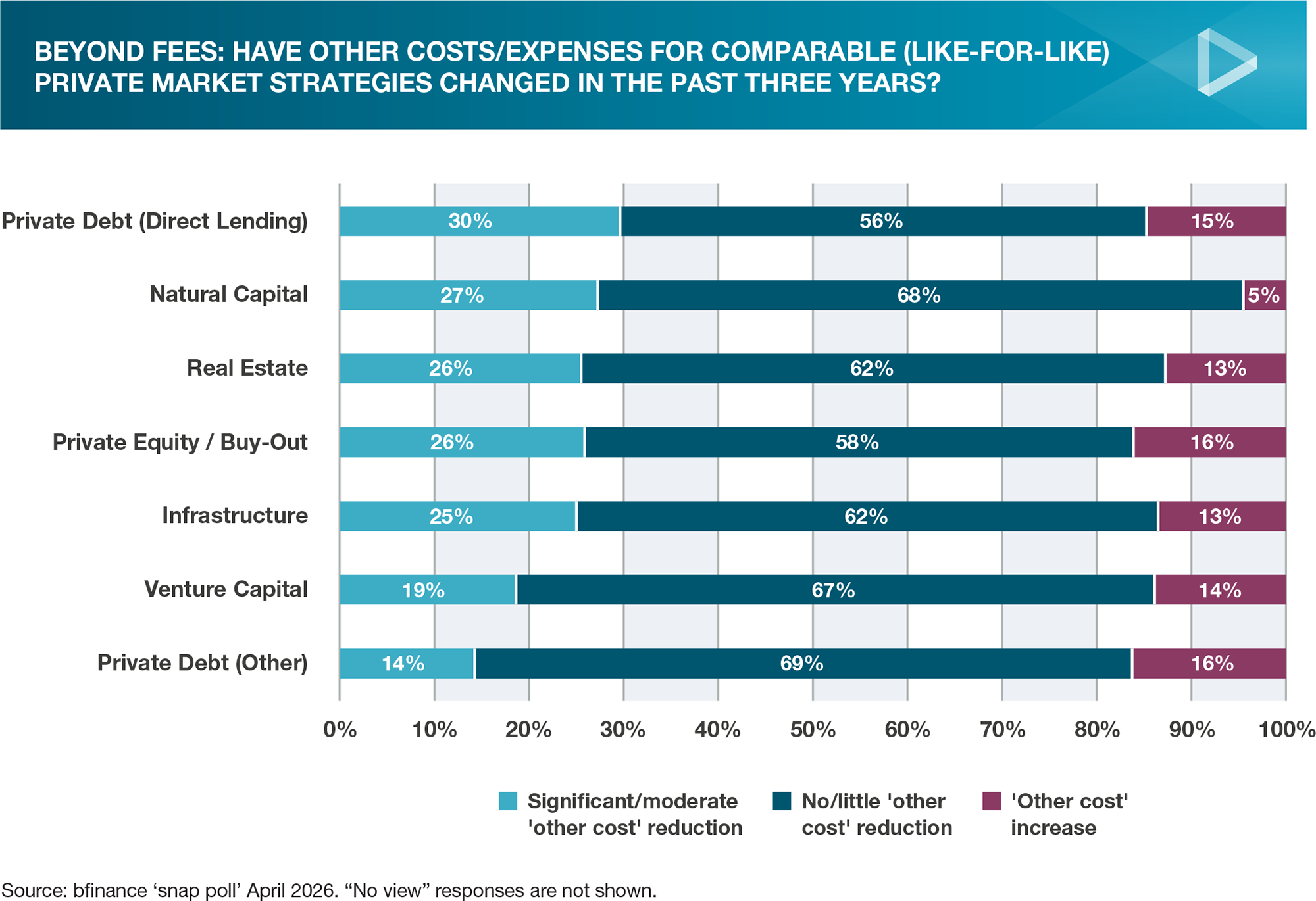
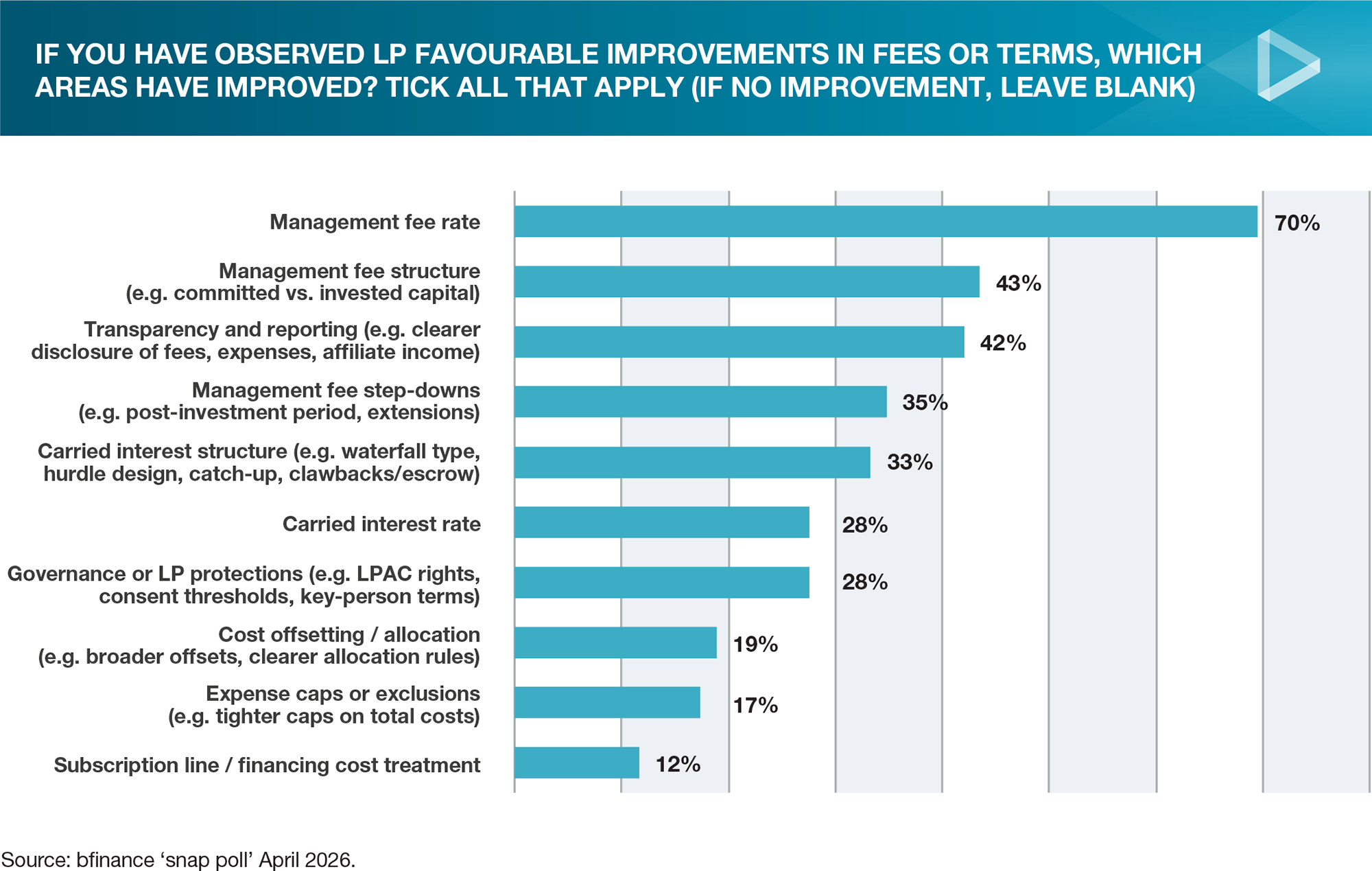
Interestingly, the picture on non-fee costs is more nuanced: while a number of LP respondents did note improvements here, a smaller (but significant) minority pointed to increased expenses that may, in some cases, be partly offsetting fee reductions. Going further, when LPs were asked to indicate the specific sources of fee/cost improvement, the basic management fee rate proved to be the most common area of change.
Turbulent twenties bring price-cutting pressure for private market GPs
From a pricing standpoint, the 2020s are proving markedly different from the 2010s, when fees for many private market asset classes proved resilient while public market active manager costs were in visible decline. Rising institutional investor allocations to private market asset classes, strong fundraising activity and attractive performance data in the post-GFC decade meant that credible fund managers were under little pressure to improve terms in the average LP's favour.
Moreover, there were major obstacles to accurate benchmarking of average fees being paid in private markets: structural complexity is problematic, diverse discounting arrangements are masked in GP-sourced data, and wide-ranging confidentiality requirements are imposed on LPs by GPs – requirements that are worded in extremely broad terms that inhibit investors from engaging even in confidential, anonymised, non-attributable disclosures. Transparency initiatives from regulators and industry bodies through this period chiefly focused on improving the disclosure offered by a GP to their specific LPs, rather than improving visibility on fees at large.
Robust price benchmarking remains a challenge, of course. So what, we might ask, has changed?
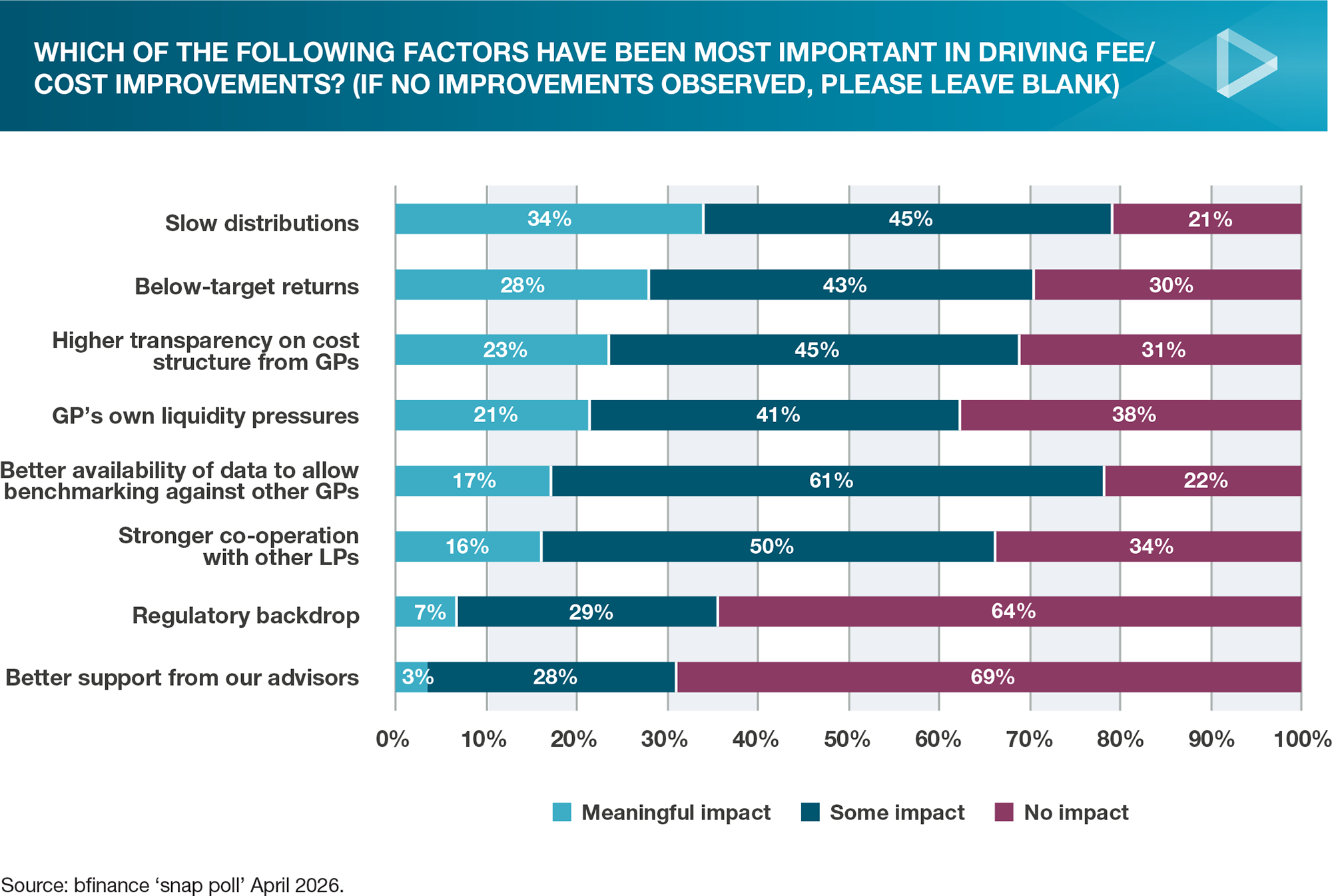
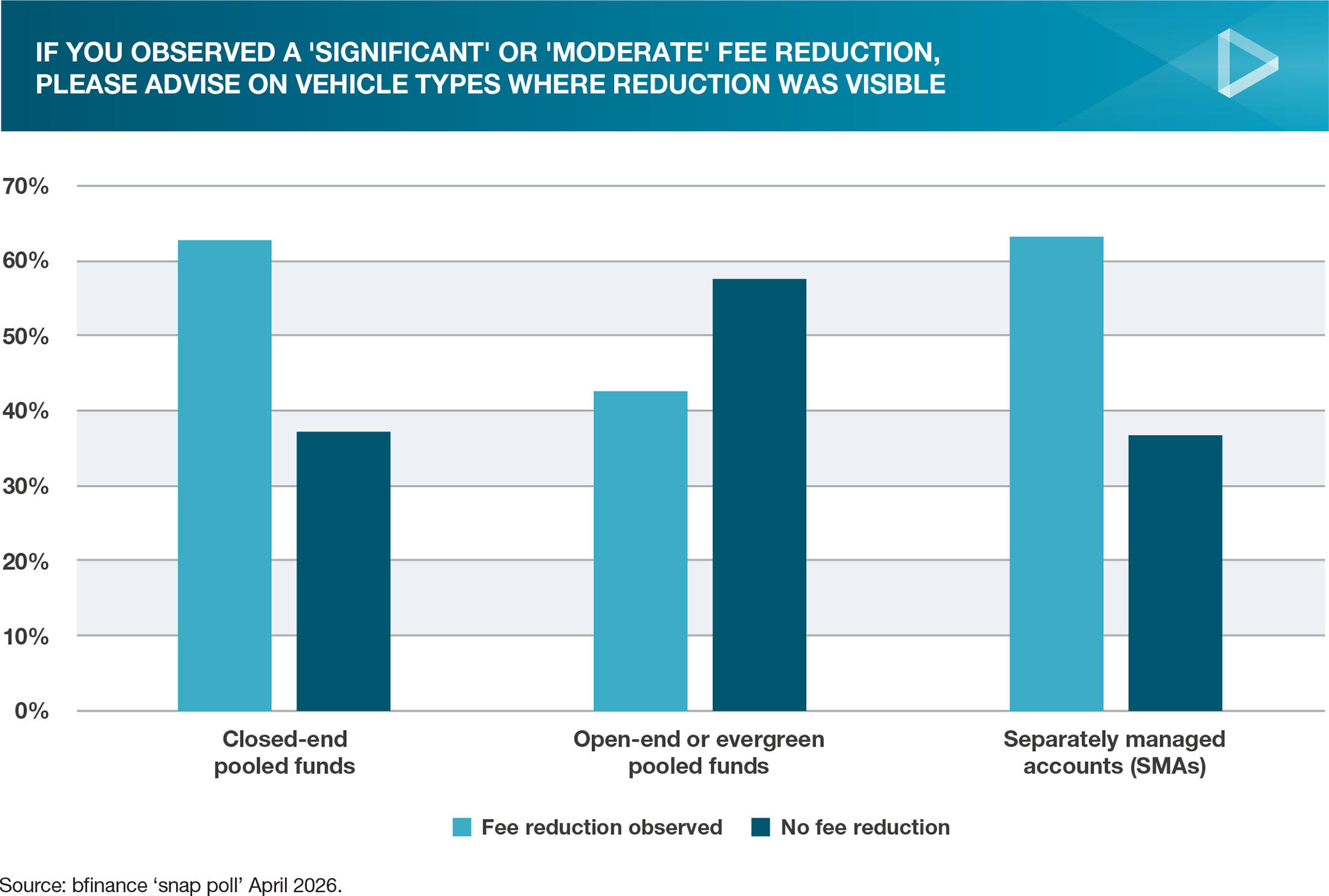
A number of key developments – including poor exits and weak fund distributions – have brought fees into sharp focus, both among LPs concerned about 'value for money' and for GPs who are now faced with a slow fundraising environment. Other consequences of the prevailing climate include a surge in secondary transaction activity.
Coming soon – 2026 bfinance Investment Management Fees Report
The 2026 bfinance Investment Management Fees report, due to be published in June 2026, will address measures that are currently contributing to reductions in private market fees as well as the latest trends in public market fees. Many of these methods may leave stated fees visibly unchanged, allowing industry participants and commentators to conclude that fees have not moved to a meaningful degree. They include more generous or prolonged first-close discounts, long fee breaks or 'holidays,' lower tiering thresholds for size-related reductions, and more.
This perhaps begs the question: if fees fall in private markets but no one accurately measures the real drop, does it make a noise? Moreover, does low visibility mean that prices are more likely to revert closer to rack-levels?
LPs say…
Warm thanks to the 84 LPs who took the time to contribute their experience and insights for this poll. Below are a few of their comments, illustrating how and why their fees have changed:
- "We were able to negotiate and lower the fees with several asset managers in the private equity and real estate landscape. There were several aspects to consider: increased size, long-standing relationship, partial underperformance."
- "We observe the most notable fee pressure in direct lending, driven by increased competition and capital inflows, particularly in the upper mid-market segment."
- "The main cause is the slower and more challenging fundraising pace of most GPs in the past few years."
- "Nobody wants to be a first closer anymore so GPs need to give better incentives for their first closes."
- "There are strong incentives for first closers."
- "[A GP gave us an] early-bird first close fee holiday of three months. This was in addition to a three-month holiday for first closers."
- "Fee model does not hold versus the liquid market. Spread compression in private markets has been substantial and thus the premium, especially for upper mid-market deals, after costs vs. liquid alternatives has shrunk to a questionable level."
- "Smaller funds are more nimble, offering significant incentives relative to larger, mega cap funds."
- "It's a tougher environment for emerging managers."
- "A question would be if automation and/or AI can make operations more efficient and hence reduce other fees."
- "The focus has shifted from headline fees to total expense ratios and net returns, where transparency remains a key differentiator between managers."
Important Notices
This commentary is for institutional investors classified as Professional Clients as per FCA handbook rules COBS 3.5R. It does not constitute investment research, a financial promotion or a recommendation of any instrument, strategy or provider. The accuracy of information obtained from third parties has not been independently verified. Opinions not guarantees: the findings and opinions expressed herein are the intellectual property of bfinance and are subject to change; they are not intended to convey any guarantees as to the future performance of the investment products, asset classes, or capital markets discussed. The value of investments can go down as well as up.