English (Global)
  Français (France)
  Deutsch (DACH)
  Dutch (Nederlands)
  English (United States)
  English (Canada)
  French (Canada)
bfinance insight from:

Weichen Ding
Director, Equity
While many equity managers claim to use AI to generate alpha or achieve productivity gains, distinguishing genuine innovation from marketing spin is far from straightforward. Investors must dig deeper, challenge assumptions, and rigorously interrogate AI‑driven strategies. Those who engage early and identify true innovators will be best positioned to capture the substantial opportunities that AI presents.
In the last three years artificial intelligence (AI) has moved from the margins to the mainstream. What began as something of a novelty is now— for many of us—a major part of our daily lives.
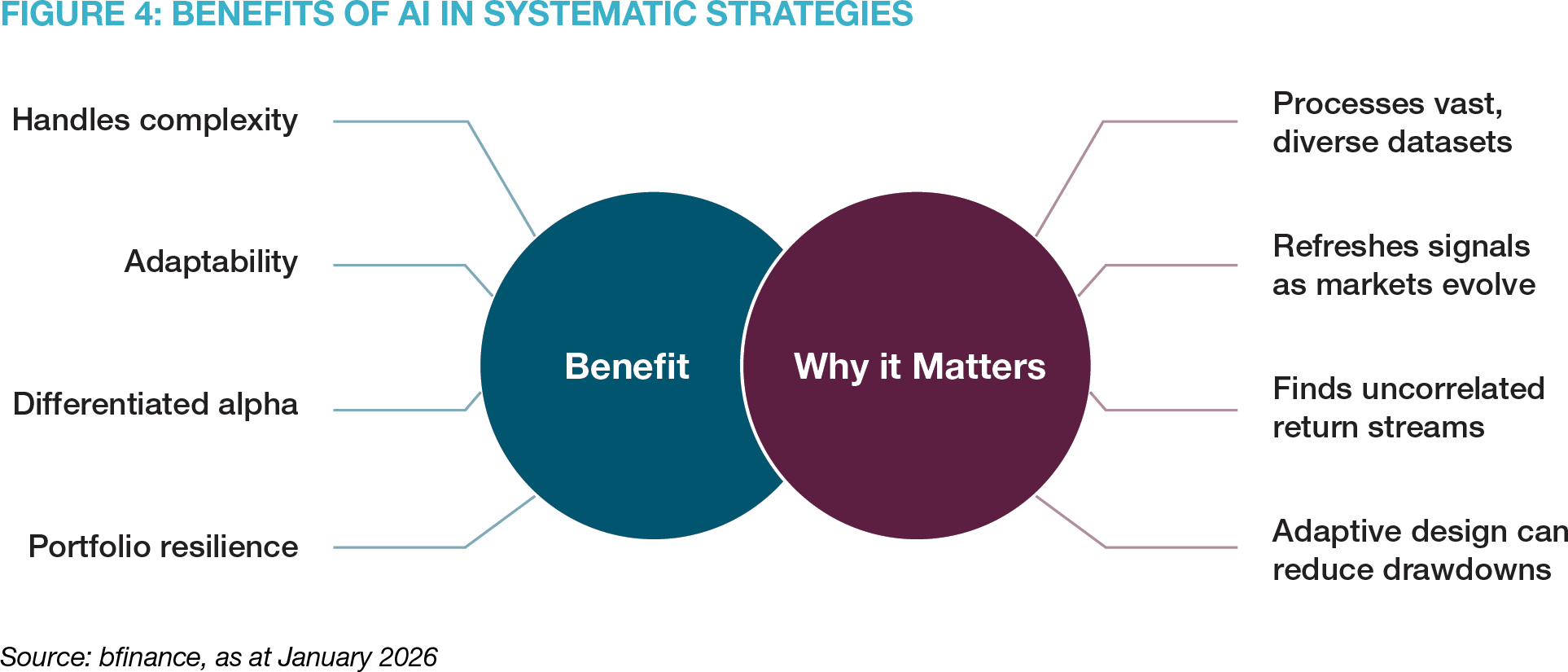
In investment management, AI promises (and is already delivering) something substantial: the ability to process vast datasets, uncover hidden or complex relationships, and adapt faster than any traditional model or analyst.
In active equities, systematic managers are using AI to expand the alpha toolkit— generating new signals and reshaping portfolio construction. Discretionary managers, meanwhile, are adopting it as a research accelerator— screening ideas, analysing sentiment, and scaling coverage.
AI now touches every stage of the investment process, from idea generation and forecasting through to portfolio construction and risk oversight. Yet for investors, one question cuts through the noise: Can AI truly deliver sustainable alpha, or will it prove to be another market fad?
To explore this, we examine how both systematic and discretionary equity managers are adopting AI – and what that means for investors.
1. AI in quant strategies
Quantitative equity investing has been built on the belief that data contains signals that can explain and predict returns. Over the past three decades, systematic managers have refined that belief through waves of innovation – from cross-sectional regressions and multi-factor risk models in the 1990s, to dynamic, Bayesian, and high-frequency frameworks in the 2000s, and the explosion of alternative data in the 2010s. Each wave promised a new edge; only those integrated with discipline, transparency, and sound governance, however, have endured.
AI represents the next step in that same progression— not a revolution, but a powerful extension. Machine learning, through the use of natural language processing (NLP) such as Large Language Models (LLMs), deep learning on structured data, reinforcement learning and generative and simulation models, has many potential applications for investors. It expands the quant toolkit, allowing models to detect nonlinear patterns and complex interactions that traditional approaches often miss. The goal remains the same: converting information into repeatable, risk-controlled sources of alpha. What changes is how information is identified, processed, and translated into investment signals. Machine-learning methods infer relationships directly from data rather than relying solely on human-designed factors, thereby expanding the pool of uncorrelated alpha beyond established risk premia.
Portfolio returns can traditionally be decomposed into market beta, factor alpha, and stock-selection alpha. The promise of AI lies in generating an additional, uncorrelated source of alpha— beyond traditional factor and stock-selection alpha.
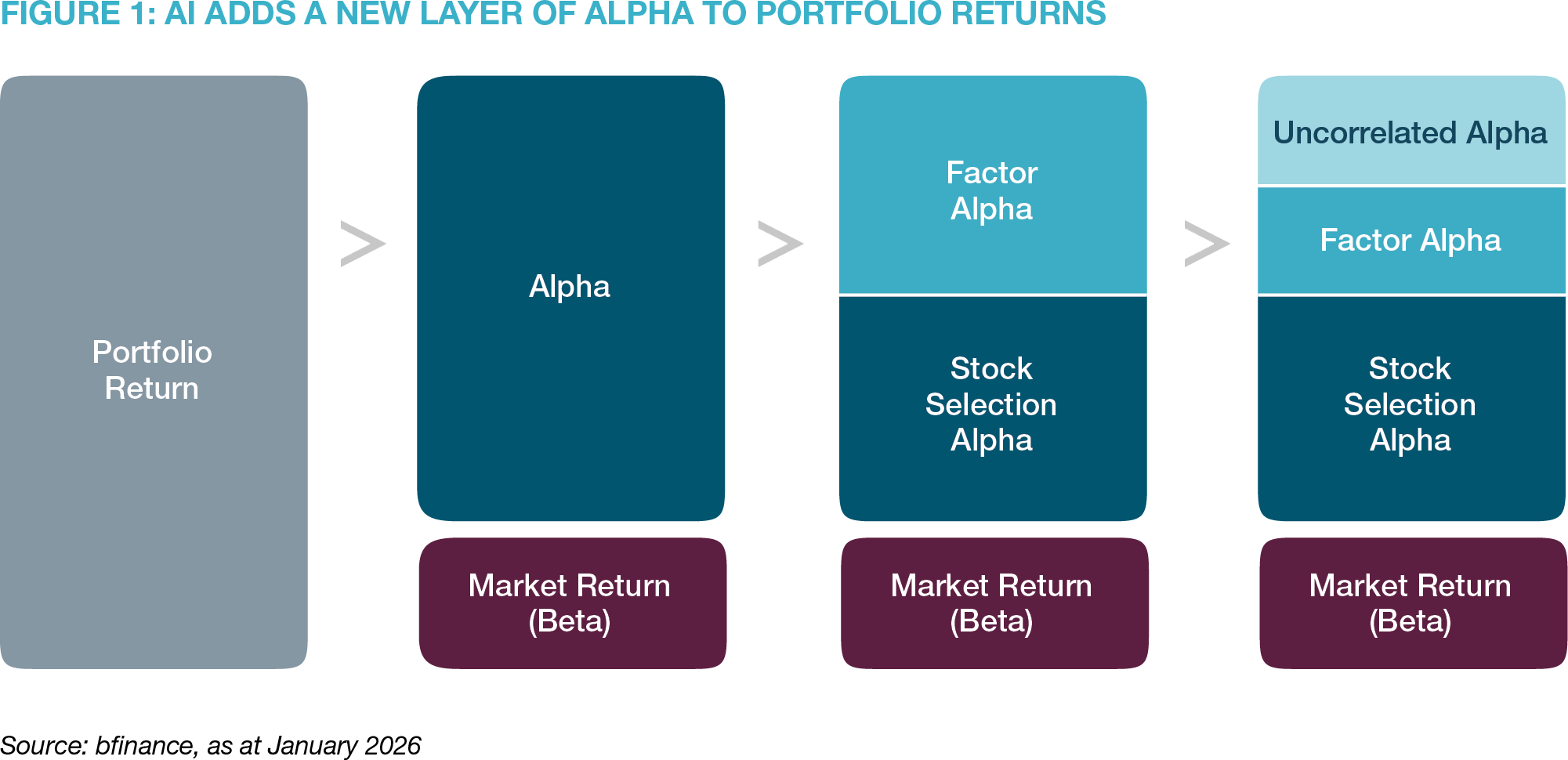
From factor models to AI models
While the applications are diverse, most systematic managers are adopting AI in one of two ways. Some are pursuing fully AI-driven models, where the investment process is built (almost) entirely around machine learning techniques. Others are taking a more incremental approach with AI-enhanced models, using AI as an additional layer to refine traditional quant frameworks.
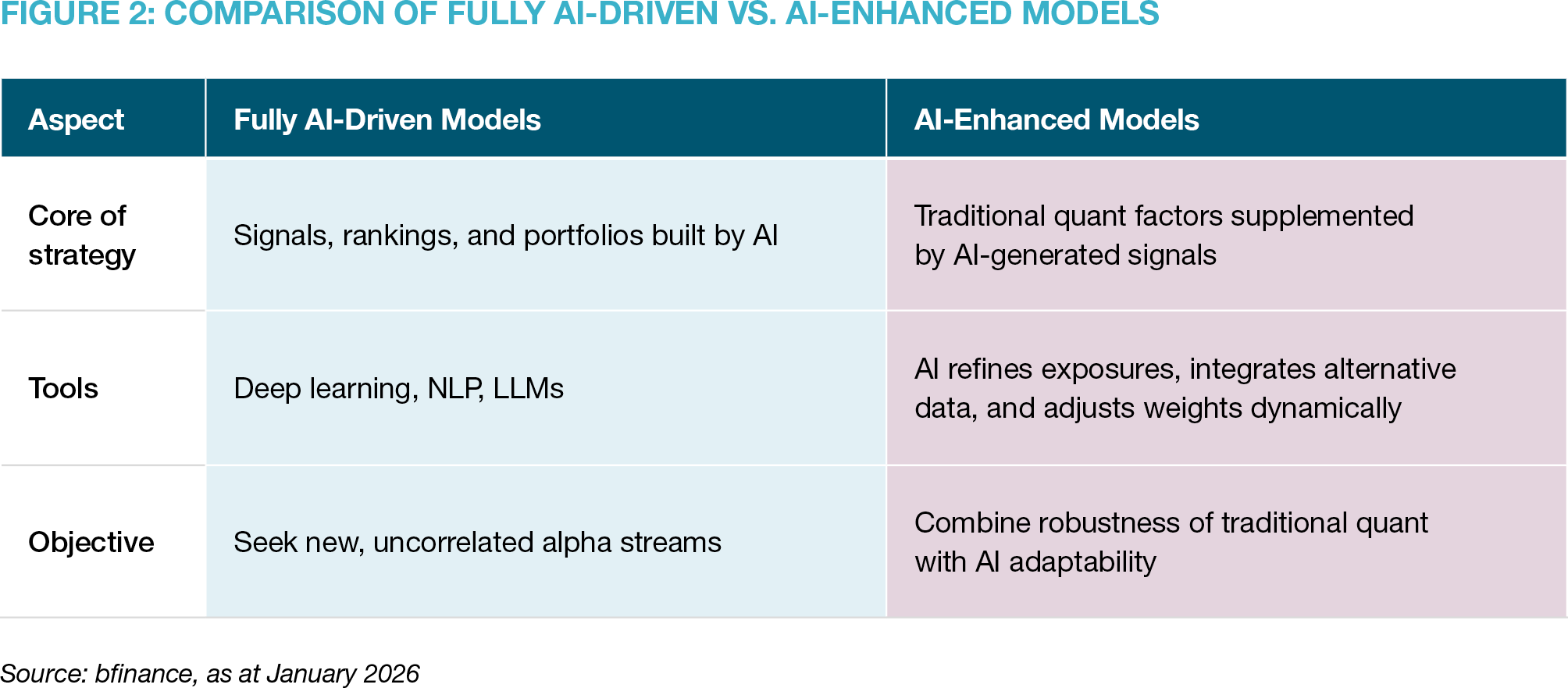
A recent bfinance survey found a low-teens number of fully AI-driven strategies globally, and a similar number for whom AI now governs the majority of the investment process. Most quantitative managers (50+), however, are taking a gradual approach— using AI to refine signal construction, test model stability, or integrate non-traditional data. The number of AI-native, AI-driven quantitative strategies is expected to continue rising over the coming years as the technology advances.
The pattern is familiar: technological shifts in quant investing have always begun as experiments before being absorbed into mainstream practice. AI is part of that continuum. The risk is not that managers will move too slowly, but that they’ll adopt tools without clear evidence of benefit— “AI for AI’s sake”.
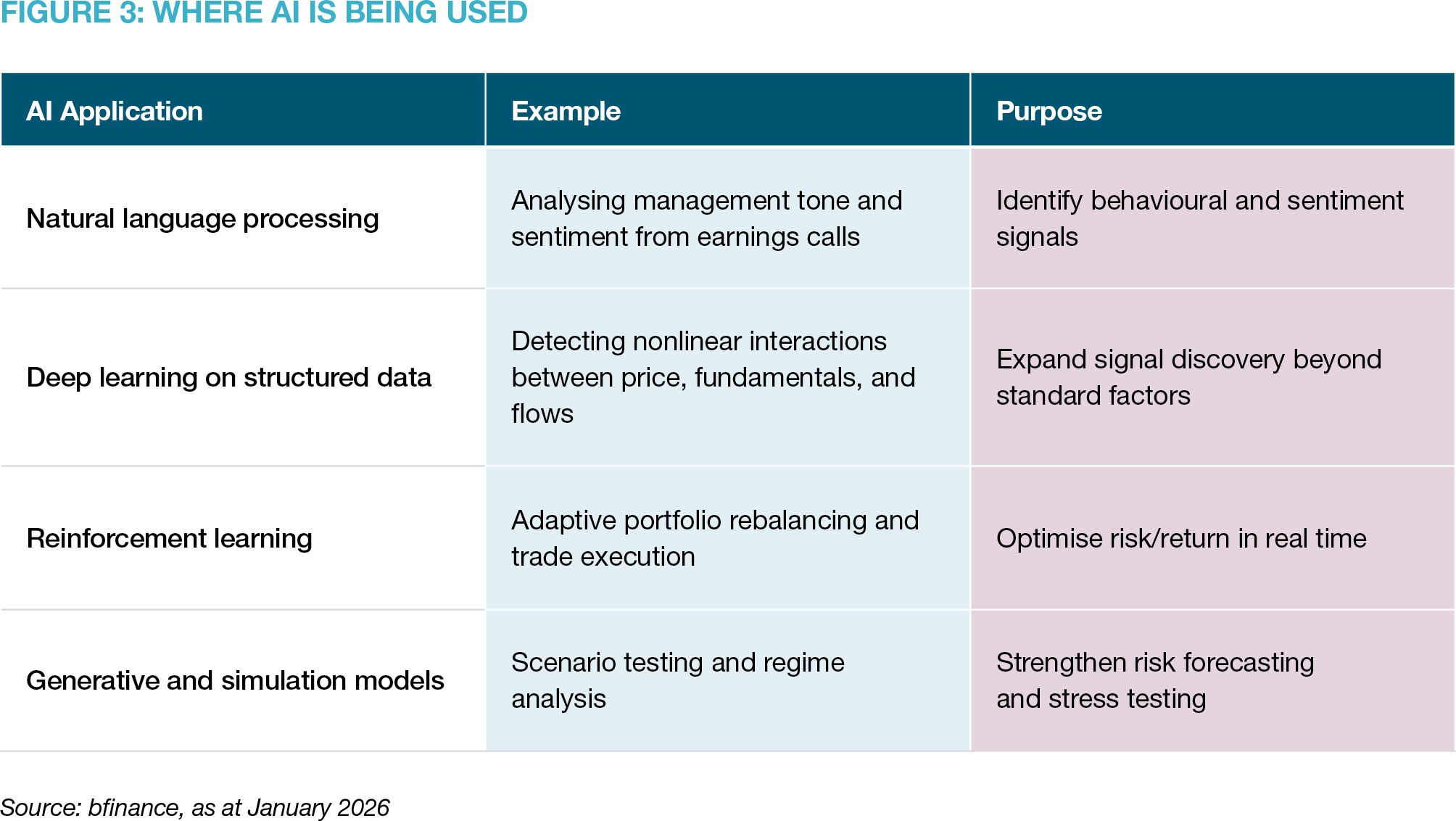
These techniques illustrate how AI extends rather than replaces the quant framework— improving how data is interpreted, linked, and transformed into investable insights.
Take machine learning-based signals as an example. Traditionally, researchers and portfolio managers decided which characteristics to include and how to combine them into a single composite score. Machine learning, in contrast, can automatically identify the most relevant signals within each factor and determine their optimal combination. In this way, factor selection and weighting can be dynamically tailored to individual stocks and prevailing market conditions.
Data and processing power as differentiators
Alternative datasets— from credit-card transactions and satellite imagery to e-commerce trends— are now widely available, though costly and unstructured. Scale helps, but data ownership alone is not an edge. The differentiator lies in integration: how effectively managers clean, align, and process messy, high-dimensional information into stable, investable outputs.
Sustainable advantage rests on four pillars:
- Data quality and diversity— breadth of inputs without diluting relevance
- Processing power and model sophistication— ability to train and retrain complex architectures
- Rigorous validation— avoiding overfitting through robust out-of-sample testing
- Integration discipline— embedding AI outputs within risk and governance frameworks
For investors, the critical question is not “does the manager use AI?” but “does AI improve the process in measurable, explainable ways?”.
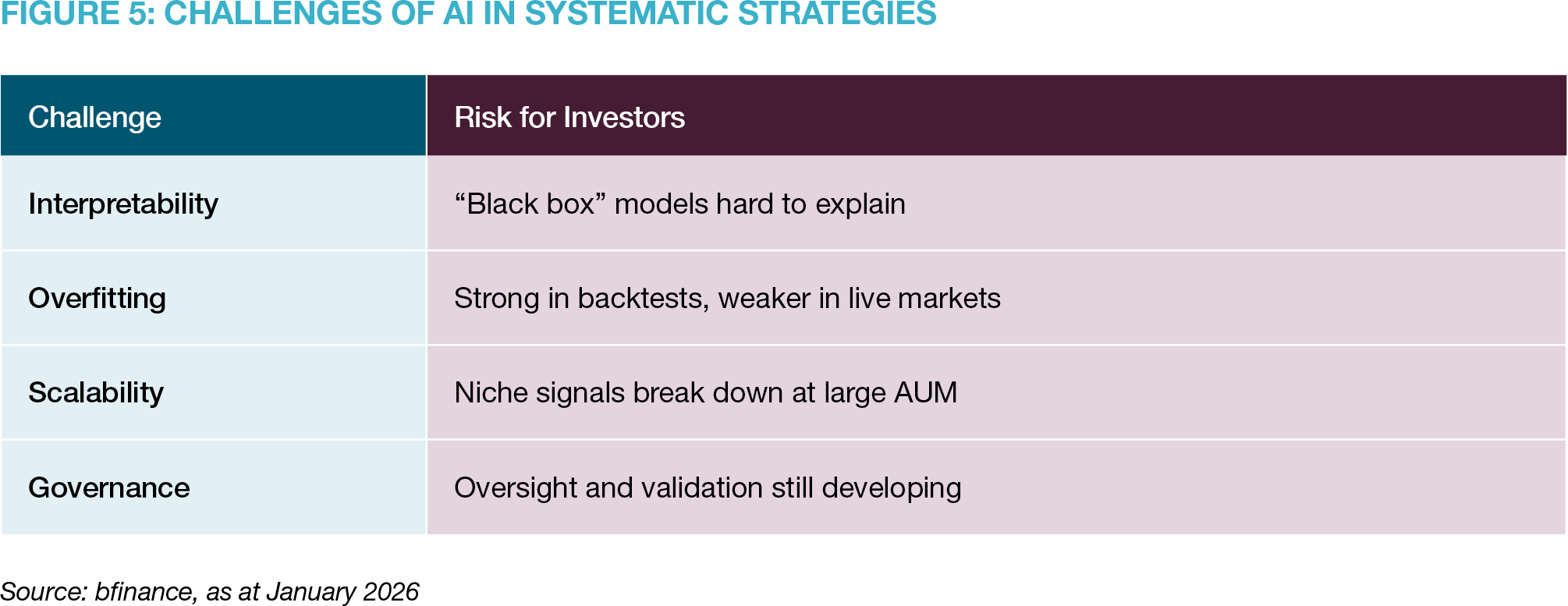
Investor lens—what to ask
When assessing AI-enabled quant strategies, investors should look beyond buzzwords and data access to examine integration, validation, and accountability.
- Governance: Is there an audit trail for how models learn, adapt, and are retired?
- Robustness: How are AI-generated signals validated out of sample, and how frequently are they retrained?
- Attribution: Can the manager explain where AI adds value beyond conventional factors?
- Transparency: Are outputs interpretable enough for institutional oversight? Does the manager provide adequate access to the investment process and R&D?
Managers who combine innovation with discipline—embedding AI within explainable, testable frameworks— are the ones most likely to turn technological promise into durable performance.
2. AI in discretionary strategies
Discretionary equity investing has always depended on human judgment—meeting management teams, assessing business models, and connecting the dots between qualitative and quantitative insight. AI does not replace that judgment; it accelerates and extends it.
In this part of the market, AI serves less as a decision-maker and more as a research amplifier. It automates repetitive analytical tasks, broadens coverage, and provides near-real-time information flow across thousands of securities. The result is faster hypothesis testing and more informed decision-making— not necessarily different philosophies, but more scalable execution of them.
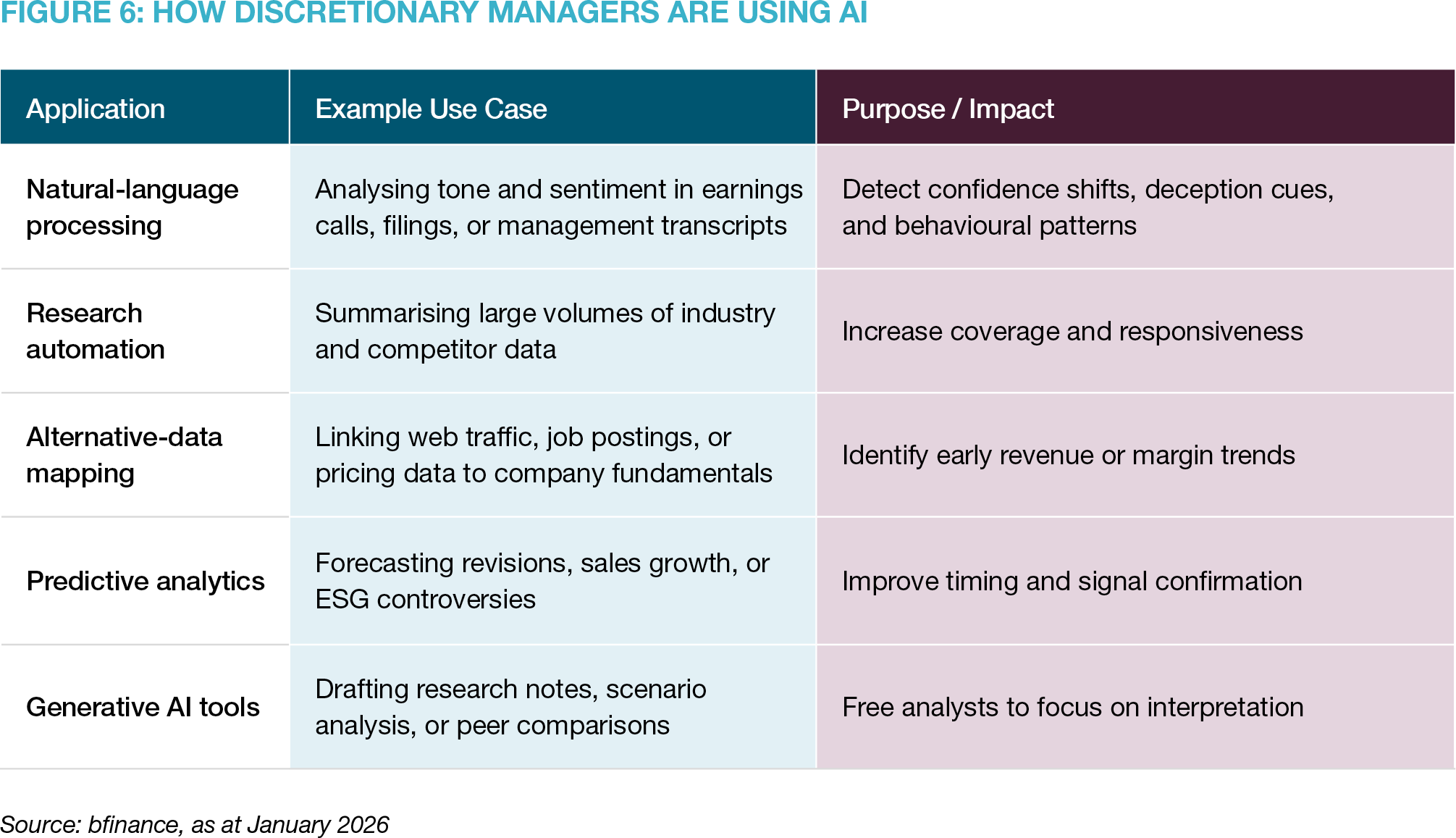
These applications illustrate a key distinction from systematic strategies: in discretionary use, AI supports process efficiency and idea generation more than signal construction.
Impact on investment teams
The integration of AI is already reshaping team structures and workflows. Traditional junior-analyst functions such as data gathering, transcription, and basic modelling are increasingly being automated. Analysts can now spend more time on synthesising the outputs, scenario testing, and engagement with companies.
Over time, some research functions may evolve into hybrid roles— part data-scientist, part sector analyst— as the line between fundamental and data-driven insight continues to blur. Teams that successfully adapt this blend tend to exhibit:
- Smaller but deeper analyst benches with greater sector breadth.
- Higher research throughput without commensurate headcount growth.
- Greater consistency in how insights are documented and shared.
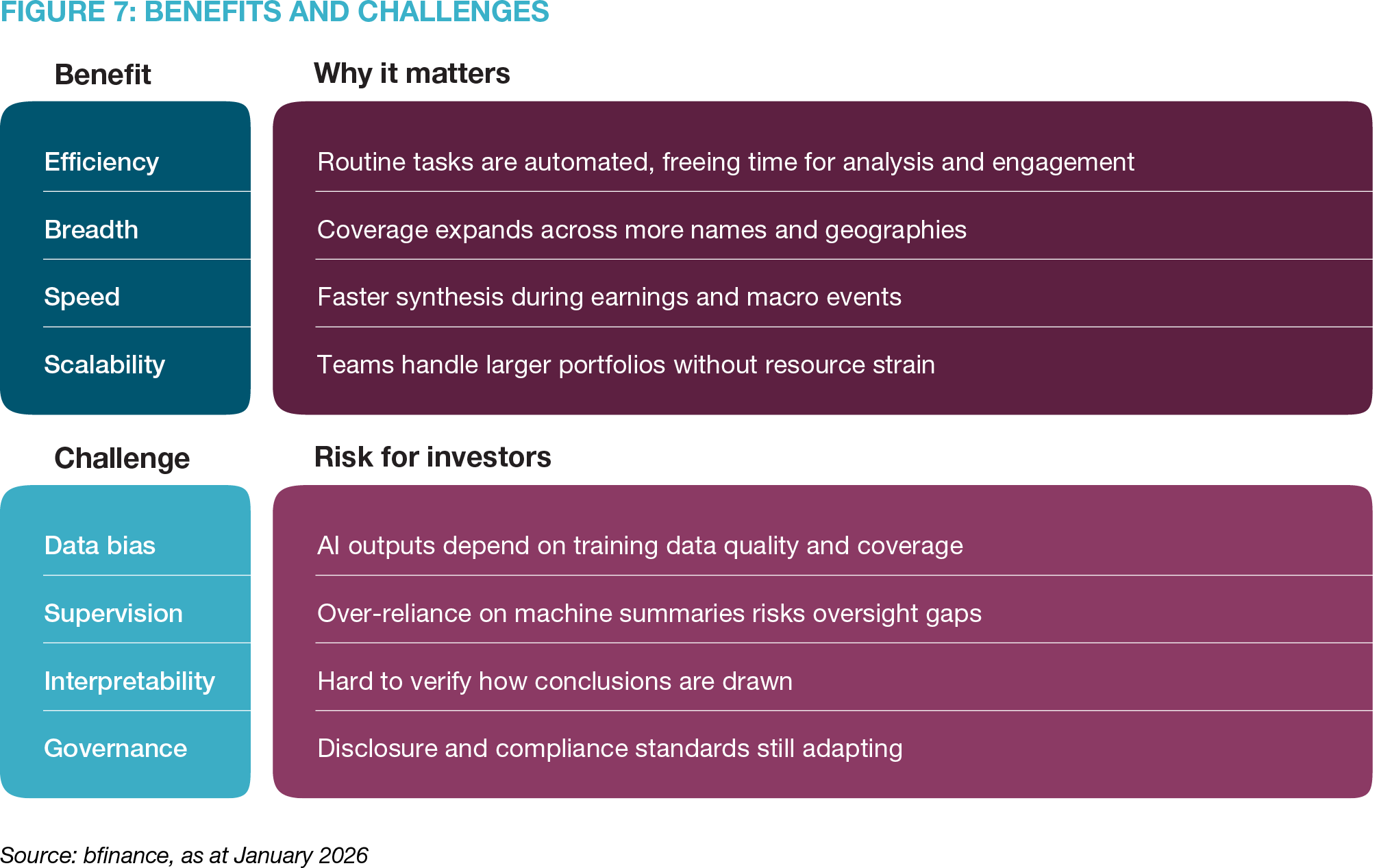
Early evidence and market practice
Adoption remains uneven. A growing number of large fundamental houses— particularly in global, thematic, and sector-specialist strategies— now use proprietary or third-party AI tools. Most report productivity gains (faster turnaround, wider coverage) rather than direct alpha improvements so far.
Performance attribution is still anecdotal: firms using AI tend to cite better reaction times around earnings season and greater internal consistency in research documentation. The measurable investment impact, however, is difficult to isolate from human decisions— reinforcing that AI’s role here is enabling, not deciding.
Investor lens—what to ask
For allocators assessing discretionary managers that claim to use AI, the due diligence focus should shift from what tools they have to how those tools shape decisions.
- Integration: How is AI embedded in the research process— idea generation, modelling, or monitoring?
- Validation: Who reviews AI outputs before they influence investment calls?
- Attribution: Can the manager evidence how AI improved coverage, speed, or insight quality?
- Governance: Are there clear controls on data use, model updates, and compliance oversight?
The best discretionary adopters of AI use it to enhance human intuition with scale, not to replace it. Those who can demonstrate this balance— combining automation with interpretability— will be best placed to deliver sustainable research advantages.
3. Implications for investors
The rise of AI in equity investing creates both opportunities and responsibilities for allocators. The challenge is separating genuine innovation from marketing spin.
Critical questions for due diligence
- Diversification: Is the alpha genuinely “new”, or repackaged factor exposure?
- Capacity & scalability: Can AI-driven signals support large institutional allocations without eroding alpha?
- Persistence: How durable are the signals? What measures are in place to manage alpha decay?
- Competitive dynamics: Is the manager making a strategic commitment to AI, or a marketing-led move?
- Governance & transparency: How are AI models validated, monitored, and explained to clients?
- Research resources: As AI takes over routine tasks, does team size still matter — or is integration more important?
- Track record: With short live histories, how should performance be judged versus research depth and governance?
Investor lens: Treat AI as a due diligence theme, not a checkbox. Focus on how it’s embedded, who oversees it, and whether it demonstrably enhances process quality.
Conclusion
AI is already reshaping how equity portfolios are built and managed. Systematic managers are using it to expand the alpha toolkit, while discretionary managers are adopting it to scale research and sharpen decision-making.
For investors, the message is clear: AI is neither a silver bullet nor a passing fad. Its power lies in how thoughtfully it is integrated– balancing innovation with transparency, and automation with human judgment.
The right question for investors is no longer “Are you using AI?” but “How is AI changing your process— and can you prove it?”. Which managers are making genuine, strategic commitments? Which are embedding AI in ways that improve resilience and adaptability? And which are only dressing up old processes with new language?
Now is the moment for investors to dig deeper, challenge assumptions, and start conversations with managers about their AI strategies. Those who engage early, and identify true innovators, will be best positioned to capture tomorrow’s opportunities.
Important Notices
This commentary is for institutional investors classified as Professional Clients as per FCA handbook rules COBS 3.5R. It does not constitute investment research, a financial promotion or a recommendation of any instrument, strategy or provider. The accuracy of information obtained from third parties has not been independently verified. Opinions not guarantees: the findings and opinions expressed herein are the intellectual property of bfinance and are subject to change; they are not intended to convey any guarantees as to the future performance of the investment products, asset classes, or capital markets discussed. The value of investments can go down as well as up.