English (Global)
  Français (France)
  Deutsch (DACH)
  Dutch (Nederlands)
  English (United States)
  English (Canada)
  French (Canada)
bfinance insight from:

Anna Morrison
Head of Private Equity
Fundraising for secondary investments in illiquid asset classes—such as private equity, infrastructure and private credit—has reached a new high-point, while transaction activity has also continued its recent upward trend. Yet activity in secondary markets can reflect both the strengths and the vulnerabilities of the underlying asset classes. In this climate, investors must insist on disciplined deployment to ensure that they are benefiting from liquidity and pricing dynamics rather than ‘holding the bag’ for over-optimistic projections.
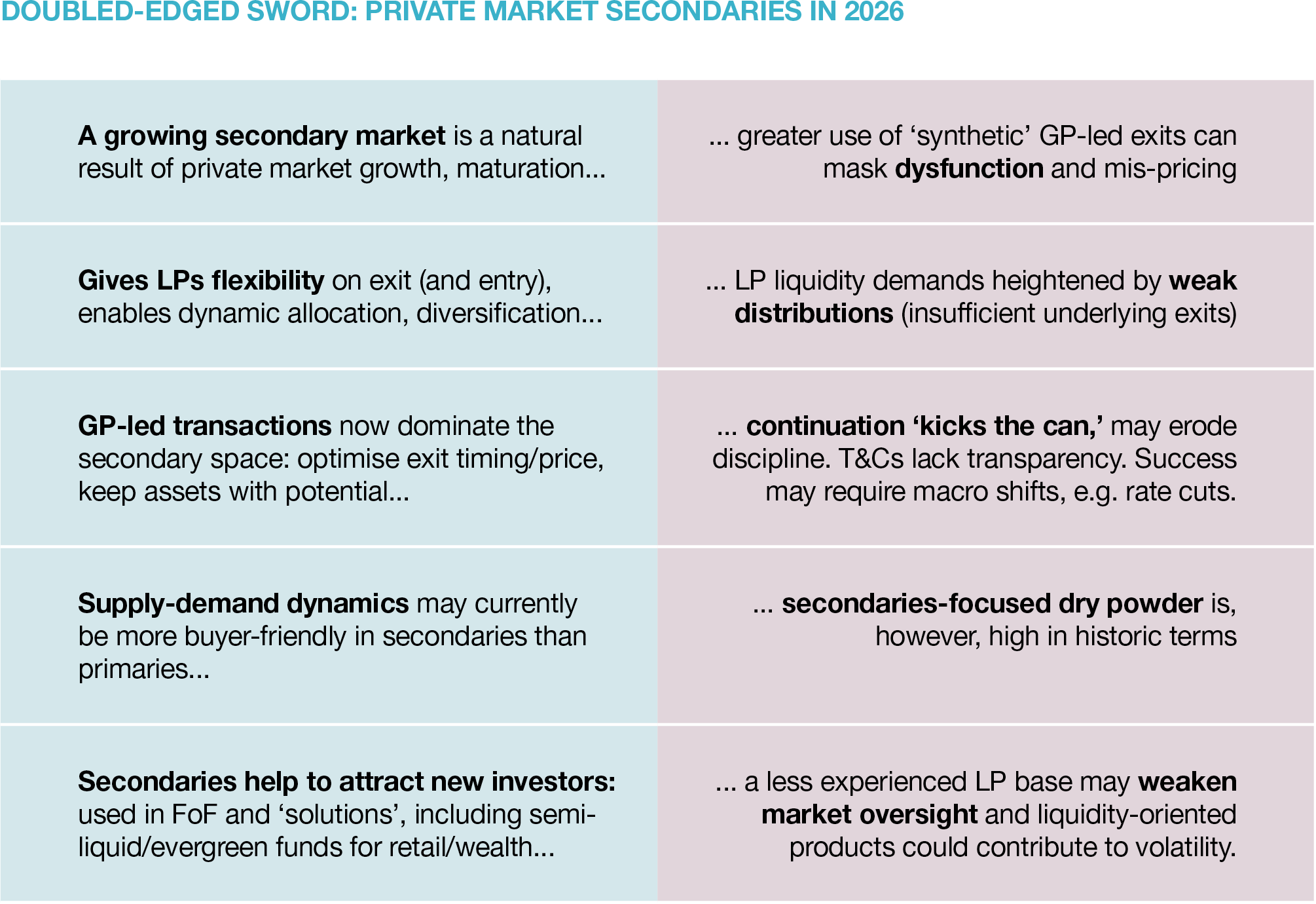
The rise of secondaries: market maturation, misalignment or both?
Secondary market transaction volume has surged, reaching approximately US$240 billion in 2025 across all private market asset classes – a staggering 50% increase versus 2024, which was itself a record year. As discussed below, this trend is evident not just in private equity but in infrastructure, private credit and even real estate. Moreover, the split between LP-led and GP-led transactions continues to hover around the 50:50 mark, as has been the case since 2021: the pre-pandemic days when LP-led deals dominated the sector have long gone.
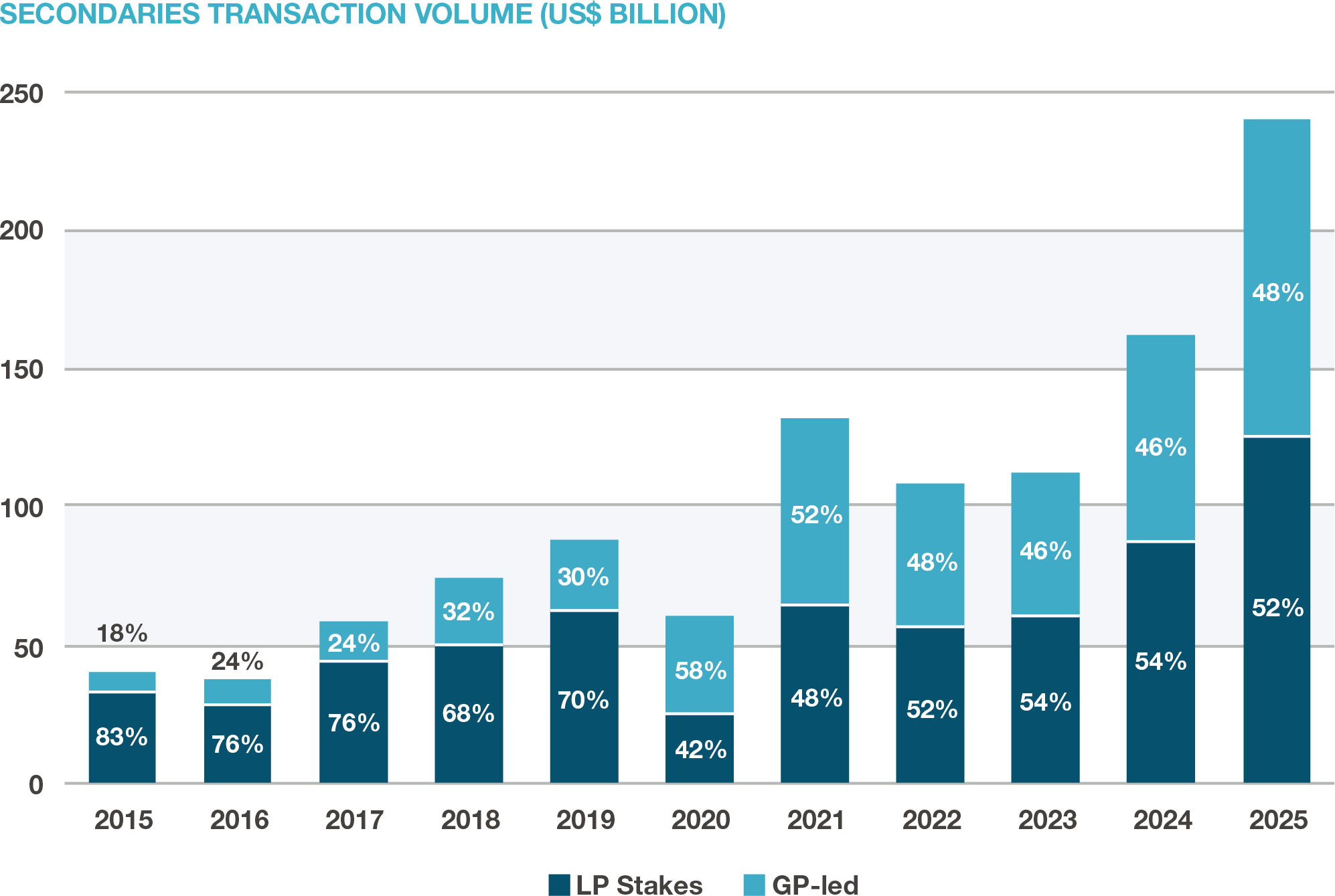
Source: Jefferies
Yet at the heart of this secondaries surge lies a fundamental (and perhaps paradoxical) tension: the interplay between ‘synthetic’ and ‘true’ exits. Although private market asset classes are still broadly awash with dry powder targeting primary deals, GPs continue to deliver slow exit activity versus what we might view as historical norms, resulting in weaker-than-expected distributions (DPI) and difficulty winding down funds in a conventional manner. Instead, they have been turning to secondary transactions such as GP-led continuation funds to execute what we might term ‘synthetic’ exits at unprecedented levels. These transactions generate LP liquidity, if they choose to cash out, and anecdotal evidence suggests that most do so. They also crystallise performance fees for the GP—though these are often rolled into the new transaction—without requiring the GP itself to exit the relevant holdings.
In other words, despite an environment of high theoretical liquidity, primary fund managers are increasingly leaning on secondaries to obtain actual liquidity for themselves as well as their LPs. They are also, it should be noted, pulling various other capital-generating levers such as GP Stakes and NAV financing.
Meanwhile, an accompanying rise in LP-led secondary transaction activity has been taking place, driven in part by investors’ own ‘liquidity squeeze.’ LP liquidity demands can be triggered by developments elsewhere in the portfolio (e.g. the 2022 market decline that provoked ‘denominator effect’ rebalancing) or a need to adjust the private market portfolio itself. Disappointing DPIs, mentioned above, play an important role here.
Importantly expansion of secondary activity is not confined to the private equity market, although this asset class is still dominant [related reading: Private Equity Secondaries Sector-in-Brief]. The secondary market in infrastructure only emerged around 2010 and has expanded dramatically in the 2020s: transaction volume in this sector almost doubled from $12 billion in 2023 to $20-24 billion in 2025, according to Campbell Lutyens.
In private debt, secondary activity more than doubled from US$6 billion in 2023 to over US$15 billion in 2025. Notably, GP-led secondaries in private credit outstripped LP-led transactions for the first time last year, reflecting a shift in underlying borrowing dynamics. Specifically, a slow PE market has delayed refinancing, stretching average effective loan duration in Direct Lending from around two-to-three years to four-to-five years – still generally lower than the legal tenor for the loans (seven years would be typical), but materially longer than the GP and their investors may have anticipated. In addition, we also note a rise in amend-and-extend activity where the loan deadlines get pushed beyond their original contracted limits. The result: substantial outstanding loans remain in play at the end of funds’ lifespans, with GP continuation—rather than a fresh loan from a different GP—as the increasingly popular fix.
Even real estate secondaries have been on the rise, no longer seen merely as a last resort for distressed players, although pricing relative to NAV remains very cheap.
Secondaries funds are attracting record investor appetite
These dynamics can generate intriguing opportunities for secondaries investors, despite (or perhaps because of) some potentially problematic fundamentals. Recent fundraising in this space has been exceptionally strong and, at present, shows no signs of softening. Data shows that upwards of US$140 billion was raised by closed-ended secondaries funds in 2025, versus less than US$100 billion in 2024 and 2023. Nearly US$40 billion of this total was directed towards private credit secondaries funds – a huge increase in share.
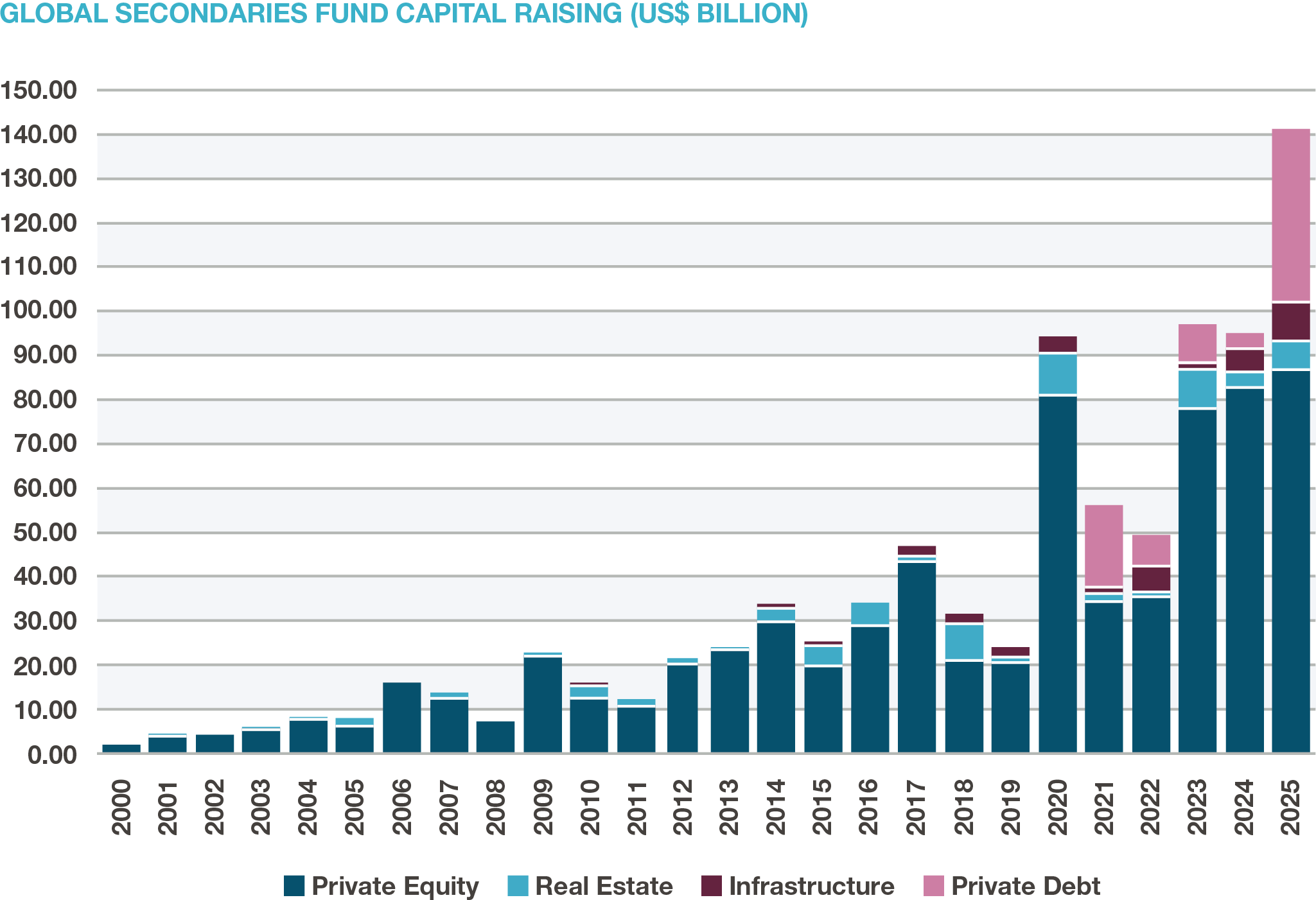
Source: bfinance, data from Preqin and Private Debt Investor
Investors should consider current supply-demand dynamics with care, robust buyer appetite places pressure on secondary investors' sourcing channels and standards. That being said, dry powder in secondaries funds may still appear modest relative to current secondary transaction activity (one-to-two years’ worth).
Key attractions for investors are often recited but bear repeating. They include rapid deployment, vintage diversification, reduction of the conventional j-curve, shorter holding periods, avoidance of ‘blind pool risk’ and (in the case of continuation funds) lower fees. The prospect of faster distributions may be particularly appealing in today’s low-DPI environment: we have seen a number of secondaries funds explicitly emphasising this characteristic.
Discounts can also be a relevant draw, although this varies heavily depending on the asset class/sector and market conditions. In direct lending secondaries, headline pricing has recently sat around 95-100% of NAV (private debt overall at around 92%), according to Jefferies and Dechert, although effective (‘economic’) discounts tend to be better than the purchase level and proprietary sourcing can help GPs to obtain attractive pricing. Even small discounts can be significant, however, due to the limited upside in the asset class. At the other end of the spectrum, real estate secondaries have flatlined at around 70% of NAV over the past few years in a challenging market environment where primary transaction volumes have remained muted and motivated sellers have been on the rise. Infrastructure secondaries tend to be priced a little closer to NAV than their private equity counterparts, due to the sector’s emphasis on stable cashflow-generating assets versus growth, but the percentage has fluctuated through recent years in both asset classes.
Whatever the attractions, investors are buying into the pitch. The past twelve months have seen a wave of new fund launches, large fundraising announcements and rose-tinted messaging (from both the industry and, consequently, industry press). In infrastructure secondaries, several managers raised large sums for dedicated funds in this space, such as Blackstone ($5.5 billion), Pantheon ($4 billion+ and still going), Ares ($5.3 billion, after lifting their hard cap), and Macquarie (whose debut fund targeted a more modest $700 million). Dedicated private credit secondaries funds were raised by Ares (their first such vehicle), Allianz, Coller and Pantheon. Stepstone garnered the largest ever real estate secondaries fund, at US$4.5 billion. Private equity secondaries funds also had a record fundraising year in 2025.
Demand for secondaries does not come purely from dedicated secondaries strategies, of course. Fund-of-funds, delegation-friendly ‘solutions’ strategies and other diversified products—whether structured as funds or separately managed accounts—often have sizeable secondaries allocations. Open-ended, evergreen or semi-liquid strategies, which have become increasingly popular, often make use of secondary exposures. Indeed, cynics might say that heavy secondaries exposures can help managers to show attractive returns in the early years of a semi-liquid fund’s life in order to encourage further fundraising. Today, we see substantial political impetus to encourage non-traditional clients—wealth, DC, broader retail—into these asset classes, supporting the semi-liquid fund trend. The August 2025 Executive Order from the US administration, for example, showed their enthusiasm for helping the private equity industry raise capital from 401k plans.
Navigating with discipline
Illiquid asset classes are in a new and unprecedented phase of development. While the evolution of secondary markets may be symptomatic of some current tensions, it may also represent some of the best sources of opportunity (and flexibility) when navigating these conditions.
Not all secondary opportunities will be savvy investments and not all secondary strategies will be ‘winners’ in this market. Selectivity is key: quality is crucial and assumptions should be vigorously interrogated by prospective LPs. Are we (and our chosen GP partners) relying on a broad near- or medium-term improvement in the overall exit environment, so that a rising tide can lift all boats, or anticipating clear asset-specific and industry-specific developments that will support underlying exits for our specific book? Are we placing too many eggs in the basket of benign macroeconomic projections, such as a return to an interest rate environment where the cost of financing shifts closer to pre-2022 levels? Are we hoping for a more seller-friendly climate, perhaps supported by a wave of new institutional/retail clients in private markets, and/or a recovery of an IPO market that has been anaemic since the 2010s?
More fundamentally, and at risk of speaking in overly abstract terms, the importance of LP discipline within illiquid asset classes cannot be overstated. Private markets are weakly regulated and lack continual buyer-driven price discovery mechanisms. As such, sophisticated LPs provide the only real driving force underpinning rigour and accountability. In an increasingly complex, intermediated and potentially ‘democratised’ investment landscape, the extent to which LPs can continue to exert discipline (upon their own GPs and upon themselves) will determine the long-term health of these markets.
Important Notices
This commentary is for institutional investors classified as Professional Clients as per FCA handbook rules COBS 3.5R. It does not constitute investment research, a financial promotion or a recommendation of any instrument, strategy or provider. The accuracy of information obtained from third parties has not been independently verified. Opinions not guarantees: the findings and opinions expressed herein are the intellectual property of bfinance and are subject to change; they are not intended to convey any guarantees as to the future performance of the investment products, asset classes, or capital markets discussed. The value of investments can go down as well as up.