English (Global)
  Français (France)
  Deutsch (DACH)
  Dutch (Nederlands)
  English (United States)
  English (Canada)
  French (Canada)
bfinance insight from:

Duncan Higgs
Managing Director, Head of Operational Solutions

Kieran Bussey
Senior Associate
US dollar volatility in 2025 and evolving macroeconomic conditions have led many investors to re-evaluate FX management. Yet, even as strategies evolve, bfinance data highlights weak oversight of costs in this space. Only one in five asset owners routinely review FX-related expenses, according to a recent poll, and many simply do not assess this subject at all – resulting in potential multi-million-dollar cost leakage for many investors.
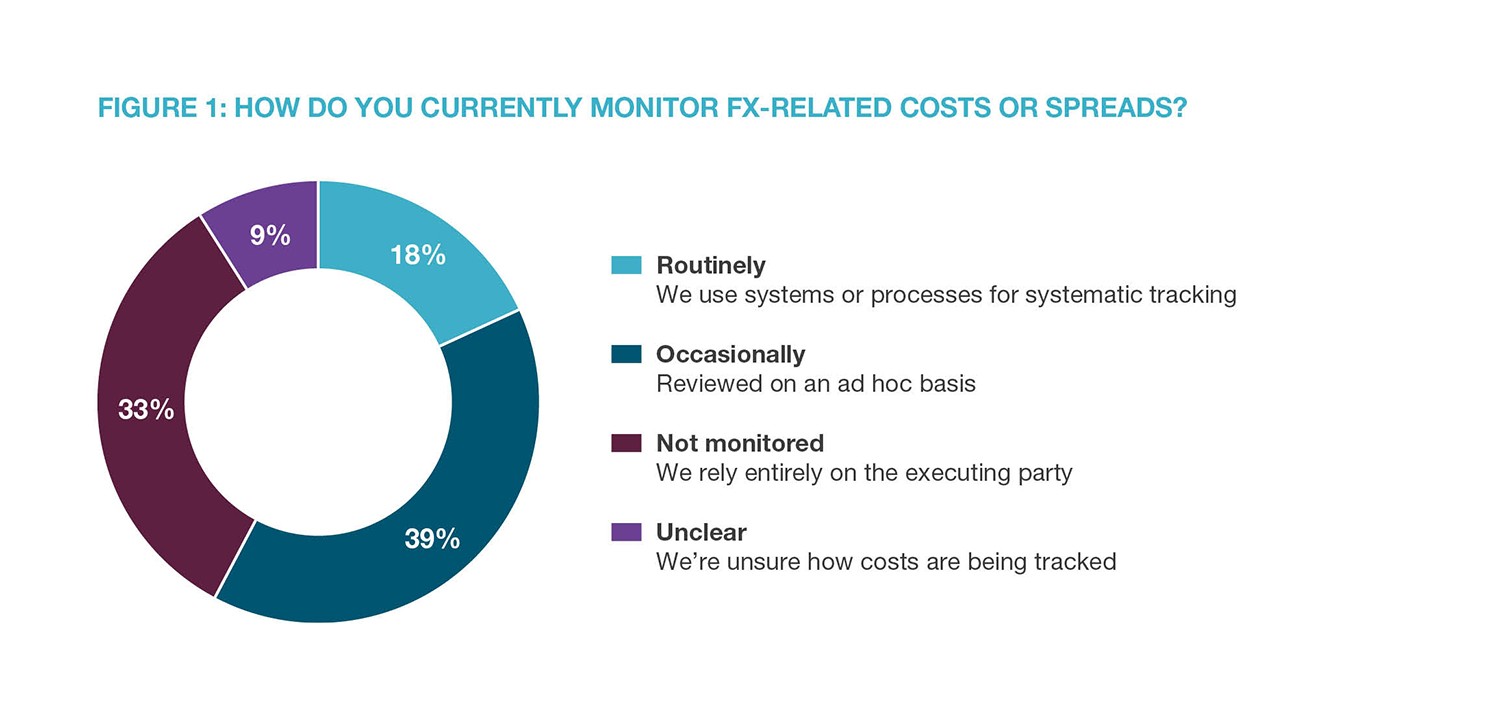
Source: bfinance, investor poll conducted in 2025
FX management is front of mind…
In recent years, FX management has moved closer to the foreground, with many investors reconsidering and, in some cases, materially adjusting their hedging activity. For example, against a backdrop of shifting US growth and interest-rate expectations, institutions have had to contend with episodes that appear inconsistent with the so-called ‘dollar smile’ paradigm (part of which is the historic tendency for the USD to strengthen in times of economic uncertainty), undermining the case for a light-touch approach to USD hedging.
Looking globally, the Bank for International Settlements published a report in June suggesting that greater currency hedging by non-US investors holding US dollar securities may have contributed toward the dollar’s slide through April and May. European pension funds and insurers have made widely discussed changes: in May 2025, Danmarks Nationalbank announced that Danish insurance companies and pension funds had increased their currency hedging of US dollar investments from 61.8% to 73.5% since the beginning of the year. Further shifts are expected — an SSGA report, for example, recommended that Euro-based investors aggressively hedge USD-denominated positions for the foreseeable future.
As well as overall hedge ratios, investors are also reevaluating the subject of FX agility. The potential attractions of a more active FX management approach have increased since the end of the ZIRP era', (previously explored in Currency Overlays and Active Management is Back, bfinance, 2023), and developments in 2025 have further reinforced the appeal of dynamic strategies. At bfinance, we have seen a consequent visible increase in overlay mandate activity from investors in multiple regions.
…but cost remains under-monitored
While FX hedging strategies have been receiving considerable attention in recent months, one key aspect of this subject is often overlooked: cost efficiency. The ’hidden costs’ associated with FX management have long been a subject of concern. A 2019 bfinance white paper, for instance, highlighted the potential price of ‘blind spots’ in this space. These can be substantial: a $10 billion investor with a 30% hedge ratio implemented via three-month rolling forwards, for example, would have an annual notional FX volume exceeding $12 billion, meaning that a mere 1 basis point reduction in cost would produce annual savings of $1.2 million. Potential savings can be many multiples larger depending on the implementation approach.
As shown in the poll result above (Figure 1), only 18% of senior investors indicated that they routinely monitor FX costs, while a further 39% conduct occasional “ad hoc” reviews. Meanwhile, one third do not monitor costs at all and 9% were “unsure” about how costs are being tracked.
However, in a further question in the same survey (Figure 2), three quarters of respondents expressed confidence in their FX cost efficiency (30% “very confident” 45% “somewhat confident”). Moreover, despite the evident lack of routine benchmarking, only 8% of investor respondents currently “suspect inefficiencies” in FX cost efficiency.
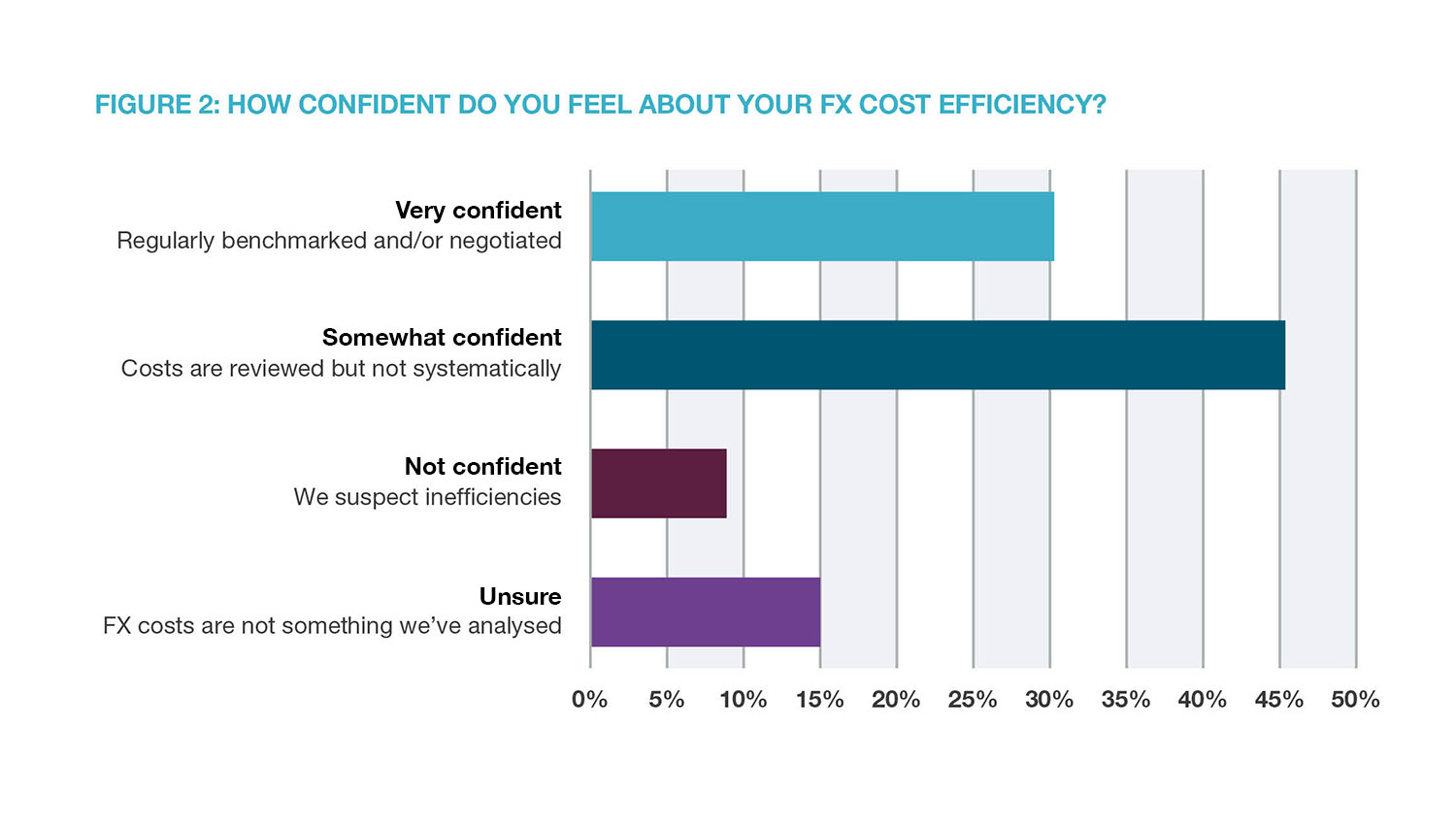
Source: bfinance, investor poll conducted in 2025
The contrast between these two findings is somewhat jarring. Confidence without evidence is not governance. Perceived inconsistencies between answers, along with a substantial proportion of “unsure” responses in both cases, also suggest a lack of clarity. Further anecdotal/written comments from respondents suggested that FX execution is often considered to be outside the remit of investment teams (who take responsibility for many other investment-related costs) or sits in a grey area between investment and operations teams, making governance unclear.
Weak transparency reflects choice – not circumstance
It can be all too tempting to assume that third parties executing on an investor’s behalf are already doing so in an appropriately efficient manner. This presumption can be reinforced by low transparency, since FX costs have not historically been disclosed in a standardised way. Spreads are embedded in rates, forward points or bundled execution, making comparisons opaque. Clean trade data is hard to extract and normalise, while true interbank benchmarks are costly and often inaccessible to investors – even where they have strong in-house expertise with their own trading desks. Where external investment managers handle FX, this service is often grouped together with broader portfolio management services, obscuring the true cost. Custodians handling FX execution also tend to combine the relevant costs in a non-transparent pricing structure. Without appropriate data and baselines, it can be hard to tell whether pricing is truly competitive.
Today, however, low transparency is increasingly becoming a choice – not a necessity. Benchmarking practices have evolved dramatically over the past decade: with the right support, technology and data, investors can discover (in very little time) whether they are bleeding basis points in unnecessary FX-related leakage.
The frequency of review also matters. Even if a proper examination of this subject has been carried out in the past, market conditions change substantially over time, undermining the validity of historic analysis, while client-specific factors such as size, volume and strategic approach will also affect potential costs. Spreads that appeared relevant and/or competitive for a particular investor two years ago may well be out of line with best execution today. The disconnect between past validation and present circumstances may be particularly significant for investors that have grown in size or substantially increased hedge ratios (and thus the relevant asset volumes), as discussed above.
Different execution channels, same transparency problem
Investors use a wide variety of execution channels for FX management, as shown in Figure 3. Moreover, many use more than one method, splitting execution between internal desks, custodians and asset managers: while this may be appropriate for the investor’s needs, it can affect clarity and accountability, making it harder to identify inefficiencies.
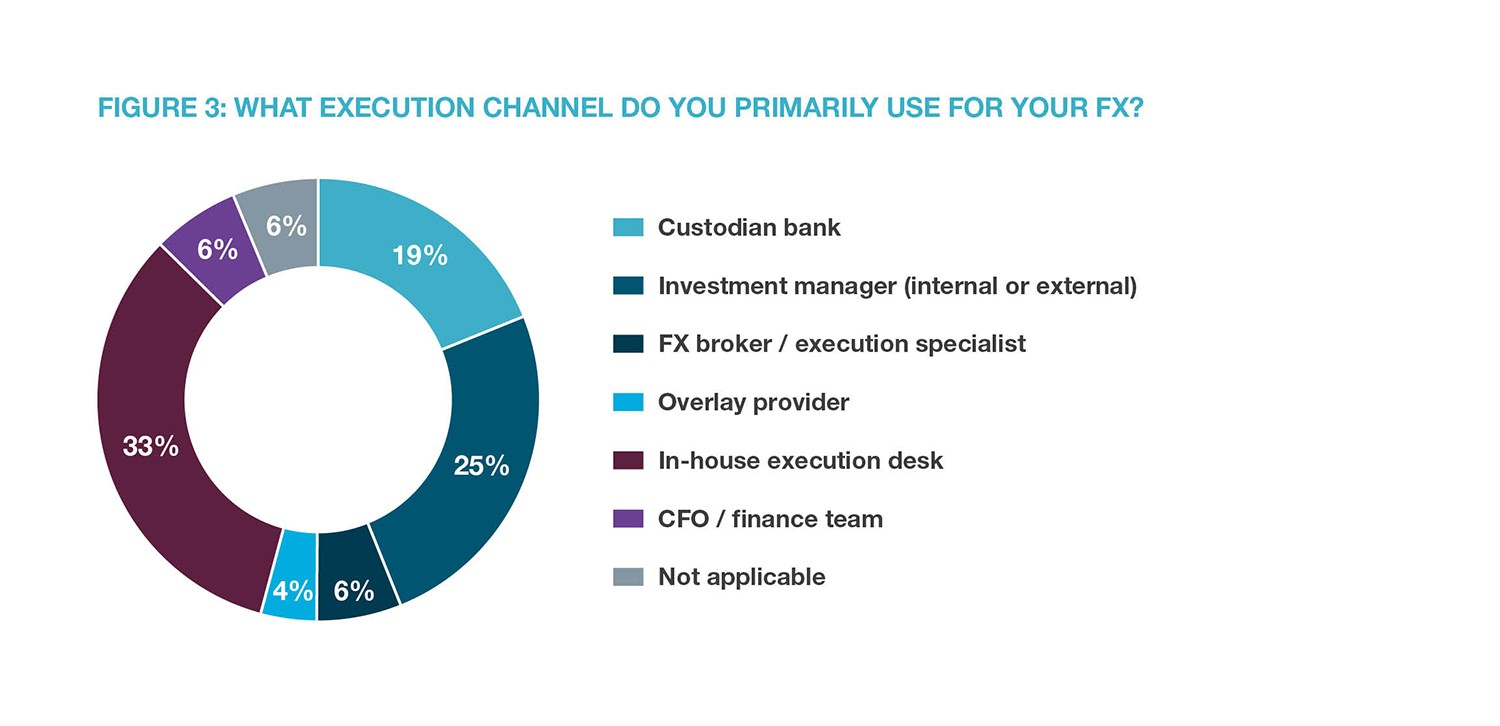
Source: bfinance, investor poll conducted in 2025
Each execution channel has its advantages and disadvantages, briefly summarised in the table below (Figure 4). It is important to avoid complacency: whoever the counterparty, the chances are that they are not incentivised to reduce the costs involved with FX execution in a proactive manner. Assurances of competitive pricing should not be taken at face value.
For example, multi-bank platforms offer multiple counterparties, theoretically enabling access to a ‘best price’, but this potential benefit can be undermined by siloed pricing (specific quotes offered for the investor that sees them), spread optimisation strategies employed by banks, and pre-agreed spreads – all based on individual client relationships and trade characteristics.

Source: bfinance
Conclusion: an opportunity to improve governance?
Institutional governance of FX matters still sits in the shadow of a lengthy ZIRP era – a period during which FX management became decidedly uninteresting to many asset owner investment leaders and trustees. With little scope for FX to move the needle at portfolio level, the FX subject was increasingly relegated to ‘routine housekeeping’ status, while institutions’ hedge ratios (and overall FX management strategies) remained relatively consistent.
As such, it is perhaps not surprising that cost governance in this particular area may have fallen through the cracks, even at a time when asset owners upgraded their focus on investment management fees and overall cost transparency. Indeed, various service providers offering investment management cost analysis and benchmarking may not even include effective examination of FX-related costs in their offerings.
With volatility in 2025 illustrating the dramatic impact that currency management decisions make on portfolio outcomes, FX is now at the forefront of strategic discussions. In addition to thinking about strategy, investors should take the opportunity to review the governance that underpins efficient implementation. A sensible strategic decision can be undermined when an investor is the passive recipient of uncompetitive pricing offered through their legacy execution channels. One potential starting point: regular, robust benchmarking of FX-related costs.
Important Notices
This commentary is for institutional investors classified as Professional Clients as per FCA handbook rules COBS 3.5R. It does not constitute investment research, a financial promotion or a recommendation of any instrument, strategy or provider. The accuracy of information obtained from third parties has not been independently verified. Opinions not guarantees: the findings and opinions expressed herein are the intellectual property of bfinance and are subject to change; they are not intended to convey any guarantees as to the future performance of the investment products, asset classes, or capital markets discussed. The value of investments can go down as well as up.