English (Global)
  Français (France)
  Deutsch (DACH)
  Dutch (Nederlands)
  English (United States)
  English (Canada)
  French (Canada)
bfinance insight from:

Toby Goodworth
Managing Director, Head of Liquid Markets

Bradley Budd
Senior Director, Wealth
In today’s pursuit of diversification without sacrificing liquidity, wealth managers are offered a new generation of liquid private markets funds – vehicles that propose institutional-style exposure with retail-friendly access. Structured with daily, weekly, or monthly redemption terms, these products aim to meet growing demand for private market exposure without the traditional ‘lock-ups’. Yet, a critical question emerges: are highly liquid private markets funds solving a new problem, or simply repackaging what liquid alternatives already deliver?
In our recent paper, Democratisation vs. Retailisation of Private Markets, we explored how a wave of semi-liquid and liquid evergreen structures offer wealth managers simplicity and accessibility, but also introduces trade-offs that demand scrutiny, including:
- Mismatch in inherently illiquid assets
- Performance drag from high cash buffers
- Limited track records
- Fee layering that could obscure return alignment
The liquid private markets universe remains small and fragmented. Many rely heavily on public or quasi-liquid assets that overlap with other areas of client portfolios. Redemption terms often include minimum hold periods, early redemption fees, gating mechanisms, and caps: meaning true liquidity is not always what it seems. Multi-strategy funds with over $500 million in AUM are rare, and single-strategy options are limited. For example, the only daily liquidity private equity fund is a listed investment company traded on the LSE, while real estate remains the most common source of daily liquidity through vehicles like REITs and property unit trusts.
Against this backdrop, it’s worth asking: at what point does liquidity innovation cease to be additive and, instead, become redundant? Liquid alternatives already offer tactical flexibility, downside protection, and uncorrelated returns, often with greater transparency and structural integrity. In a market driven by product development, the challenge for wealth managers is not access, but discernment.
This article explores how liquid alternatives could play a central role in client portfolios, offering the required liquidity as well as robust diversification and strategic value without the structural compromises that often accompany liquidity engineering in private markets.
Obviously, there are alternative methods besides adding liquidity by allocating to increasingly liquid forms of existing private market exposures, and we wish to challenge wealth managers to consider whether introducing portfolio liquidity through complementary liquid alternative allocations might better serve their investors’ needs.
Understanding liquid alternatives
Liquid alternatives are an investment style that aim to deliver returns independent of traditional stock and bond markets by using a broader, less constrained set of investment techniques, using techniques such as long/short or relative value investing or derivatives.
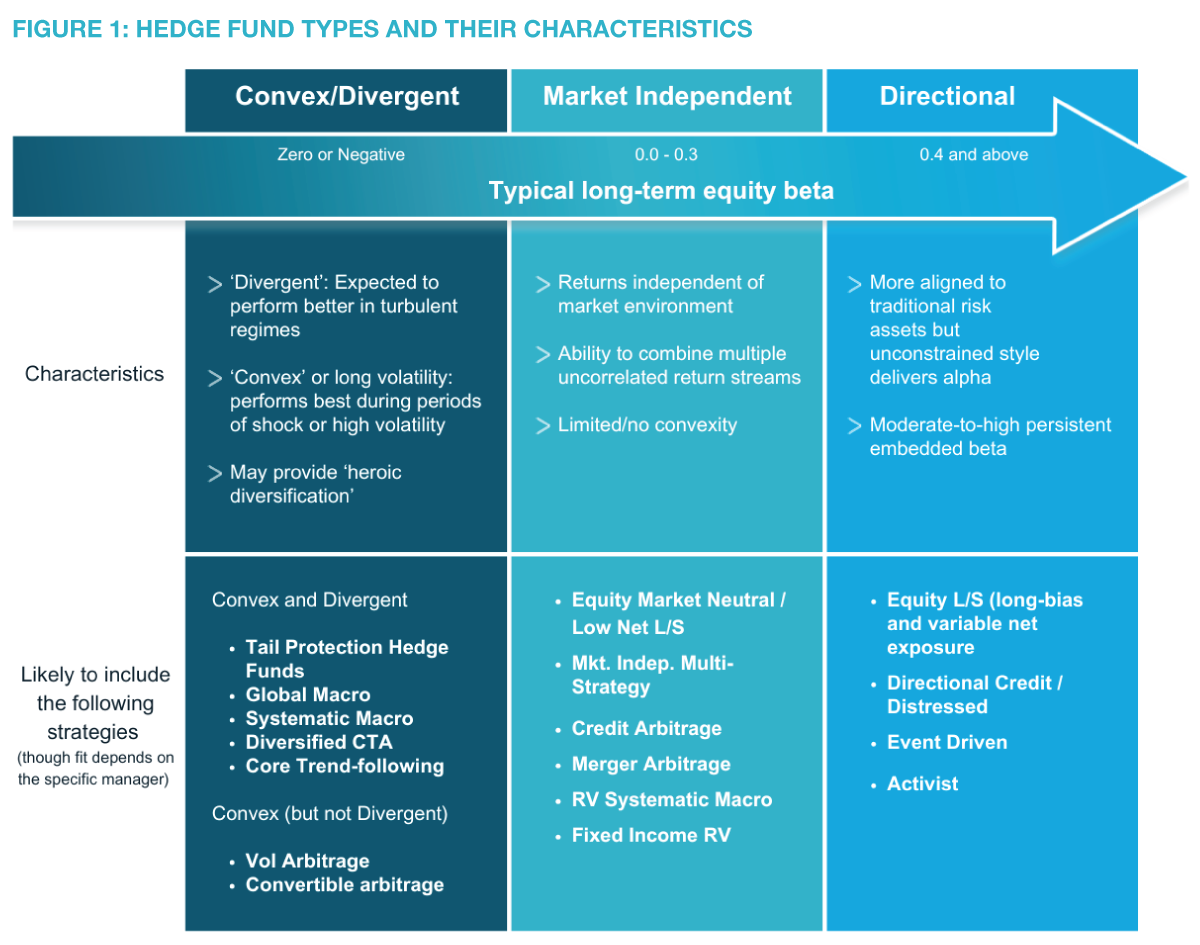
The universe of liquid alternative strategies (often referred to as hedge funds) is extremely diverse and can often appear daunting to access at first glance. By understanding what is important to investors’ portfolios, the access challenge can be vastly simplified. In a recent paper (Forget Hedge Fund Strategy Labels – Here Are Three Groups that Matter), we identified three styles of liquid alternatives returns: Market Independent – reliable alpha-rich return streams that are broadly uncorrelated to traditional risk, Convex/Divergent – strategies that are expected to deliver the majority of their returns in more stressed market environments, and finally, Directional strategies – strategies where the desired idiosyncratic return component cannot be easily accessed without some embedded beta exposure.
Source: bfinance
Portfolio benefits of liquid alternatives
Wealth managers are also facing challenges in relation to the reliability of equity beta, and the relative absence of diversification benefits from bonds can also be remedied through use of liquid alternatives.
Put simply, if liquid alternatives can’t bring something usefully different to a portfolio, they don’t warrant allocation, so the acid test for these strategies is demonstrable improvement in portfolio outcomes and or improved portfolio resilience in challenging markets. Fortunately, the current market environment offers just such a window into the usefulness of these strategies. With the current market environment typified by increased macro and geopolitical uncertainty, equity returns have proved to be less dependable, similarly bonds have been a less reliable portfolio diversifier – take 2022 for example.
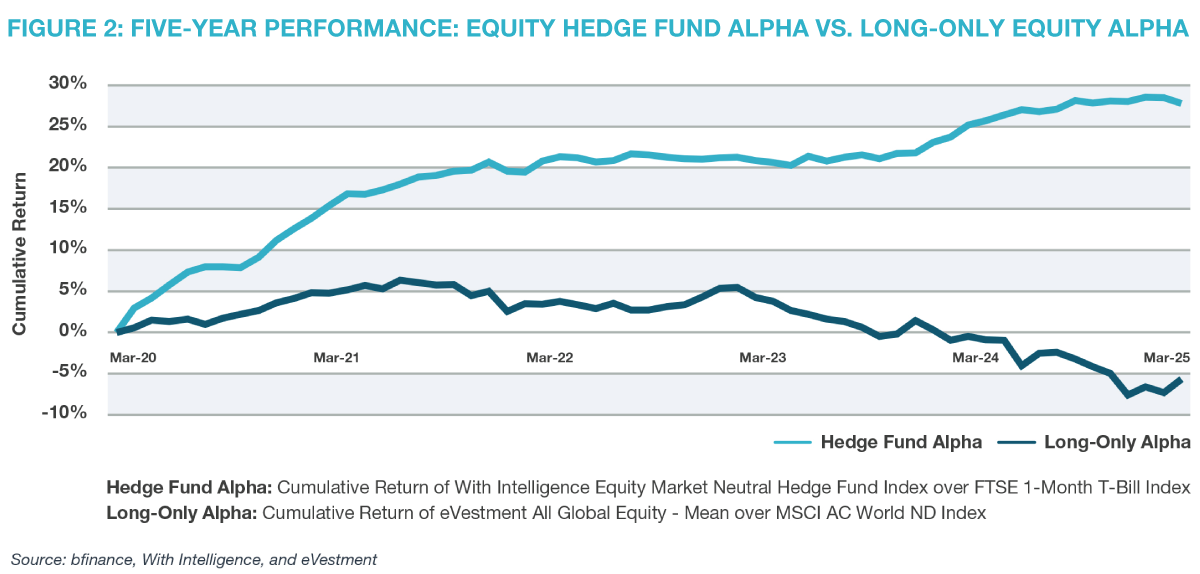
We have seen wealth managers turn to a combination of market independent strategies to introduce uncorrelated alpha to improve the robustness of the risk/return stream whilst creating portfolio liquidity. For example, during recent tariff volatility, alpha strategies were largely unaffected, even as traditional assets swung. Key areas of investor focus here include equity market neutral and/or market independent multi-strategy allocations, both of which offer liquid (often monthly or better dealing with no gates) ‘cash-plus’ return streams (e.g. cash + 4-6% p.a.) with limited or no equity beta sensitivity.
Alternative use cases have involved allocations to both market independent (alpha) return streams coupled with allocations to convex/divergent strategies to help with the heavy lifting in more volatile environments. Used concurrently, market independent and convex/divergent strategies can offer a robust and compelling return stream which can help diversify the diversifiers (bonds) as well as providing valuable dry powder for investors when liquidity may be constrained and investment opportunities can become more attractive – what we call defensive diversification. Not only do the convex/divergent strategies help out in tough markets (e.g. these strategies typically saw double digit gains in 2022, while equities and fixed income experienced double digit losses) but unlike semi-liquid private markets, they are readily monetisable, offering investors the flexibility to tactically rebalance their portfolios to capture attractive entry points into longer-term risk assets.
Strategic allocation for wealth managers
Liquid alternatives are attractive because the current market environment offers a fertile ground for alpha generation and has done since the onset of the post-COVID era. In the Pre-COVID era, a lack of uncertainty and market volatility effectively handcuffed many liquid alternative approaches to several years’ worth of uninspiring cash-like returns. Whilst currently compelling, the use case for liquid alternatives may wane if certain market dynamics prevail.
Whatever your preferred route to achieve improved portfolio liquidity for your clients, it is essential to be able to communicate the role the allocation has in the portfolio and why its absence can lead to inferior portfolio outcomes. Afterall, liquidity, like insurance, is only valuable when you need it, and liquidity both in liquid and private market forms will often come with an inherent cost of capital that needs to be explained with outcome-oriented/scenario-driven language to investors.
Implementation burden or portfolio complexity need not be an excuse for ignoring liquid alternatives either. With well-chosen providers, each having clearly defined roles to play in the portfolio, a fit-for-purpose allocation can be constructed from just a few carefully selected managers, or a partnership with a fund of hedge funds provider. Whilst we have supported some wealth managers who wished to adopt a more granular approach to their liquid alternatives portfolios with 5-6 manager allocations, many have elected for more streamlined allocations with 2-3 line items, or in some cases a single well-diversified multi-strategy manager.
The liquidity trap in product innovation
- The rise of liquid private markets is hailed as a breakthrough for wealth clients, but rapid innovation risks misaligning product design with portfolio purpose.
- Liquidity is appealing but not inherently valuable. When it dominates product design, flexibility can be prioritised over fundamentals: redemption frequency does not equal stronger portfolios, and in practice illiquid assets, cash buffers, and gating mechanisms often dilute returns and distort expectations.
- Liquidity should serve the portfolio, not define it. Wealth managers must ask whether the liquidity on offer is truly additive or just a repackaging of exposures available through more established liquid alternatives.
Rethinking diversification through alternatives
Rather than chasing increasing liquidity down the private market spectrum through less-tested innovation and product trends, we would encourage wealth managers to look more widely at the range of tools at their disposal and consider the use of well-established liquid alternative strategies as a way of satisfying the current need for improved investor liquidity and improved portfolio robustness.
Whilst liquid alternatives are an often-overlooked segment of the market, and one not without its fair share of historic baggage, the current market environment offers a unique opportunity for wealth managers to exploit these strategies tactically as part of their portfolio tool kit to help best meet investor expectations.
Important Notices
This commentary is for institutional investors classified as Professional Clients as per FCA handbook rules COBS 3.5R. It does not constitute investment research, a financial promotion or a recommendation of any instrument, strategy or provider. The accuracy of information obtained from third parties has not been independently verified. Opinions not guarantees: the findings and opinions expressed herein are the intellectual property of bfinance and are subject to change; they are not intended to convey any guarantees as to the future performance of the investment products, asset classes, or capital markets discussed. The value of investments can go down as well as up.