English (Global)
  Français (France)
  Deutsch (DACH)
  Italiano (Italia)
  Dutch (Nederlands)
  English (United States)
  English (Canada)
bfinance insight from:

Anna Morrison
Head of Private Equity
An apparent fundraising slump for ‘GP Stakes’ funds offers a fascinating window into the current tensions within the illiquid investment industry. Are these niche private equity strategies the ‘canary in the coalmine,’ signalling weak investor confidence in GPs and, potentially, the underlying asset classes? Or are the attractive characteristics of GP Stakes strategies merely being overlooked in favour of other opportunities?
The latest capital raising data from sources such as Preqin seems to show a dramatic decline in fundraising by ‘GP Stakes’ strategies – funds that buy minority stakes in alternative asset management companies (General Partners, or ‘GPs’). While such datasets can of course be flawed, restricted and slow to reflect actual activity, it does now appear undeniable that fundraising in 2023-2025 was remarkably weak versus 2020-2022, exhibiting a far sharper decline than the overall trend observed in the private equity sector. Moreover, the slump does not appear to have been connected with a shortage of available offerings: in early 2024, for example, bfinance manager research identified at least fifteen such vehicles that were actively seeking to raise a combined record total of USD30 billion, versus the USD 17 billion that they had gathered in 2022-3 (chiefly 2022).
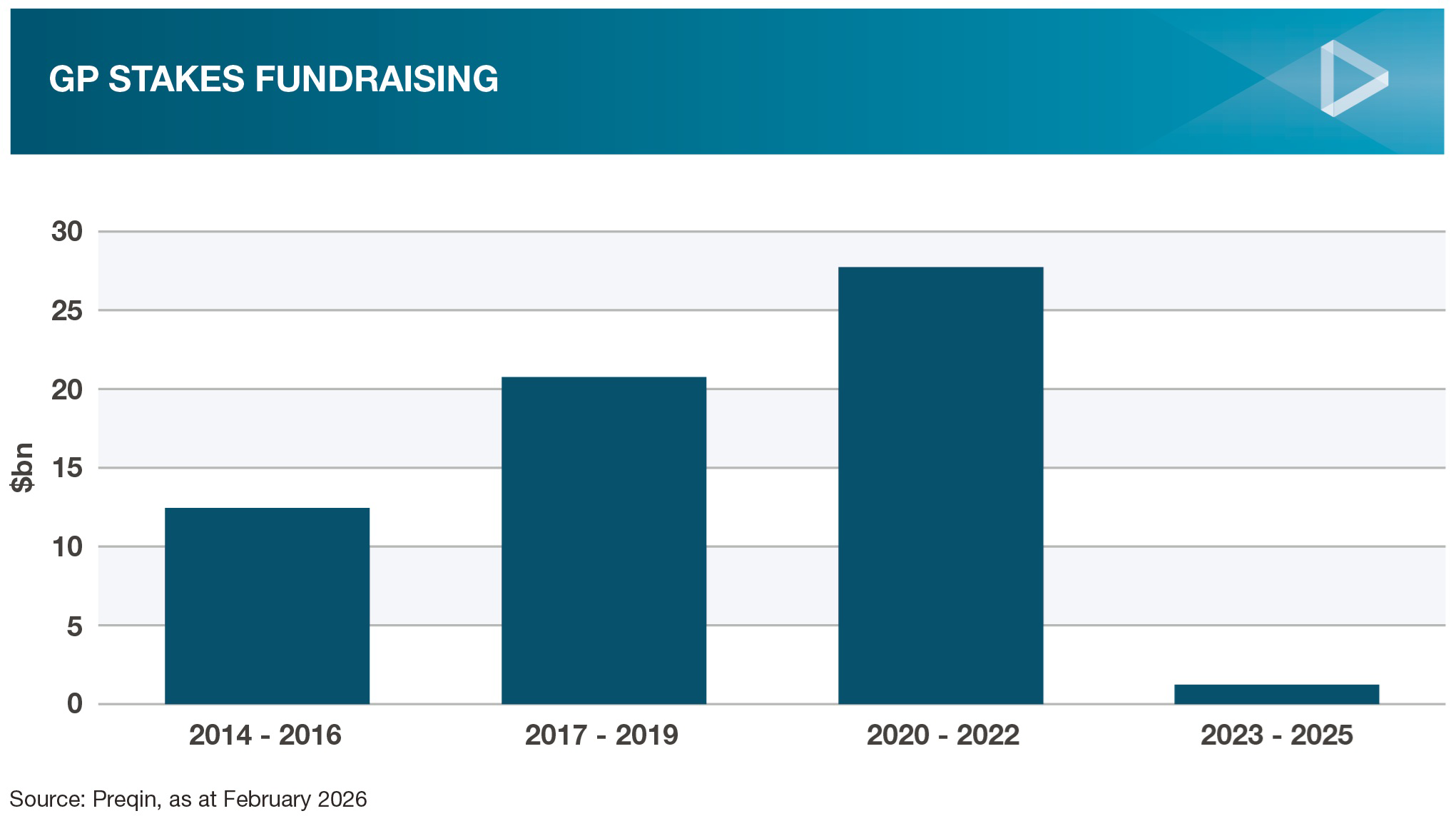
Softer investor activity also seems to be visible in newer surveys of allocators. The 2026 PEI LP Perspectives Study, which shows data gathered in late 2025, indicated that 14% of investor respondents had invested in GP Stakes funds, down considerably from the 34% peak shown in their 2024 study; conversely, the percentage who “intend to or would like to invest in GP Stakes funds” had increased from 15% to 23%, perhaps suggesting some pent-up appetite. Combined, the percentage of LPs that are either committed to or interested in such funds had declined from 49% to 37%.
Overlooked opportunity?
On paper, the key attributes of GP Stakes funds should be highly compelling in today’s climate for both institutional and retail/wealth investors. For example, these vehicles offer rapid distributions to investors, underpinned by immediate yields that are derived directly from the GPs’ own management fee revenues. This is an enticing profile in an environment where slower-than-predicted Distributions to Paid-in Capital (DPI) from the overall private equity sector are causing investors considerable frustration and, simultaneously, where vehicles offering a degree of liquidity are gaining traction. They also provide immediate diversification: each single stake provides indirect exposure to the economics of all of the GP’s underlying funds, which can span different geographies, asset classes, sectors and (of course) vintages. Indeed, features such as early distributions and broad diversification have driven a record-high capital raising year in 2025 for another family of private market vehicles: secondaries funds.
GP Stakes funds also boast a strong case for adding operational value, since the ‘GP stakes’ manager and the GP are in the same industry, the former can bring specific expertise, capabilities and client relationships that would directly support the growth of the latter. Operational value-add would typically be a significant draw in this period of the cycle, when the macroeconomic fundamentals that could otherwise fuel a growth in valuations (such as cheap debt) are less favourable. Arguably, this segment is also less over-crowded than other parts of the private equity landscape: the list of specialist managers remains relatively small, particularly in Europe.
These strategies could even be regarded as a tactical play that takes direct advantage of current difficulties faced by GPs. Illiquid investment managers have been riding out a weak exit environment for a prolonged period and, in many cases, have responded by deferring exits until conditions improve. While this may be a credible strategy, it does create capital constraints for GPs, whose business models rely not just on management fee revenues but on the opportunity to crystallise performance fees (carry). Capital is needed for new GP fund commitments, enhancing capabilities and pursuing client diversification (such as attracting retail/wealth investors).
Indeed, another niche of the illiquid investment landscape that similarly seeks to take advantage of GPs’ need for capital – NAV financing and GP financing – has recently enjoyed an explosive growth in LP demand. Based on an examination of various data sources and internal research, we would estimate that LP commitments to strategies focused on NAV financing (lending based on fund NAV) and/or GP financing (corporate lending to GPs) grew by more than 30% year-over-year in 2025 versus 2024.
Looking ahead, changes to Solvency II regulations in January 2027 will dramatically reduce the capital charges for insurers that invest in GP Stakes, while charges for mainstream private equity will remain high. This under-reported shift has the potential to significantly increase the buyer landscape, supporting future exit prospects.
Canary in the coalmine?
There are plenty of benign reasons why investor demand for GP Stakes funds may falter, irrespective of their aforementioned attractions. A relatively narrow manager universe means that the timing of launches, fundraising, deployment and returning to market can be inherently lumpy. Niche illiquid strategies can be overlooked in periods when allocators are reducing allocations or adjusting to slower-than-expected distributions. Unfamiliarity and unusual traits (such as minority ownership) can make it difficult to obtain stakeholder approval: considerable education may be required. Investors may even choose to take direct stakes in GPs rather than using a fund to access opportunities of this nature.
These generic arguments may, however, seem insufficient to explain the specific trends discussed above. This begs the question: does the apparent weakness in recent demand for GP Stakes signify some deeper malaise? Are investors, for instance, uncomfortable with the underlying portfolios that are being managed by private market GPs? A record fundraising year for secondaries strategies across private equity, private credit and infrastructure, as well as the surge in commitments to NAV financing strategies, would strongly suggest otherwise. Are they worried about GP business models, profitability and commercial prospects, particularly for mid-sized and smaller firms? Sector tailwinds remain strong, including the expansion of the client base and the increasing variety of product types available for institutional and wealth/retail clients. While fundraising has increasingly favoured the largest GPs, this dynamic is supportive of ongoing M&A activity (which can create exit opportunities for stakeholders).
Weak fundraising for GP Stakes funds in 2024-2025 does not, we believe, reflect the strength of the current opportunity. Indeed, less over-crowding may help funds in this sector to remain selective and disciplined in their deployment – which will be crucial to success.
This article was first published in Funds People.
Important Notices
This commentary is for institutional investors classified as Professional Clients as per FCA handbook rules COBS 3.5R. It does not constitute investment research, a financial promotion or a recommendation of any instrument, strategy or provider. The accuracy of information obtained from third parties has not been independently verified. Opinions not guarantees: the findings and opinions expressed herein are the intellectual property of bfinance and are subject to change; they are not intended to convey any guarantees as to the future performance of the investment products, asset classes, or capital markets discussed. The value of investments can go down as well as up.