English (Global)
  Français (France)
  Deutsch (DACH)
  Italiano (Italia)
  Dutch (Nederlands)
  English (United States)
  English (Canada)
bfinance insight from:

Kieren Bussey
Senior Associate, Portfolio Solutions

Duncan Higgs
Managing Director, Head of Portfolio Solutions
The high cost of illiquid investments has long represented a key area of focus for investors. Yet, despite some positive developments in transparency and benchmarking, one crucial aspect of cost management is still commonly overlooked: validation. In practice, many investors rely solely on manager’s calculations, with in-house reviews typically prioritising overall fee levels over accuracy checks. Our analysis suggests this approach can leave a governance blind spot that may prove costly over time.
Broad scrutiny on Private Markets is Increasing
Managing costs in private market investment continues to be a high priority for asset owners. The subject has grown in importance, and in terms of impact on overall investor’s fees and costs, as average investor allocations toward illiquid asset classes have steadily increased. Non-traditional investment strategies continue to hold a reputation for high fees and sub-optimal cost transparency. With some recent disappointment in performance, such as lower-than-hoped distribution rates in private equity, scrutiny from stakeholders is increasing. In addition, industry groups such as ILPA have also helped to drive investors’ attention toward certain aspects of this subject, including efforts to improve transparency around ‘hidden costs’ and various non-fee expenses, however more is required.
Validation remains a blind spot
Where is attention being directed? Data from a 2025 bfinance snap poll indicates that private market investors are typically more focused on transparency and benchmarking than on validation – the process of checking whether agreed terms are being implemented correctly. In the recent poll, when asked to rank a list of four potential cost concerns in private markets, 90% of LPs placed ‘hidden/opaque costs’ in first or second position (shown in Figure 1), while 61% placed ‘difficulty benchmarking’ in their top two slots. In contrast, only one in ten prioritised the more validation-focussed subject of ‘lack of compliance with Limited Partner Agreements (LPAs)’ and just over a third picked ‘incorrect waterfall or carried interest calculations’ as their first or second concern.
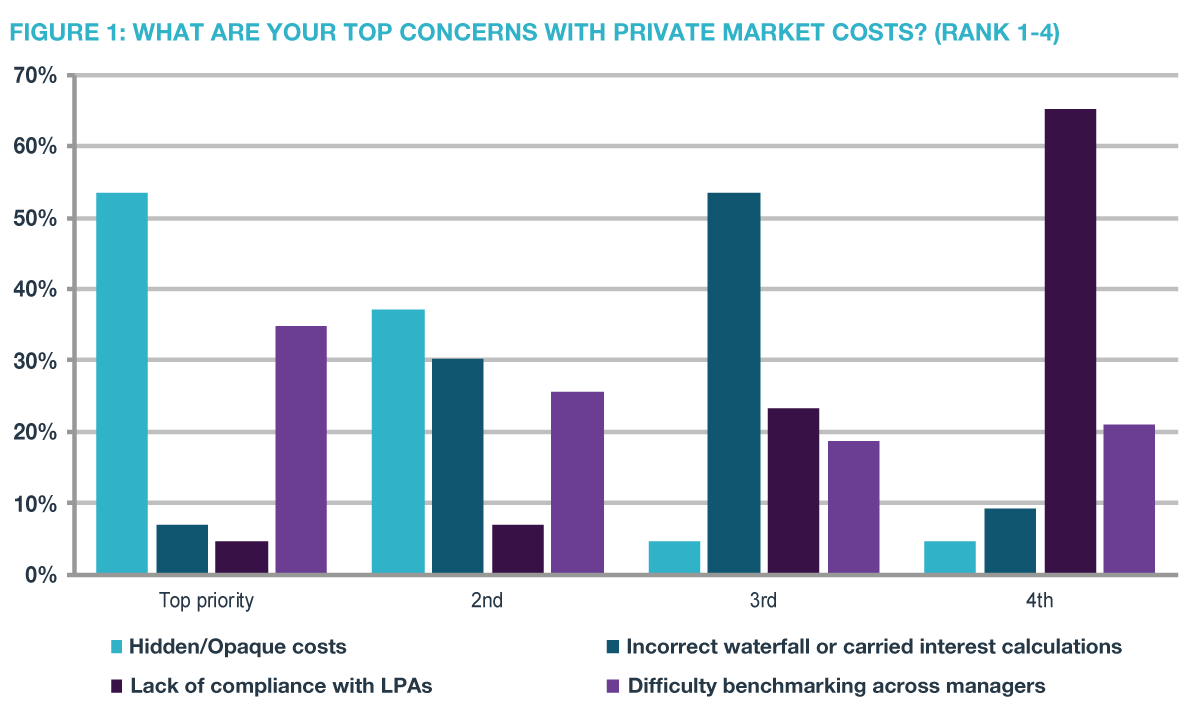
Source: bfinance Private Markets & FX Fees Snap Poll, 2025
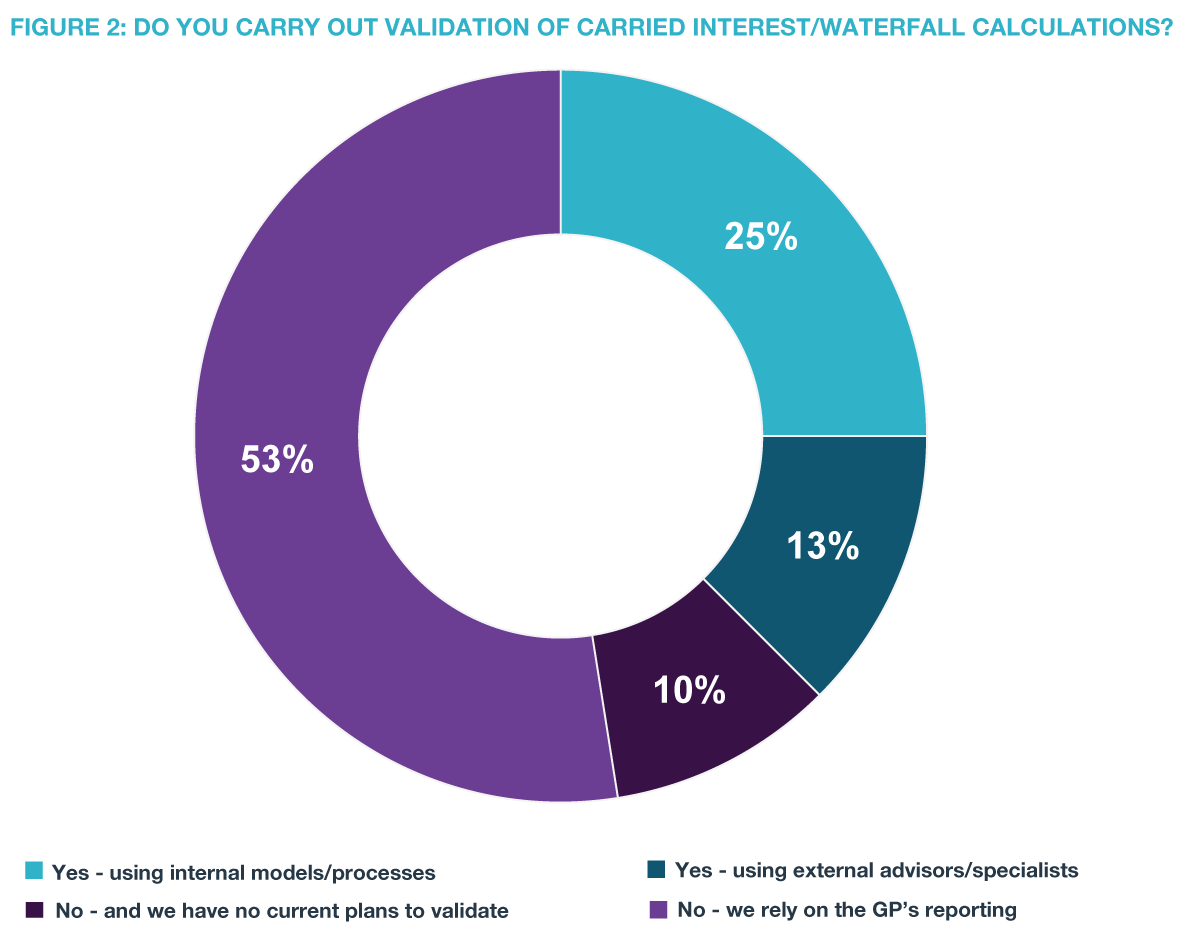
When digging further into processes for specific approaches to cost management in private markets, we find—for example—that nearly two thirds of investors “do not carry out any validation” of GPs’ carried interest/waterfall calculations (Figure 2), where a significant proportion of private market costs can originate. Among the minority of investor survey respondents that do check directly, the most common approach is to rely on internal processes without involving any external parties.
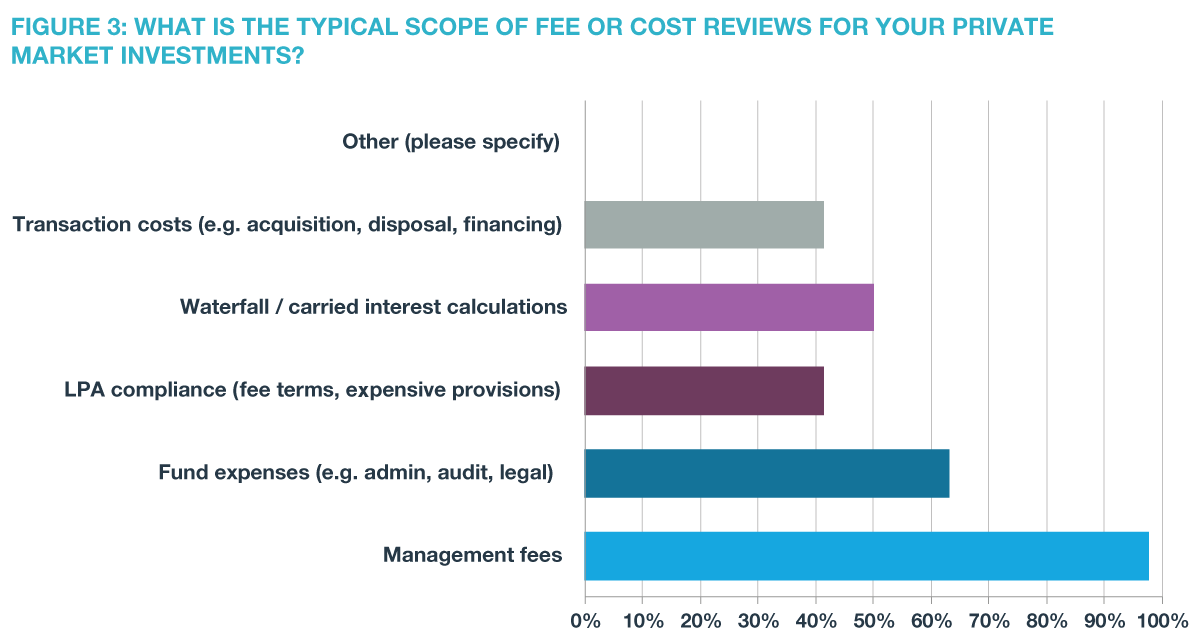
Illustrating the importance of managing expenses in private markets, many institutional investors do carry out reviews of fees and costs in this space which is positive. These may be conducted on an ad hoc or routine basis, depending on their purpose and scope. Yet, as suggested in Figure 3, there is a tendency for these periodic examinations to prioritise management fee levels. Only 42% of investors engaged in such projects will scrutinise LPA compliance as part of the analysis, while only half will check waterfall/carry calculations during reviews. This represents a potential material blind spot for investors.
Understanding the findings
The prioritisation shown in Figure 1 is understandable. Fee and cost benchmarking will naturally fall within the remit of an investment team: estimating total expenses and comparing fund managers’ fees versus competitors are viewed as front office responsibilities, closely tied to the work of understanding expected (net of fee) returns, optimising the investment portfolio and selecting external asset managers. By contrast, checking whether a GP has complied with the terms of investment (Limited Partner Agreement or Private Placement Memorandum) or validating waterfall and carried interest calculations may often be seen as a middle-office or back-office concern, falling somewhere between investment, compliance, and finance staff. Indeed, internal responsibility for the subject can be unclear.
Part of the challenge is that validation is less tangible than benchmarking. The latter can deliver visible outcomes that feed directly into manager selection or fee negotiations, while the former is about governance assurance: confirming that agreed terms are applied consistently and accurately. Yet it is precisely this assurance that safeguards returns.
Why investors should take notice
Investors may even assume that errors will be rare or minor, particularly when dealing with large, well-established managers. In practice, however, this assumption is misplaced. Mistakes or misinterpretations have proven more common than investors may assume, and when they do occur, they can be material with overcharges of up to millions of dollars.
In addition to our own and anecdotal evidence, there have been multiple SEC actions on private fund fees/expenses over the last decade, involving firms from mid-market players to global names, and spanning various private market asset classes. These cases have required reimbursements ranging from several hundred thousand to tens of millions of dollars in individual instances.
It is important to recognise, however, that these public cases do not capture the full picture. Regulators are only able to examine a fraction of the private funds in existence, and enforcement activity inevitably reflects a small subset of the market. Independent reviews often uncover similar discrepancies outside the regulatory spotlight, suggesting that such issues are far more widespread than official actions alone might imply.
Our observations do not suggest systemic malpractice, but they do underline two important points:
- Even sophisticated firms can make errors, often stemming from the complexity of fund structures and the interpretation of LPAs.
- When errors occur, they can materially affect outcomes - in diversified institutional portfolios, multiple discrepancies of this magnitude can translate into millions of dollars in lost value over time.
Mistakes and misunderstandings: where do they occur?
A variety of errors can occur in private market manager calculations. They may represent concrete inaccuracies or differing interpretations of LPA provisions that are open to judgment. While some mistakes may stem from operational oversight, our experience indicates that errors more often tend to disadvantage LPs than to favour them. A few notable areas we have observed are outlined below, though this is by no way exhaustive:
Mishandling of the fee base
- GPs continue to charge on committed capital beyond the agreed step-down point or fail to exclude investments that should no longer be fee-bearing.
- We observe differences in how accrual timing is applied. For example, where an LPA specifies daily accrual (with quarterly billing), some managers have instead accrued quarterly in line with billing practices. While often operational in nature, such deviations can create inconsistencies. with the agreed methodology.
Hybrid waterfall miscalculation
- Hybrid waterfalls are a distribution structure that blends deal-by-deal and whole-of-fund approaches to carried interest. Expenses are generally reimbursed before distributions are calculated, so the hybrid mechanism does not change how expenses are treated, but rather governs when and how the GP is able to crystallise carried interest.
- In some cases, the methodology shifts once the investment period ends or certain thresholds are met, which requires careful application.
- We have seen instances where managers applied this transition incorrectly, to the detriment of investors. Figure 4 shows the potential effect on a USD $100m fund, with the dollar error being material and a creeping error, one that will not be immediately obvious and instead lead to erosion of value over time.
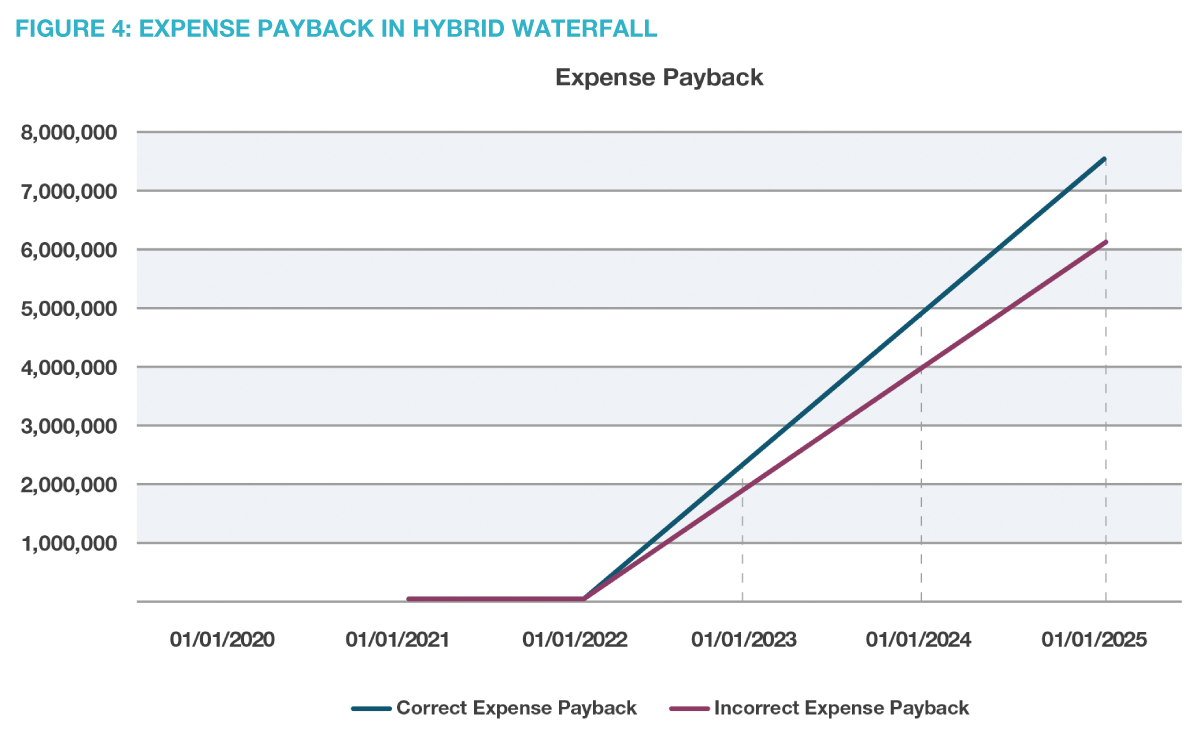
For illustrative purposes only. Not based on actual data.
Fund-level versus investor-level costs
- While fund managers often report expenses at the overall fund level, the picture for a specific investor can differ significantly: looking at an individual investor’s actual costs can be eye-opening.
- Different share classes act as an obstacle to transparency. For example, high AUM levels in significantly lower management fee share classes can mean that an LP’s expense ratio diverges markedly from the fund-level average.
Performance fee hangovers for ‘semi-liquid’ funds and secondaries
- Depending on crystallization or true-up mechanics, investors in such vehicles may risk being charged for gains realised before their entry.
Strict compounding versus simple compounding
- Many funds calculate preferred returns using ‘strict compounding’: interest should be calculated on the outstanding capital and added (usually at year end) so that the following year’s interest is calculated on the new larger balance.
- We note cases where the GP (incorrectly) applies ‘simple compounding,’ where the interest has not been added, leading to a lower preferred return. This can then affect aspects of fee and cost calculation.
Misapplication of the hurdle
- Errors can arise where a continuous compounding hurdle is misapplied or confused with an IRR-based threshold.
From transparency to validation
Cost transparency is a worthy subject and deserves the attention it has received in recent years. Yet transparency does not ensure accuracy and the importance of validation should not be underestimated.
Errors in fee and expense calculation are more common than many investors assume and even small deviations, such as a misapplied compounding method or a missed step-down, can materially affect long-term outcomes. Systematic monitoring and validation can help identify and correct discrepancies, recover over-payments - providing a basis for constructive dialogue with GPs where interpretations of the LPA differ.
In short, transparency may highlight costs, but accuracy and validation are essential to ensure that investors are paying the right ones.
Important Notices
This commentary is for institutional investors classified as Professional Clients as per FCA handbook rules COBS 3.5R. It does not constitute investment research, a financial promotion or a recommendation of any instrument, strategy or provider. The accuracy of information obtained from third parties has not been independently verified. Opinions not guarantees: the findings and opinions expressed herein are the intellectual property of bfinance and are subject to change; they are not intended to convey any guarantees as to the future performance of the investment products, asset classes, or capital markets discussed. The value of investments can go down as well as up.