English (Global)
  Français (France)
  Italiano (Italia)
  Dutch (Nederlands)
  English (United States)
  English (Canada)
  French (Canada)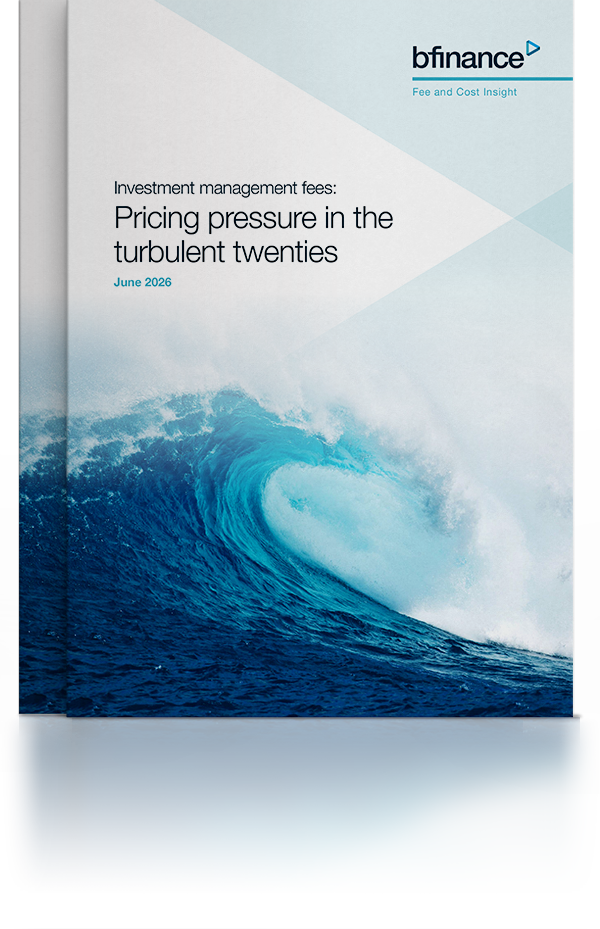
IN THIS PAPER
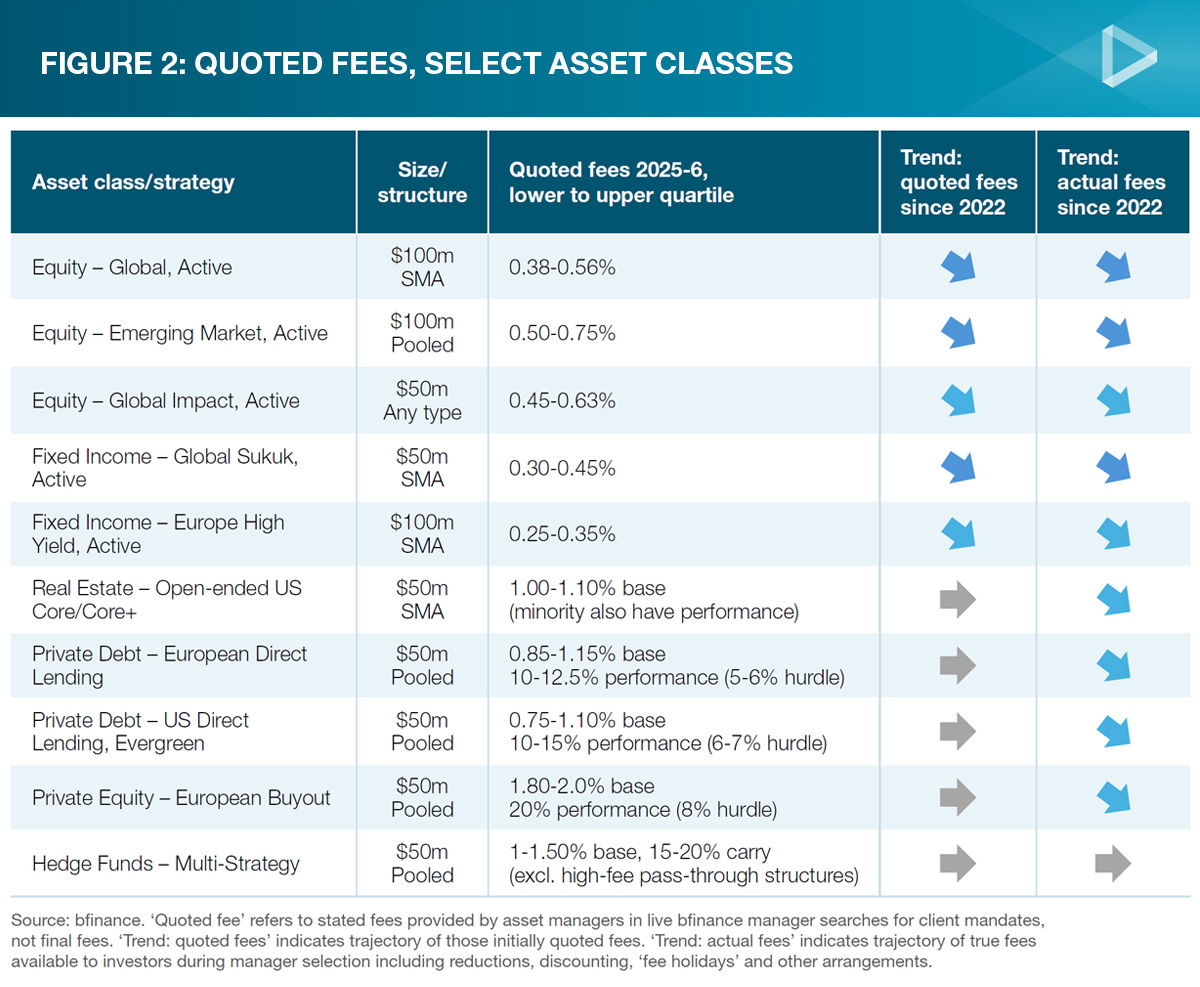
Fees at a glance: See upper-to-lower-quartile quoted fees for a selection of asset classes, drawn from bfinance manager research. Trends in 'quoted' fees since 2022 are contrasted with trends in actual fees available (following negotiation, discounts, etc…).
Exploring key fee-reduction trends: Granular data and commentary on areas of notable price decline including emerging market equities, impact equities, high yield credit and private market asset classes.
Pricing power and the profitability paradox: Beneath current fee compression dynamics lie deeper questions about the evolution of the investment industry and its ability to maintain pricing power, particularly in 'premium' product categories.
Fee benchmarking and negotiation checklist: Strong fee evaluations and negotiations are not based on data points alone but on nuanced assessment of the specific strategies, market participants and prevailing market conditions.
WHY DOWNLOAD?
The turbulent twenties are bringing a new wave of price reduction in active asset management.
While the fee declines of the 'easing teens' (2010s) were often concentrated in public market asset classes, underpinned by competition from low-cost strategies and a Zero Interest-Rate Policy (Zirp) environment, the pricing shifts of the 2020s are fundamentally different in nature.
New trends are shaped by a higher-for-longer rate climate, strongly influenced by performance considerations and, by extension, may be more skewed towards private market asset classes (which had demonstrated strong fee resilience through the 2010s). The old themes have not gone away, but they have evolved. Low-cost competition, for example, is still relevant, but its profile has changed.
Yet investors should be wary: the pendulum of pricing power may have swung toward allocators in certain key areas, but not everyone will benefit. In private markets, for example, the shift is masked – typically manifesting in more aggressive discounting practices rather than reductions in stated fees – and strongly favours large, traditional institutional clients versus smaller institutions or newer entrants from the wealth sector. Cost transparency remains problematic in sectors where real fee improvements would make the greatest difference to the bottom line.
Explore the bfinance Cost and Fee Insight series...
IMF Series
Investment Management Fees: Pricing pressure in the turbulent twenties
 The latest instalment in the bfinance Fee and Cost Insight series highlights recent price pressures in both private and public markets as the...
Investment Management Fees: Fairness Revisited
 Amid macroeconomic shifts and changes in the investment industry, fees and alignment of interest require fresh attention. This Investment Management...
Investment Management Fees: Capturing Price Evolution
 The latest edition in bfinance’s biennial Investment Management Fees series. New analysis highlights areas where investors may be able to benefit...
Investment Management Fees: Is Competition Working?
 The latest edition in bfinance’s biennial Investment Management Fees series. New analysis highlights areas where investors may be able to benefit...
Investment Management Fees: New Savings, New Challenges
 The latest edition in bfinance’s biennial Investment Management Fees series. New analysis highlights areas where investors may be able to benefit...
Important Notices
This commentary is for institutional investors classified as Professional Clients as per FCA handbook rules COBS 3.5R. It does not constitute investment research, a financial promotion or a recommendation of any instrument, strategy or provider. The accuracy of information obtained from third parties has not been independently verified. Opinions not guarantees: the findings and opinions expressed herein are the intellectual property of bfinance and are subject to change; they are not intended to convey any guarantees as to the future performance of the investment products, asset classes, or capital markets discussed. The value of investments can go down as well as up.